
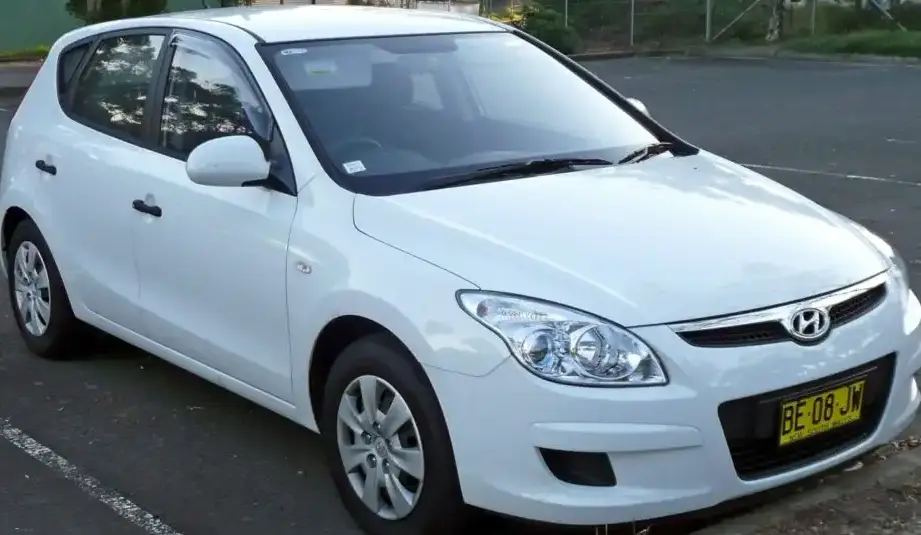
The Hyundai i30, launched in 2007, represented a significant step forward for the Korean automaker in the European compact hatchback market. Designed as a direct competitor to established players like the Volkswagen Golf and Ford Focus, the i30 aimed to offer a compelling blend of value, practicality, and a surprisingly sophisticated driving experience. The first generation, designated the i30 I (and internally as FD), spanned from 2007 to 2010, and was offered with a range of engines and transmissions. This article focuses specifically on the 1.6-liter gasoline engine producing 122 horsepower, paired with a five-speed manual transmission – a popular configuration within the i30 lineup, positioned as a mainstream, well-rounded option.
Technical Specifications
| Brand | Hyundai |
| Model | i30 |
| Generation | i30 I |
| Type (Engine) | 1.6 (122 Hp) |
| Start of production | 2007 |
| End of production | 2010 |
| Powertrain Architecture | Internal Combustion engine |
| Body type | Hatchback |
| Seats | 5 |
| Doors | 5 |
| Fuel consumption (urban) | 8 l/100 km (29.4 US mpg) |
| Fuel consumption (extra urban) | 5.2 l/100 km (45.2 US mpg) |
| Fuel consumption (combined) | 6.2 l/100 km (37.9 US mpg) |
| Fuel Type | Petrol (Gasoline) |
| Acceleration 0 – 100 km/h | 11.1 sec |
| Acceleration 0 – 62 mph | 11.1 sec |
| Acceleration 0 – 60 mph | 10.5 sec |
| Maximum speed | 192 km/h (119.3 mph) |
| Emission standard | Euro 4 |
| Weight-to-power ratio | 10.4 kg/Hp |
| Weight-to-torque ratio | 8.1 kg/Nm |
| Power | 122 Hp @ 6200 rpm |
| Torque | 157 Nm @ 4200 rpm (115.8 lb.-ft. @ 4200 rpm) |
| Engine layout | Front, Transverse |
| Engine Model/Code | G4FC |
| Engine displacement | 1591 cm3 (97.09 cu. in.) |
| Number of cylinders | 4 |
| Engine configuration | Inline |
| Cylinder Bore | 77 mm (3.03 in.) |
| Piston Stroke | 85.4 mm (3.36 in.) |
| Compression ratio | 10.5:1 |
| Number of valves per cylinder | 4 |
| Fuel injection system | Multi-port manifold injection |
| Engine aspiration | Naturally aspirated engine |
| Valvetrain | DOHC |
| Engine oil capacity | 3.3 l (3.49 US qt | 2.9 UK qt) |
| Coolant capacity | 6 l (6.34 US qt | 5.28 UK qt) |
| Kerb Weight | 1268 kg (2795.46 lbs.) |
| Max. weight | 1720 kg (3791.95 lbs.) |
| Max load | 452 kg (996.49 lbs.) |
| Trunk (boot) space – minimum | 340 l (12.01 cu. ft.) |
| Trunk (boot) space – maximum | 1200 l (42.38 cu. ft.) |
| Fuel tank capacity | 53 l (14 US gal | 11.66 UK gal) |
| Length | 4245 mm (167.13 in.) |
| Width | 1775 mm (69.88 in.) |
| Height | 1480 mm (58.27 in.) |
| Wheelbase | 2650 mm (104.33 in.) |
| Number of gears | 5 |
| Gearbox type | Manual transmission |
INTRODUCTION
The Hyundai i30 I, launched in 2007, was a pivotal model for the brand, marking a significant shift towards more European-focused design and engineering. Built on the PB platform (shared with the Kia Cee’d), the i30 aimed to provide a practical and affordable alternative to established European hatchbacks. The 1.6-liter engine with 122 horsepower, coupled with a five-speed manual transmission, was a core offering, representing a balance between fuel efficiency and acceptable performance for everyday driving. It was positioned as the entry-to-mid-range trim, appealing to buyers prioritizing value and practicality over outright performance.
Powertrain & Engine Architecture
The heart of this i30 variant is the Hyundai G4FC engine, a 1.6-liter inline-four cylinder gasoline engine. This engine utilizes a naturally aspirated configuration with multi-point fuel injection and a double overhead camshaft (DOHC) valvetrain. The G4FC is known for its relatively simple design, contributing to its reliability. The 122 horsepower output is achieved at 6200 rpm, while peak torque of 157 Nm (115.8 lb-ft) arrives at 4200 rpm. The five-speed manual transmission provides a fairly conventional gear ratio spread, prioritizing fuel economy over rapid acceleration. First gear is relatively short for easy take-off, while fifth gear is geared for comfortable highway cruising. The transmission itself is known for being durable, though not particularly sporty in its feel.
Driving Characteristics
The 1.6-liter i30 offers a competent, if not exhilarating, driving experience. Acceleration from 0-60 mph takes around 10.5 seconds, making it suitable for everyday commuting and urban driving. The engine feels reasonably responsive at lower speeds, but begins to feel strained when pushed hard, particularly when fully loaded. Compared to the more powerful 1.8-liter or diesel variants, the 1.6 feels noticeably slower, especially during overtaking maneuvers. The five-speed manual transmission is easy to operate, but the gear ratios aren’t optimized for performance. The suspension provides a comfortable ride, absorbing bumps and imperfections in the road well, but it doesn’t offer the same level of handling precision as some of its rivals. Steering feel is light and accurate, making it easy to maneuver in tight spaces.
Equipment & Trim Levels
The 1.6-liter i30 typically came equipped with a reasonable level of standard features. These included air conditioning, power steering, electric front windows, a basic audio system with CD player, and ABS brakes. Higher trim levels, such as the Comfort or Style, added features like alloy wheels, a multi-function steering wheel, rear electric windows, and upgraded audio systems. Optional extras included a sunroof, parking sensors, and metallic paint. Interior upholstery was typically cloth, with a relatively simple and functional dashboard layout. The overall interior design prioritized practicality and durability over luxury.
Chassis & Braking
The i30 I utilizes a MacPherson strut front suspension and a coupled torsion beam rear suspension. This setup provides a good balance between ride comfort and handling. Braking duties are handled by disc brakes on the front wheels and drum brakes on the rear wheels. ABS (Anti-lock Braking System) is standard, providing enhanced braking performance in emergency situations. The chassis is relatively lightweight, contributing to the car’s overall fuel efficiency. Stabilizer bars are fitted to both the front and rear axles to reduce body roll during cornering.
Market Reception & Comparison
The Hyundai i30 1.6 was generally well-received by automotive critics as a solid and dependable family hatchback. It was praised for its value for money, comfortable ride, and spacious interior. However, it was often criticized for its somewhat uninspiring engine performance and relatively bland styling. Compared to the 1.8-liter version, the 1.6 offered better fuel economy but significantly less power. The diesel variants provided even better fuel economy and more torque, but at a higher purchase price. Against competitors like the Volkswagen Golf and Ford Focus, the i30 offered a more affordable alternative, but lacked the same level of brand prestige and driving refinement.
Legacy
The Hyundai i30 I 1.6 has proven to be a reliable and durable vehicle, with many examples still on the road today. The G4FC engine is known for its longevity, provided it receives regular maintenance. Common issues are relatively minor, often relating to wear and tear on suspension components or electrical systems. In the used car market, the 1.6-liter i30 represents a particularly affordable option for buyers seeking a practical and economical hatchback. While it may not offer the most exciting driving experience, its reliability and low running costs make it a sensible choice for those prioritizing value and dependability.
