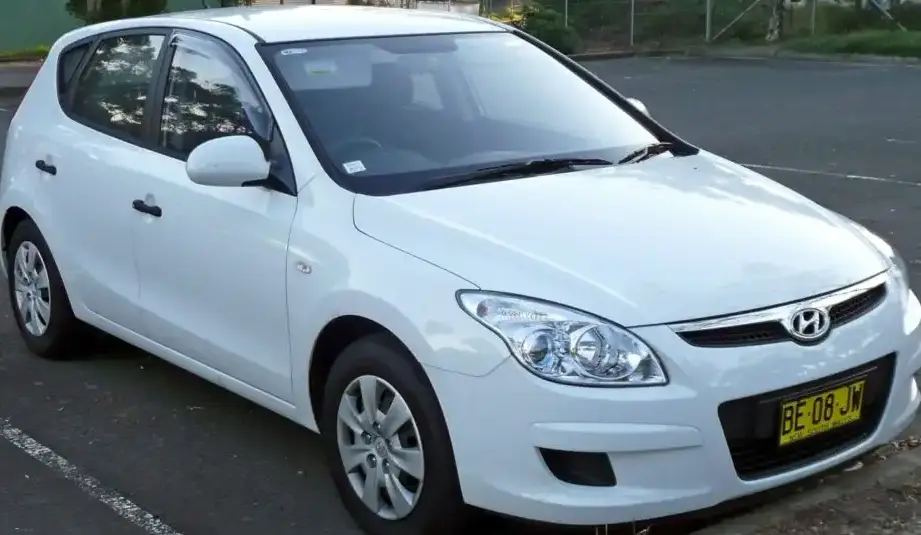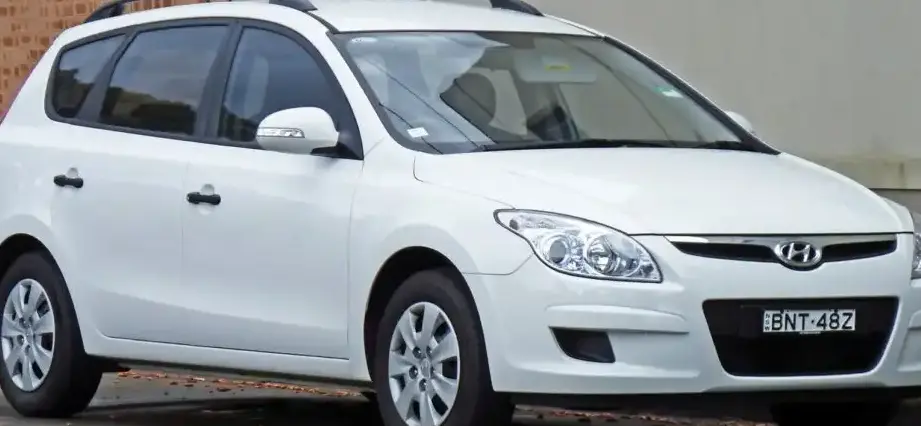
The Hyundai i30 CW 1.6 (126 hp) is a compact station wagon that was produced from 2008 to 2010 as part of the first generation (i30 I) of the i30 model. Introduced as a more practical alternative to the five-door hatchback, the CW (Cross Wagon) variant aimed to broaden the i30’s appeal to families and those requiring increased cargo capacity. This particular engine and trim level occupied a mid-range position within the i30 lineup, offering a balance between affordability, fuel efficiency, and usability. It was positioned below the more powerful 1.6 GDI and diesel variants, and above the base 1.4L engine option.
Technical Specifications
| Brand | Hyundai |
| Model | i30 |
| Generation | i30 I CW |
| Type (Engine) | 1.6 (126 Hp) |
| Start of production | 2008 |
| End of production | 2010 |
| Powertrain Architecture | Internal Combustion engine |
| Body type | Station wagon (estate) |
| Seats | 5 |
| Doors | 5 |
| Fuel consumption (urban) | 8 l/100 km (29.4 US mpg) |
| Fuel consumption (extra urban) | 5.2 l/100 km (45.2 US mpg) |
| Fuel consumption (combined) | 6.2 l/100 km (37.9 US mpg) |
| Fuel Type | Petrol (Gasoline) |
| Acceleration 0 – 100 km/h | 11.5 sec |
| Acceleration 0 – 62 mph | 11.5 sec |
| Acceleration 0 – 60 mph | 10.9 sec |
| Maximum speed | 192 km/h (119.3 mph) |
| Emission standard | Euro 4 |
| Weight-to-power ratio | 9.8 kg/Hp |
| Weight-to-torque ratio | 8 kg/Nm |
| Power | 126 Hp @ 6200 rpm |
| Torque | 154 Nm @ 4200 rpm (113.58 lb.-ft. @ 4200 rpm) |
| Engine layout | Front, Transverse |
| Engine Model/Code | G4FC |
| Engine displacement | 1591 cm3 (97.09 cu. in.) |
| Number of cylinders | 4 |
| Engine configuration | Inline |
| Cylinder Bore | 77 mm (3.03 in.) |
| Piston Stroke | 85.4 mm (3.36 in.) |
| Compression ratio | 10.5:1 |
| Number of valves per cylinder | 4 |
| Fuel injection system | Multi-port manifold injection |
| Engine aspiration | Naturally aspirated engine |
| Valvetrain | DOHC |
| Engine oil capacity | 3.3 l (3.49 US qt | 2.9 UK qt) |
| Coolant capacity | 6 l (6.34 US qt | 5.28 UK qt) |
| Kerb Weight | 1236 kg (2724.91 lbs.) |
| Max. weight | 1820 kg (4012.41 lbs.) |
| Max load | 584 kg (1287.5 lbs.) |
| Trunk (boot) space – minimum | 415 l (14.66 cu. ft.) |
| Trunk (boot) space – maximum | 1395 l (49.26 cu. ft.) |
| Fuel tank capacity | 53 l (14 US gal | 11.66 UK gal) |
| Length | 4475 mm (176.18 in.) |
| Width | 1775 mm (69.88 in.) |
| Height | 1565 mm (61.61 in.) |
| Wheelbase | 2700 mm (106.3 in.) |
| Front track | 1546 mm (60.87 in.) |
| Rear track | 1544 mm (60.79 in.) |
| Drag coefficient (Cd) | 0.31 |
| Minimum turning circle | 10.4 m (34.12 ft.) |
| Drivetrain | Front wheel drive |
| Number of gears | 5 |
| Gearbox type | Manual transmission |
| Front suspension | Independent, McPherson with coil spring and anti-roll bar |
| Rear suspension | Independent multi-link with stabilizer |
| Front brakes | Ventilated discs |
| Rear brakes | Disc |
| Assisting systems | ABS (Anti-lock braking system) |
| Steering type | Steering rack and pinion |
| Tires size | 185/65 R15 H |
| Wheel rims size | 15 |
INTRODUCTION
The Hyundai i30 CW 1.6, launched in 2008, represented Hyundai’s attempt to capture a larger share of the European compact wagon market. Building upon the success of the i30 hatchback, the CW offered increased practicality with its extended roofline and larger cargo area. The 1.6-liter engine, designated G4FC, was a key component of Hyundai’s Gamma engine family, known for its relatively lightweight construction and decent fuel economy. This variant was aimed at buyers seeking a sensible, affordable, and reasonably equipped family vehicle.
Powertrain & Engine Architecture
The heart of the i30 CW 1.6 is the G4FC 1.6-liter inline-four cylinder gasoline engine. This engine utilizes a multi-point fuel injection system, delivering fuel directly into the intake ports. The engine features a double overhead camshaft (DOHC) valvetrain with four valves per cylinder, contributing to improved breathing and power output. The compression ratio is set at 10.5:1. The engine produces 126 horsepower at 6200 rpm and 154 Nm (113.58 lb-ft) of torque at 4200 rpm. Paired with this engine is a five-speed manual transmission, providing a balance between fuel efficiency and driver control. The transmission’s gear ratios are tuned for everyday driving, prioritizing smooth shifts and acceptable acceleration.
Driving Characteristics
The i30 CW 1.6 offered a comfortable, if not particularly sporty, driving experience. With 126 hp, acceleration was adequate for most situations, taking approximately 11.5 seconds to reach 62 mph (100 km/h). The five-speed manual transmission allowed drivers to maintain optimal engine speed for efficient cruising. Compared to the more powerful engine options (like the 1.6 GDI), the 1.6L felt less responsive, especially when fully loaded or tackling steep inclines. However, the lower power output also translated to better fuel economy. The gear ratios were spaced to provide reasonable acceleration in each gear, but didn’t offer the close ratios found in performance-oriented vehicles. The steering was light and easy, making it well-suited for urban driving.
Equipment & Trim Levels
The i30 CW 1.6 typically came equipped with a reasonable level of standard features. These included air conditioning, power windows, central locking, and an audio system with CD player. Safety features such as ABS (Anti-lock Braking System) and front airbags were also standard. Higher trim levels offered options like alloy wheels, fog lights, a trip computer, and upgraded upholstery. Interior materials were generally durable and functional, though not particularly luxurious. The dashboard layout was straightforward and easy to use, with logically placed controls.
Chassis & Braking
The i30 CW 1.6 utilized a McPherson strut front suspension and a multi-link rear suspension. This setup provided a good balance between ride comfort and handling. The front suspension incorporated a stabilizer bar to reduce body roll during cornering. Braking duties were handled by ventilated discs at the front and solid discs at the rear. The ABS system helped to maintain steering control during emergency braking situations. The suspension tuning was geared towards comfort, resulting in a relatively soft ride quality.
Market Reception & Comparison
The Hyundai i30 CW 1.6 was generally well-received by automotive critics as a practical and affordable family wagon. It offered a compelling alternative to established European competitors like the Ford Focus Estate and Volkswagen Golf Variant. Critics praised its spacious interior, generous cargo capacity, and competitive fuel economy. However, some noted that the 1.6-liter engine could feel underpowered, especially when the vehicle was fully loaded. Compared to the diesel variants, the 1.6L offered lower running costs upfront but sacrificed fuel efficiency. The manual transmission was generally considered smooth and easy to use, but some drivers preferred the convenience of an automatic option (which was available with other engine choices).
Legacy
The Hyundai i30 CW 1.6 has proven to be a relatively reliable vehicle in the used car market. The G4FC engine is known for its durability, and routine maintenance is generally straightforward and affordable. While not known for exceptional performance, the 1.6L engine has a good track record for longevity. Common issues are typically related to wear and tear, such as exhaust system components and suspension bushings. Today, the i30 CW 1.6 represents a budget-friendly option for buyers seeking a practical and dependable station wagon. Its combination of affordability, fuel efficiency, and spaciousness continues to make it a viable choice in the used car market.