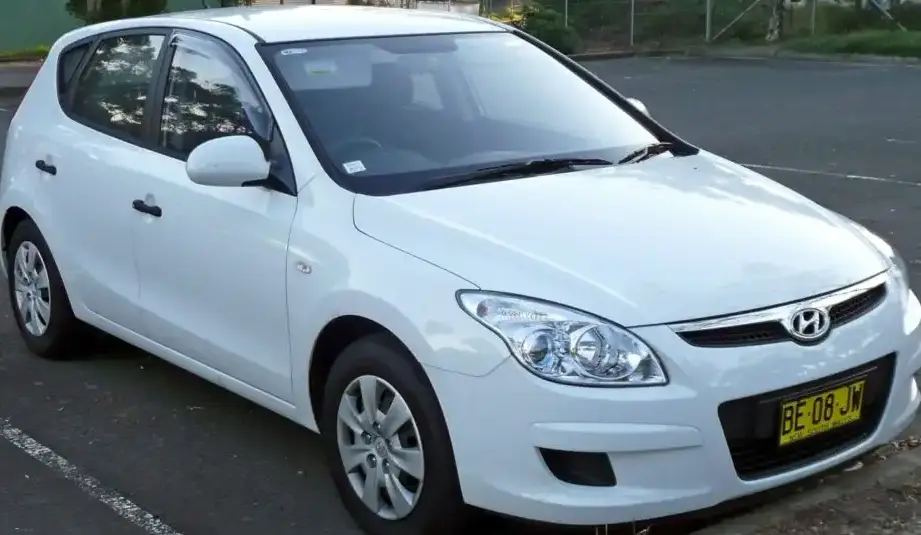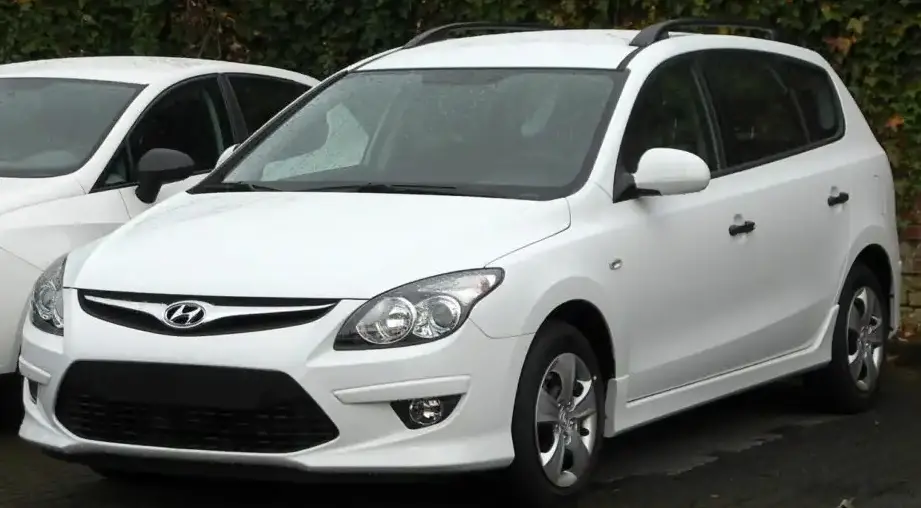
The Hyundai i30 I CW (facelift 2010) 1.4, producing 109 horsepower, was a key variant in Hyundai’s European lineup during its 2010-2012 production run. Positioned as an entry-level option within the i30 CW (Combined Wagon) range, it offered a practical and fuel-efficient choice for families and individuals seeking a versatile compact estate car. This model represented Hyundai’s continued efforts to establish itself as a mainstream competitor in the European market, offering a compelling alternative to established brands. The facelift brought styling updates and refinements to the original i30, enhancing its appeal.
Technical Specifications
| Brand | Hyundai |
| Model | i30 |
| Generation | i30 I CW (facelift 2010) |
| Type (Engine) | 1.4 (109 Hp) |
| Start of production | 2010 |
| End of production | 2012 |
| Powertrain Architecture | Internal Combustion engine |
| Body type | Station wagon (estate) |
| Seats | 5 |
| Doors | 5 |
| Fuel consumption (urban) | 7.7 l/100 km (30.5 US mpg) |
| Fuel consumption (extra urban) | 5.5 l/100 km (42.8 US mpg) |
| Fuel consumption (combined) | 6.3 l/100 km (37.3 US mpg) |
| CO2 emissions | 147 g/km |
| Fuel Type | Petrol (Gasoline) |
| Acceleration 0 – 100 km/h | 12.6 sec |
| Acceleration 0 – 62 mph | 12.6 sec |
| Acceleration 0 – 60 mph | 12 sec |
| Maximum speed | 187 km/h (116.2 mph) |
| Emission standard | Euro 5 |
| Weight-to-power ratio | 11.3 kg/Hp |
| Weight-to-torque ratio | 9 kg/Nm |
| Power | 109 Hp @ 6200 rpm |
| Torque | 137 Nm @ 5000 rpm (101.05 lb.-ft. @ 5000 rpm) |
| Engine layout | Front, Transverse |
| Engine Model/Code | G4FA |
| Engine displacement | 1396 cm3 (85.19 cu. in.) |
| Number of cylinders | 4 |
| Engine configuration | Inline |
| Cylinder Bore | 77 mm (3.03 in.) |
| Piston Stroke | 75 mm (2.95 in.) |
| Compression ratio | 10.5:1 |
| Number of valves per cylinder | 4 |
| Fuel injection system | Multi-port manifold injection |
| Engine aspiration | Naturally aspirated engine |
| Valvetrain | DOHC |
| Engine oil capacity | 3.3 l (3.49 US qt | 2.9 UK qt) |
| Kerb Weight | 1236 kg (2724.91 lbs.) |
| Max. weight | 1820 kg (4012.41 lbs.) |
| Max load | 584 kg (1287.5 lbs.) |
| Trunk (boot) space – minimum | 415 l (14.66 cu. ft.) |
| Trunk (boot) space – maximum | 1395 l (49.26 cu. ft.) |
| Fuel tank capacity | 53 l (14 US gal | 11.66 UK gal) |
| Permitted trailer load with brakes (12%) | 1200 kg (2645.55 lbs.) |
| Permitted trailer load without brakes | 550 kg (1212.54 lbs.) |
| Length | 4500 mm (177.17 in.) |
| Width | 1775 mm (69.88 in.) |
| Height | 1565 mm (61.61 in.) |
| Wheelbase | 2700 mm (106.3 in.) |
| Front track | 1546 mm (60.87 in.) |
| Rear (Back) track | 1544 mm (60.79 in.) |
| Ride height (ground clearance) | 135 mm (5.31 in.) |
| Drag coefficient (Cd) | 0.31 |
| Minimum turning circle (turning diameter) | 10.4 m (34.12 ft.) |
| Drivetrain Architecture | Front wheel drive |
| Drive wheel | Front wheel drive |
| Number of gears and type of gearbox | 5 gears, manual transmission |
| Front brakes | Ventilated discs |
| Rear brakes | Disc |
| Assisting systems | ABS (Anti-lock braking system) |
| Steering type | Steering rack and pinion |
| Power steering | Electric Steering |
| Tires size | 185/65 R15 H |
| Wheel rims size | 15 |
Powertrain & Engine Architecture
The i30 1.4 CW utilized the Hyundai G4FA engine, a 1.4-liter inline-four cylinder gasoline engine. This engine was part of Hyundai’s Gamma family, known for its relatively simple design and focus on fuel efficiency. The G4FA featured a dual overhead camshaft (DOHC) valvetrain with four valves per cylinder, and a multi-point fuel injection system. The engine produced 109 horsepower at 6200 rpm and 137 Nm (101 lb-ft) of torque at 5000 rpm. The engine’s design prioritized smooth operation and reasonable fuel economy over outright performance. The five-speed manual transmission was the standard offering, designed to complement the engine’s power band and provide adequate acceleration for everyday driving.
Driving Characteristics
The 1.4-liter i30 CW offered a comfortable, if not particularly exciting, driving experience. Acceleration from 0-100 km/h (0-62 mph) took approximately 12.6 seconds, making it slower than higher-powered i30 variants like the 1.6 GDI or diesel models. The five-speed manual transmission was well-matched to the engine, providing usable gearing for both city and highway driving. While not sporty, the i30 CW 1.4 offered predictable handling and a reasonably compliant ride. The relatively low power output meant that the engine needed to be revved to maintain speed on inclines or when carrying a full load. Compared to the more powerful engines in the i30 lineup, the 1.4 prioritized fuel efficiency and affordability over performance.
Equipment & Trim Levels
The i30 1.4 CW typically came with a respectable level of standard equipment, reflecting Hyundai’s commitment to value. Standard features generally included air conditioning, power windows, central locking, a basic audio system with USB connectivity, and ABS brakes. Higher trim levels, available as options, could add features like alloy wheels, a more advanced audio system, cruise control, and fog lights. Interior upholstery was typically cloth, with a functional and durable design. The dashboard layout was straightforward and user-friendly, prioritizing ease of use over stylistic flair.
Chassis & Braking
The i30 CW featured a typical front-wheel-drive chassis layout with MacPherson strut front suspension and a coupled torsion beam rear suspension. This setup provided a good balance between ride comfort and handling. The front brakes were ventilated discs, while the rear brakes were solid discs. ABS (Anti-lock Braking System) was standard, enhancing safety during emergency braking situations. The suspension tuning was geared towards comfort, making the i30 CW a pleasant companion for long journeys. The steering was electrically assisted, providing light and easy steering feel.
Market Reception & Comparison
The Hyundai i30 1.4 CW was generally well-received by automotive critics as a practical and affordable estate car. It was praised for its spacious interior, good fuel economy, and competitive pricing. However, it was often criticized for its lack of outright performance and somewhat bland styling. Compared to rivals like the Ford Focus Estate or Volkswagen Golf Estate, the i30 1.4 offered a more affordable entry point, but lacked the brand prestige and driving dynamics of those competitors. The 1.6 GDI and diesel variants of the i30 offered more performance and were targeted towards drivers who prioritized driving enjoyment or long-distance fuel economy, respectively.
Legacy
The Hyundai i30 I CW 1.4 has proven to be a relatively reliable vehicle in the used car market. The G4FA engine is known for its durability, and routine maintenance is generally straightforward and affordable. While not a performance icon, the i30 1.4 CW remains a practical and economical choice for buyers seeking a used estate car. Its spacious interior and good fuel economy continue to make it a viable option for families and individuals who prioritize practicality and value.