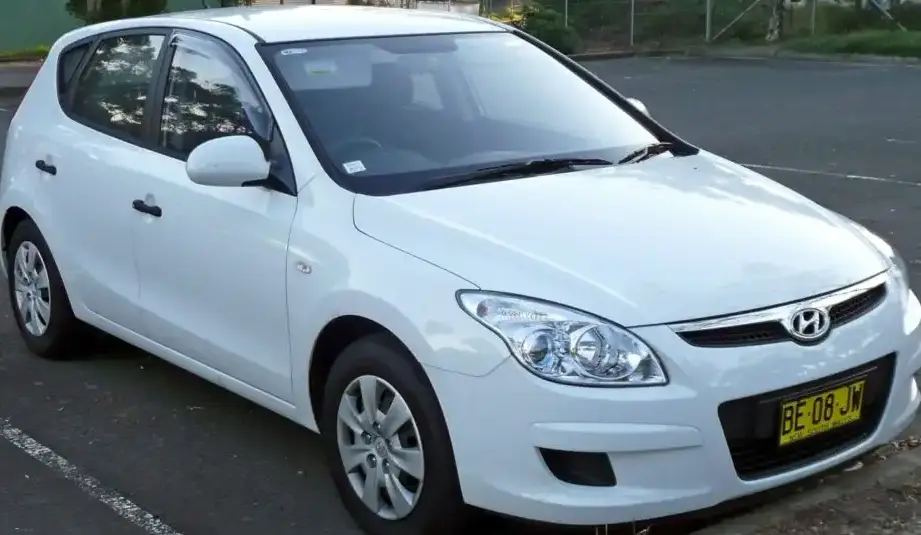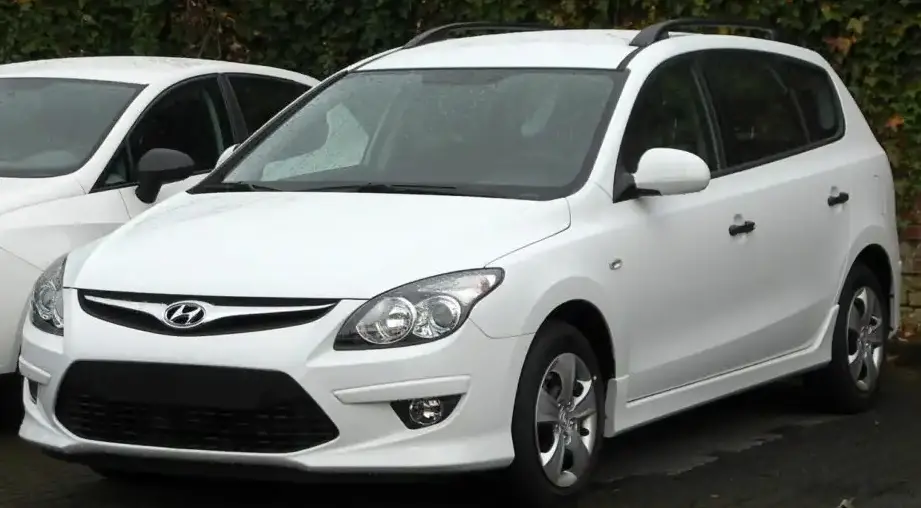
The Hyundai i30 I CW (facelift 2010) 1.6 CRDi, producing 116 horsepower, was a key variant within Hyundai’s first-generation i30 (FD) series, specifically the CW body style – a station wagon or estate. Introduced in 2010 as part of a mid-cycle refresh, this model aimed to provide a fuel-efficient and practical option for European buyers seeking a compact family vehicle. Production continued through 2012. This variant occupied a mid-range position in the i30 lineup, offering a balance between affordability, economy, and usability, slotting below the more powerful petrol engines and above the base diesel models.
Technical Specifications
| Brand | Hyundai |
| Model | i30 |
| Generation | i30 I CW (facelift 2010) |
| Type (Engine) | 1.6 CRDi (116 Hp) |
| Start of production | 2010 |
| End of production | 2012 |
| Powertrain Architecture | Internal Combustion engine |
| Body type | Station wagon (estate) |
| Seats | 5 |
| Doors | 5 |
| Fuel consumption (urban) | 5.4 l/100 km (43.6 US mpg, 52.3 UK mpg, 18.5 km/l) |
| Fuel consumption (extra urban) | 4.3 l/100 km (54.7 US mpg, 65.7 UK mpg, 23.3 km/l) |
| Fuel consumption (combined) | 4.7 l/100 km (50 US mpg, 60.1 UK mpg, 21.3 km/l) |
| CO2 emissions | 124 g/km |
| Fuel Type | Diesel |
| Acceleration 0 – 100 km/h | 11.6 sec |
| Acceleration 0 – 62 mph | 11.6 sec |
| Acceleration 0 – 60 mph | 11 sec |
| Maximum speed | 188 km/h (116.82 mph) |
| Emission standard | Euro 5 |
| Weight-to-power ratio | 11.5 kg/Hp, 87 Hp/tonne |
| Weight-to-torque ratio | 5.2 kg/Nm, 191.2 Nm/tonne |
| Power | 116 Hp @ 4000 rpm |
| Power per litre | 73.3 Hp/l |
| Torque | 255 Nm @ 1900-2750 rpm (188.08 lb.-ft. @ 1900-2750 rpm) |
| Engine layout | Front, Transverse |
| Engine Model/Code | D4FB |
| Engine displacement | 1582 cm3 (96.54 cu. in.) |
| Number of cylinders | 4 |
| Engine configuration | Inline |
| Cylinder Bore | 77.2 mm (3.04 in.) |
| Piston Stroke | 84.5 mm (3.33 in.) |
| Compression ratio | 17.3:1 |
| Number of valves per cylinder | 4 |
| Fuel injection system | Diesel Commonrail |
| Engine aspiration | Turbocharger, Intercooler |
| Valvetrain | DOHC |
| Engine oil capacity | 5.3 l (5.6 US qt | 4.66 UK qt) |
| Coolant | 6.8 l (7.19 US qt | 5.98 UK qt) |
| Kerb Weight | 1334 kg (2940.97 lbs.) |
| Max. weight | 1920 kg (4232.88 lbs.) |
| Max load | 586 kg (1291.91 lbs.) |
| Trunk (boot) space – minimum | 415 l (14.66 cu. ft.) |
| Trunk (boot) space – maximum | 1395 l (49.26 cu. ft.) |
| Fuel tank capacity | 53 l (14 US gal | 11.66 UK gal) |
| Permitted trailer load with brakes (12%) | 1400 kg (3086.47 lbs.) |
| Permitted trailer load without brakes | 550 kg (1212.54 lbs.) |
| Length | 4500 mm (177.17 in.) |
| Width | 1775 mm (69.88 in.) |
| Height | 1565 mm (61.61 in.) |
| Wheelbase | 2700 mm (106.3 in.) |
| Front track | 1546 mm (60.87 in.) |
| Rear (Back) track | 1544 mm (60.79 in.) |
| Ride height (ground clearance) | 135 mm (5.31 in.) |
| Drag coefficient (Cd) | 0.31 |
| Minimum turning circle (turning diameter) | 10.4 m (34.12 ft.) |
| Drivetrain Architecture | The Internal combustion engine (ICE) drives the front wheels of the vehicle. |
| Drive wheel | Front wheel drive |
| Number of gears and type of gearbox | 6 gears, manual transmission |
| Front brakes | Ventilated discs |
| Rear brakes | Disc |
| Assisting systems | ABS (Anti-lock braking system) |
| Steering type | Steering rack and pinion |
| Power steering | Electric Steering |
| Tires size | 185/65 R15 H |
| Wheel rims size | 15 |
INTRODUCTION
The Hyundai i30 I CW 1.6 CRDi (116 Hp) represented Hyundai’s attempt to capture a larger share of the European compact wagon market. The “CW” designation signifies the station wagon body style, offering increased cargo capacity compared to the five-door hatchback. The 2010 facelift brought subtle styling revisions, improved interior materials, and enhanced safety features. This variant was particularly popular in countries where estate cars remained a preferred choice for families and those requiring versatile load-carrying capabilities. It was built on the 1HX0/A3 platform, shared with the Kia Cee’d.
Powertrain & Engine Architecture
At the heart of the i30 CW 1.6 CRDi was the D4FB engine, a 1.6-liter inline-four cylinder diesel engine. This engine utilized a second-generation common-rail direct injection system, delivering fuel at extremely high pressure for improved combustion efficiency and reduced emissions. The engine featured a turbocharger with an intercooler, boosting power output to 116 horsepower and 255 Nm (188 lb-ft) of torque. The torque curve was relatively flat, providing good pulling power from low engine speeds. The engine also incorporated a Diesel Particulate Filter (DPF) to meet stringent Euro 5 emission standards. The engine employed a Double Overhead Camshaft (DOHC) valvetrain with four valves per cylinder. The transmission was a six-speed manual gearbox, chosen for its efficiency and driver engagement. While an automatic transmission was available on other i30 variants, it wasn’t offered with this specific engine and power output.
Driving Characteristics
The 1.6 CRDi engine, paired with the six-speed manual transmission, provided a reasonably responsive driving experience. Acceleration from 0 to 100 km/h (0-62 mph) took approximately 11.6 seconds, and top speed was rated at 188 km/h (117 mph). Compared to the more powerful petrol versions of the i30, the diesel variant prioritized fuel economy over outright performance. The gear ratios were well-chosen to maximize efficiency and provide adequate acceleration in everyday driving situations. The turbocharger provided a noticeable boost in power at higher engine speeds, but the engine lacked the punch of larger displacement engines. The manual transmission offered precise shifts and a good level of control. The ride quality was generally comfortable, although the suspension could feel slightly firm on rough road surfaces.
Equipment & Trim Levels
The i30 CW 1.6 CRDi typically came equipped with a respectable level of standard features. These included air conditioning, power windows, central locking, a CD/MP3 stereo system, and ABS brakes. Higher trim levels, such as Comfort or Style, added features like alloy wheels, fog lights, a leather-wrapped steering wheel, and a trip computer. Optional extras included a sunroof, parking sensors, and a navigation system. Interior upholstery was typically cloth, with higher trims offering partial leather options. The dashboard layout was functional and straightforward, with easy-to-read gauges and controls.
Chassis & Braking
The i30 CW featured a MacPherson strut front suspension and a multi-link rear suspension, providing a good balance between ride comfort and handling. The front brakes were ventilated discs, while the rear brakes were solid discs. ABS (Anti-lock Braking System) was standard, enhancing braking performance and stability. The steering was a rack-and-pinion system with electric power assistance, offering light and precise steering feel. The chassis was designed to provide a stable and predictable driving experience, even when fully loaded. The weight distribution was relatively balanced, contributing to good handling characteristics.
Market Reception & Comparison
The Hyundai i30 CW 1.6 CRDi was generally well-received by automotive critics. It was praised for its fuel efficiency, practicality, and competitive pricing. However, some reviewers noted that the engine could be somewhat noisy and lacked the refinement of some of its rivals. Compared to other trims in the i30 lineup, the 1.6 CRDi offered the best fuel economy, making it an attractive option for drivers who prioritized running costs. The petrol versions provided more power and a smoother engine, but at the expense of fuel efficiency. The higher-powered diesel variants offered more performance but were also more expensive.
Legacy
The Hyundai i30 I CW 1.6 CRDi has proven to be a relatively reliable vehicle in the used car market. The D4FB engine is known for its durability, although regular maintenance is essential to ensure long-term reliability. Common issues include DPF blockages (particularly on vehicles used primarily for short journeys) and wear and tear on suspension components. Overall, the i30 CW 1.6 CRDi remains a practical and affordable option for buyers seeking a fuel-efficient and versatile compact wagon. Its combination of economy, practicality, and reasonable performance has ensured its continued popularity in the used car market.