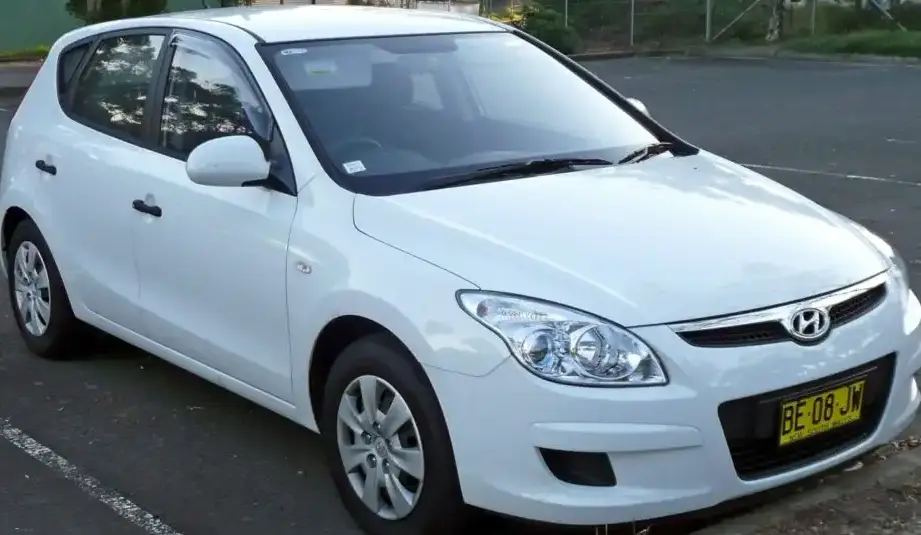
The Hyundai i30 I CW (facelift 2010) 1.6 CRDi 90 hp represents a specific configuration within the first generation (i30 I) of Hyundai’s compact wagon, produced from 2010 to 2012. This variant, designated as a ‘CW’ (Cargo Wagon) signified Hyundai’s entry into the European market with a practical, fuel-efficient estate car. Positioned as an entry-level diesel option, it aimed to provide affordability and economy for buyers prioritizing practicality over outright performance. It was built on the FD platform, shared with the Hyundai Elantra and Kia Cerato.
Technical Specifications
| Brand | Hyundai |
| Model | i30 |
| Generation | i30 I CW (facelift 2010) |
| Type (Engine) | 1.6 CRDi (90 Hp) |
| Start of production | 2010 |
| End of production | 2012 |
| Powertrain Architecture | Internal Combustion engine |
| Body type | Station wagon (estate) |
| Seats | 5 |
| Doors | 5 |
| Fuel consumption (urban) | 5.4 l/100 km (43.6 US mpg, 52.3 UK mpg, 18.5 km/l) |
| Fuel consumption (extra urban) | 4.3 l/100 km (54.7 US mpg, 65.7 UK mpg, 23.3 km/l) |
| Fuel consumption (combined) | 4.7 l/100 km (50 US mpg, 60.1 UK mpg, 21.3 km/l) |
| CO2 emissions | 124 g/km |
| Fuel Type | Diesel |
| Acceleration 0 – 100 km/h | 14.4 sec |
| Acceleration 0 – 62 mph | 14.4 sec |
| Acceleration 0 – 60 mph | 13.7 sec |
| Maximum speed | 172 km/h (106.88 mph) |
| Emission standard | Euro 5 |
| Weight-to-power ratio | 14.8 kg/Hp, 67.5 Hp/tonne |
| Weight-to-torque ratio | 5.7 kg/Nm, 176.2 Nm/tonne |
| Power | 90 Hp @ 4000 rpm |
| Power per litre | 56.9 Hp/l |
| Torque | 235 Nm @ 1750-2500 rpm (173.33 lb.-ft. @ 1750-2500 rpm) |
| Engine layout | Front, Transverse |
| Engine Model/Code | D4FB |
| Engine displacement | 1582 cm3 (96.54 cu. in.) |
| Number of cylinders | 4 |
| Engine configuration | Inline |
| Cylinder Bore | 77.2 mm (3.04 in.) |
| Piston Stroke | 84.5 mm (3.33 in.) |
| Compression ratio | 17.3:1 |
| Number of valves per cylinder | 4 |
| Fuel injection system | Diesel Commonrail |
| Engine aspiration | Turbocharger, Intercooler |
| Valvetrain | DOHC |
| Engine oil capacity | 5.3 l (5.6 US qt | 4.66 UK qt) |
| Coolant | 6.8 l (7.19 US qt | 5.98 UK qt) |
| Kerb Weight | 1334 kg (2940.97 lbs.) |
| Max. weight | 1920 kg (4232.88 lbs.) |
| Max load | 586 kg (1291.91 lbs.) |
| Trunk (boot) space – minimum | 415 l (14.66 cu. ft.) |
| Trunk (boot) space – maximum | 1395 l (49.26 cu. ft.) |
| Fuel tank capacity | 53 l (14 US gal | 11.66 UK gal) |
| Permitted trailer load with brakes (12%) | 1400 kg (3086.47 lbs.) |
| Permitted trailer load without brakes | 550 kg (1212.54 lbs.) |
| Length | 4500 mm (177.17 in.) |
| Width | 1775 mm (69.88 in.) |
| Height | 1565 mm (61.61 in.) |
| Wheelbase | 2700 mm (106.3 in.) |
| Front track | 1546 mm (60.87 in.) |
| Rear (Back) track | 1544 mm (60.79 in.) |
| Ride height (ground clearance) | 135 mm (5.31 in.) |
| Drag coefficient (Cd) | 0.31 |
| Minimum turning circle (turning diameter) | 10.4 m (34.12 ft.) |
| Drivetrain Architecture | The Internal combustion engine (ICE) drives the front wheels of the vehicle. |
| Drive wheel | Front wheel drive |
| Number of gears and type of gearbox | 6 gears, manual transmission |
| Front brakes | Ventilated discs |
| Rear brakes | Disc |
| Assisting systems | ABS (Anti-lock braking system) |
| Steering type | Steering rack and pinion |
| Power steering | Electric Steering |
| Tires size | 185/65 R15 H |
| Wheel rims size | 15 |
INTRODUCTION
The Hyundai i30 I CW 1.6 CRDi 90 hp, launched in 2010 following a facelift of the original i30, was designed to appeal to European buyers seeking a practical and economical family car. The ‘CW’ body style, a station wagon, offered increased cargo capacity compared to the hatchback version, making it suitable for families or those requiring more space for luggage or equipment. This particular engine and transmission combination represented the base-level diesel offering, prioritizing fuel efficiency and affordability over performance. It was a key model in Hyundai’s strategy to establish a stronger foothold in the competitive European C-segment.
Powertrain & Engine Architecture
At the heart of the i30 CW 1.6 CRDi 90 hp lies the D4FB engine, a 1.6-liter inline-four cylinder diesel engine. This engine utilizes a second-generation common rail direct injection system, delivering fuel directly into the combustion chamber at extremely high pressure. This technology, coupled with a turbocharger and intercooler, optimizes combustion efficiency and boosts power output. The engine features a double overhead camshaft (DOHC) valvetrain with four valves per cylinder, enhancing breathing and contributing to improved performance. The 90 horsepower output is achieved at 4000 rpm, while peak torque of 235 Nm (173.33 lb.-ft.) is available between 1750-2500 rpm. This broad torque curve provides good low-end responsiveness, making it suitable for everyday driving. The engine is transversely mounted in the front of the vehicle. The transmission is a 6-speed manual gearbox, chosen for its efficiency and cost-effectiveness.
Driving Characteristics
The i30 CW 1.6 CRDi 90 hp offers a comfortable, if not particularly exciting, driving experience. The 90 hp output and relatively low torque figure result in modest acceleration – 0-60 mph takes around 13.7 seconds. The focus is on fuel economy and usability rather than outright speed. The 6-speed manual transmission is well-matched to the engine, allowing drivers to keep the engine in its optimal torque band for efficient cruising and overtaking. Gear ratios are geared towards maximizing fuel efficiency. Compared to higher-powered versions of the i30, such as those equipped with the 1.6 GDI petrol engine or the more powerful 1.7 CRDi diesel, this variant feels noticeably slower. However, it provides a more relaxed and economical driving experience, particularly on long journeys.
Equipment & Trim Levels
The i30 CW 1.6 CRDi 90 hp typically came with a reasonable level of standard equipment, though it was generally less lavishly equipped than higher-spec models. Standard features often included air conditioning, electric front windows, central locking, a basic audio system with USB connectivity, and ABS brakes. Safety features such as airbags were also standard. Interior upholstery was typically cloth, and the dashboard featured a functional, if somewhat understated, design. Optional extras available for this trim level could include alloy wheels, rear parking sensors, a more advanced audio system, and climate control. Trim levels varied slightly depending on the specific market, but the 1.6 CRDi 90 hp generally represented the entry point to the i30 CW range.
Chassis & Braking
The i30 CW 1.6 CRDi 90 hp utilizes a MacPherson strut front suspension and a coupled torsion beam rear suspension. This setup provides a good balance between ride comfort and handling. The front brakes are ventilated discs, offering good stopping power, while the rear brakes are solid discs. ABS (Anti-lock Braking System) is standard, enhancing safety during emergency braking. The suspension is tuned for comfort, prioritizing a smooth ride over sporty handling. Stabilizer bars are fitted to both the front and rear axles to reduce body roll during cornering. The relatively low weight of the vehicle, at 1334 kg (2940.97 lbs.), contributes to its manageable handling characteristics.
Market Reception & Comparison
The Hyundai i30 CW 1.6 CRDi 90 hp was generally well-received by critics as a practical and economical family car. It was praised for its fuel efficiency, spacious interior, and competitive price point. However, some reviewers noted that the engine lacked outright power and refinement compared to some of its rivals. Compared to other trims in the i30 lineup, such as the 1.6 GDI petrol or the 1.7 CRDi diesel, this variant offered the lowest running costs but also the least exciting driving experience. Its main competitors included the Ford Focus Estate, Volkswagen Golf Estate, and Skoda Octavia Estate.
Legacy
The Hyundai i30 I CW 1.6 CRDi 90 hp has proven to be a relatively reliable and durable vehicle. The D4FB engine, while not without its quirks, is generally considered to be a robust unit. Common issues include potential problems with the diesel particulate filter (DPF) and the turbocharger, particularly if the vehicle has not been properly maintained. In the used car market today, these i30 CWs represent an affordable and practical option for buyers seeking a fuel-efficient estate car. They are often sought after by those prioritizing economy and reliability over performance and luxury. Their continued presence on roads is a testament to their build quality and enduring appeal.