Technical Specifications
| Brand | Hyundai |
| Model | i30 |
| Generation | i30 I (facelift 2010) |
| Type (Engine) | 1.6 CRDi (90 Hp) |
| Start of production | 2010 |
| End of production | 2012 |
| Powertrain Architecture | Internal Combustion engine |
| Body type | Hatchback |
| Seats | 5 |
| Doors | 5 |
| Fuel consumption (urban) | 5 l/100 km (47 US mpg, 56.5 UK mpg, 20 km/l) |
| Fuel consumption (extra urban) | 4.1 l/100 km (57.4 US mpg, 68.9 UK mpg, 24.4 km/l) |
| Fuel consumption (combined) | 4.4 l/100 km (53.5 US mpg, 64.2 UK mpg, 22.7 km/l) |
| CO2 emissions | 115 g/km |
| Fuel Type | Diesel |
| Acceleration 0 – 100 km/h | 14.9 sec |
| Acceleration 0 – 62 mph | 14.9 sec |
| Acceleration 0 – 60 mph | 14.2 sec |
| Maximum speed | 172 km/h (106.88 mph) |
| Emission standard | Euro 5 |
| Weight-to-power ratio | 14.3 kg/Hp, 69.7 Hp/tonne |
| Weight-to-torque ratio | 5.5 kg/Nm, 182 Nm/tonne |
| Power | 90 Hp @ 4000 rpm |
| Power per litre | 56.9 Hp/l |
| Torque | 235 Nm @ 1750-2500 rpm (173.33 lb.-ft. @ 1750-2500 rpm) |
| Engine layout | Front, Transverse |
| Engine Model/Code | D4FB |
| Engine displacement | 1582 cm3 (96.54 cu. in.) |
| Number of cylinders | 4 |
| Engine configuration | Inline |
| Cylinder Bore | 77.2 mm (3.04 in.) |
| Piston Stroke | 84.5 mm (3.33 in.) |
| Compression ratio | 17.3:1 |
| Number of valves per cylinder | 4 |
| Fuel injection system | Diesel Commonrail |
| Engine aspiration | Turbocharger, Intercooler |
| Valvetrain | DOHC |
| Engine oil capacity | 5.3 l (5.6 US qt | 4.66 UK qt) |
| Coolant capacity | 6.8 l (7.19 US qt | 5.98 UK qt) |
| Kerb Weight | 1291 kg (2846.17 lbs.) |
| Max. weight | 1820 kg (4012.41 lbs.) |
| Max load | 529 kg (1166.25 lbs.) |
| Trunk (boot) space – minimum | 340 l (12.01 cu. ft.) |
| Trunk (boot) space – maximum | 1250 l (44.14 cu. ft.) |
| Fuel tank capacity | 53 l (14 US gal | 11.66 UK gal) |
| Permitted trailer load with brakes (12%) | 1400 kg (3086.47 lbs.) |
| Permitted trailer load without brakes | 550 kg (1212.54 lbs.) |
| Length | 4280 mm (168.5 in.) |
| Width | 1775 mm (69.88 in.) |
| Height | 1480 mm (58.27 in.) |
| Wheelbase | 2650 mm (104.33 in.) |
| Front track | 1546 mm (60.87 in.) |
| Rear track | 1544 mm (60.79 in.) |
| Drag coefficient (Cd) | 0.33 |
| Minimum turning circle | 10.2 m (33.46 ft.) |
| Drivetrain | Front wheel drive |
| Number of gears | 6 |
| Gearbox type | Manual transmission |
| Front brakes | Ventilated discs |
| Rear brakes | Disc |
| Assisting systems | ABS (Anti-lock braking system) |
| Steering type | Steering rack and pinion |
| Tires size | 185/65 R15 H |
| Wheel rims size | 15 |
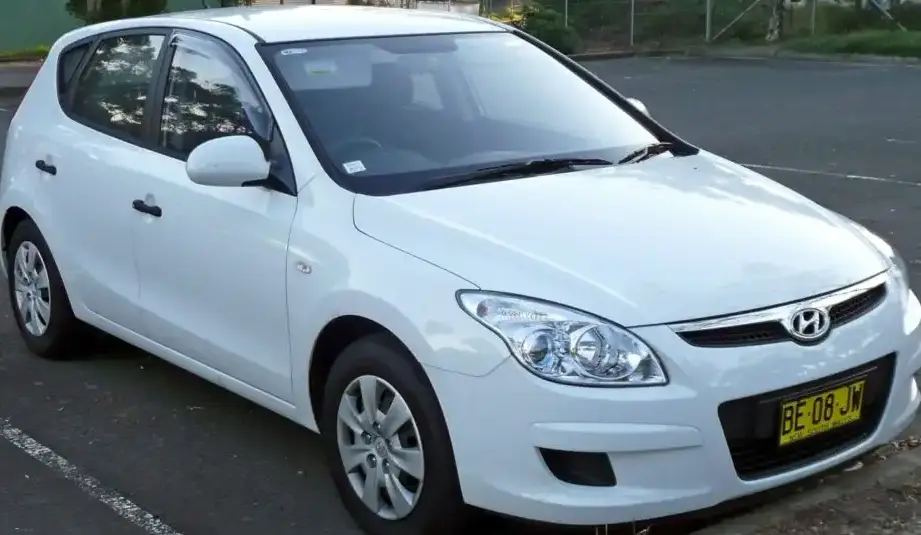
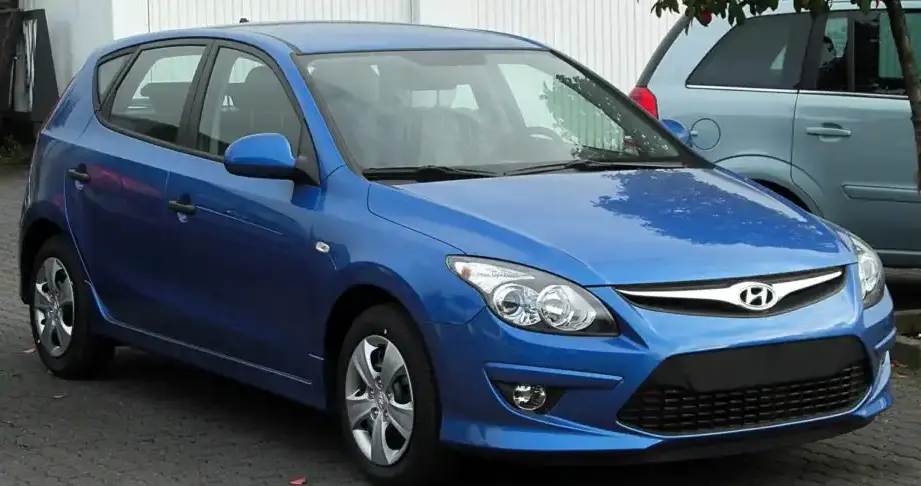
The Hyundai i30 1.6 CRDi 90hp (facelift, 2010-2012) was positioned as the entry-level diesel variant within the i30 range. It was built on the 1HX0/A3 platform, shared with the Kia Cee’d. This model aimed to deliver a balance of fuel efficiency, practicality, and affordability, targeting cost-conscious buyers in Europe. The facelift brought subtle cosmetic changes, including a revised front grille and headlights, along with improvements to the interior trim and equipment levels. The 1.6 CRDi engine was a key component of Hyundai’s strategy to offer a competitive diesel option in the European market, where diesel-powered vehicles were – and still are – popular due to favorable taxation and fuel economy.
Powertrain & Engine Architecture
The heart of this i30 variant is the D4FB 1.6-liter inline-four cylinder diesel engine. This engine utilizes a second-generation common-rail direct injection system, delivering fuel at extremely high pressure for improved combustion efficiency and reduced emissions. The engine is turbocharged with a variable geometry turbocharger (VGT) and intercooled, enhancing low-end torque and overall performance. The D4FB engine features a double overhead camshaft (DOHC) valvetrain with four valves per cylinder, optimizing gas flow and contributing to its power output. The 90 horsepower version of this engine was specifically tuned for fuel economy, prioritizing efficiency over outright power. It’s paired with a six-speed manual transmission, chosen for its efficiency and driver engagement. The engine meets Euro 5 emission standards, incorporating a diesel particulate filter (DPF) to reduce particulate matter emissions.
Driving Characteristics
The 1.6 CRDi 90hp i30 offers a comfortable, if not particularly exhilarating, driving experience. With 90 horsepower and 235 Nm (173 lb-ft) of torque, acceleration is modest, taking around 14.9 seconds to reach 62 mph (100 km/h). However, the engine’s strong low-end torque makes it well-suited for everyday driving and overtaking maneuvers on the highway. The six-speed manual transmission is well-matched to the engine, allowing drivers to keep the engine in its optimal torque band. Compared to the more powerful 1.6 CRDi variants (110hp or 128hp) or the petrol engines, this version feels noticeably slower. However, it excels in fuel economy, achieving combined fuel consumption figures of around 53.5 US mpg (64.2 UK mpg). The steering is light and precise, making it easy to maneuver in urban environments.
Equipment & Trim Levels
The 1.6 CRDi 90hp i30 typically came with a reasonable level of standard equipment, though it was generally positioned as the base trim level. Standard features often included air conditioning, power windows, central locking, a CD/MP3 stereo system, and ABS brakes. Safety features such as airbags (front, side, and curtain) were also standard. Higher trim levels offered additional features such as alloy wheels, a trip computer, electric mirrors, and a leather-wrapped steering wheel. Optional extras included a sunroof, parking sensors, and a more advanced audio system. Interior upholstery was typically cloth, with a functional and durable design.
Chassis & Braking
The i30’s chassis features a MacPherson strut front suspension and a coupled torsion beam rear suspension. This setup provides a good balance of ride comfort and handling. The front brakes are ventilated discs, while the rear brakes are solid discs. ABS (Anti-lock Braking System) is standard, enhancing braking performance and stability. The suspension is tuned for comfort, absorbing bumps and imperfections in the road surface effectively. The steering is a rack and pinion system, providing precise and responsive steering feel. The 15-inch wheels and 185/65 R15 tires contribute to a comfortable ride quality.
Market Reception & Comparison
The Hyundai i30 1.6 CRDi 90hp was generally well-received by critics as a practical and economical hatchback. It was praised for its fuel efficiency, comfortable ride, and competitive price point. However, some reviewers noted its lack of outright performance compared to more powerful rivals. Compared to other trims in the i30 lineup, this variant offered the lowest running costs but sacrificed some performance. Against competitors like the Ford Focus, Volkswagen Golf, and Opel Astra, the i30 1.6 CRDi 90hp offered a compelling value proposition, particularly for buyers prioritizing fuel economy and affordability.
Legacy
The D4FB engine, in its various iterations, proved to be a relatively reliable powertrain. While diesel particulate filters (DPFs) can be prone to clogging if the vehicle is primarily used for short trips, the D4FB engine itself is generally robust. In the used car market, the i30 1.6 CRDi 90hp remains a popular choice for buyers seeking an economical and practical hatchback. Its fuel efficiency and relatively low maintenance costs make it an attractive option. However, potential buyers should be aware of the importance of regular DPF maintenance and ensure the vehicle has a full service history.