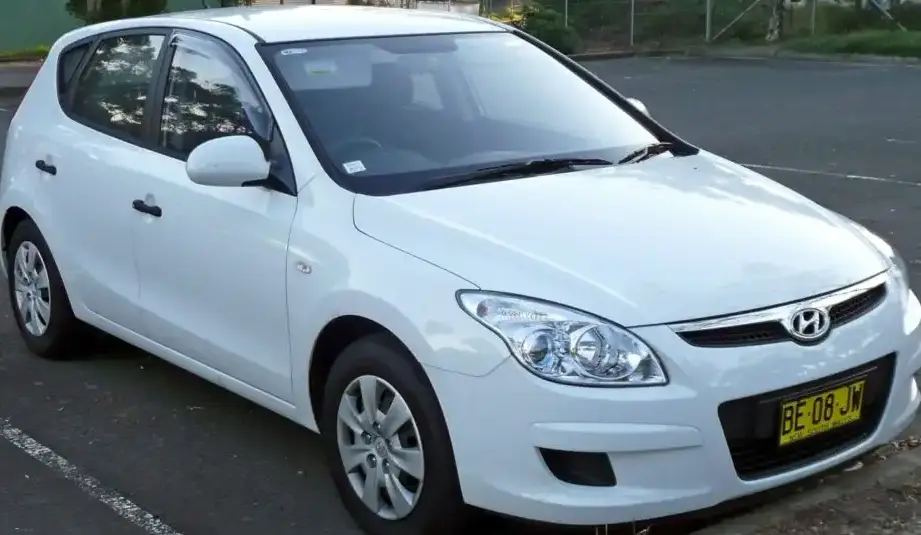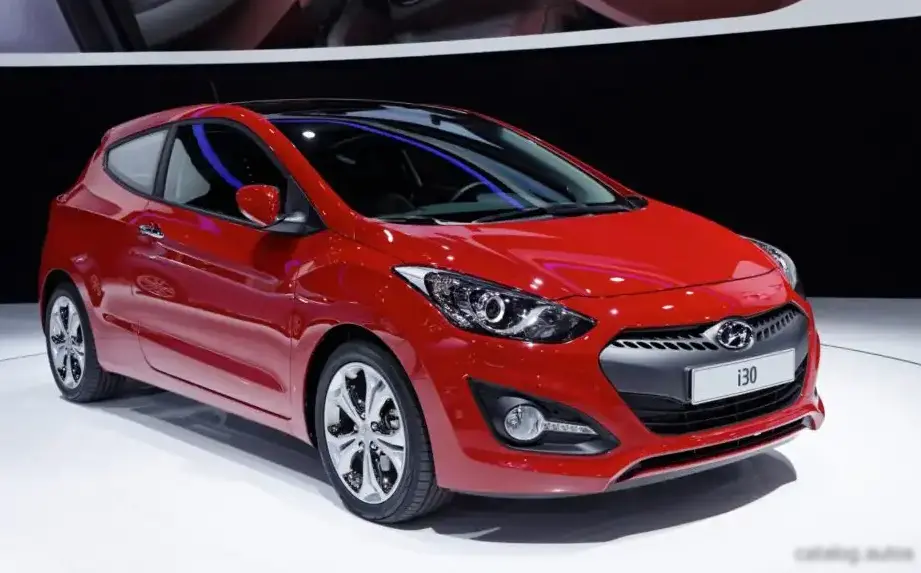
The Hyundai i30 II Coupe 1.4, producing 100 horsepower, was a variant of the second-generation i30 Coupe produced between 2013 and 2015. Positioned as an entry-level offering within the Coupe range, it aimed to provide an affordable and fuel-efficient option for buyers seeking a stylish, compact vehicle. This model was primarily marketed in Europe and other regions where Hyundai was expanding its presence, offering a blend of practicality and contemporary design. It sat below the more powerful 1.6L gasoline and diesel variants in the i30 Coupe lineup.
Technical Specifications
| Brand | Hyundai |
| Model | i30 |
| Generation | i30 II Coupe |
| Type (Engine) | 1.4 (100 Hp) |
| Start of production | 2013 |
| End of production | 2015 |
| Powertrain Architecture | Internal Combustion engine |
| Body type | Coupe |
| Seats | 5 |
| Doors | 3 |
| Fuel consumption (urban) | 8.4-7.9 l/100 km (28 – 29.8 US mpg) |
| Fuel consumption (extra urban) | 4.8-4.9 l/100 km (49 – 48 US mpg) |
| Fuel consumption (combined) | 6.1-6.0 l/100 km (38.6 – 39.2 US mpg) |
| Fuel Type | Petrol (Gasoline) |
| Acceleration 0 – 100 km/h | 13.2 sec |
| Acceleration 0 – 62 mph | 13.2 sec |
| Acceleration 0 – 60 mph | 12.5 sec |
| Maximum speed | 182 km/h (113.09 mph) |
| Emission standard | Euro 5 |
| Weight-to-power ratio | 13.1 kg/Hp |
| Weight-to-torque ratio | 9.5 kg/Nm |
| Power | 100 Hp @ 5500 rpm |
| Torque | 137 Nm @ 4200 rpm (101.05 lb.-ft. @ 4200 rpm) |
| Engine layout | Front, Transverse |
| Engine Model/Code | G4FA |
| Engine displacement | 1396 cm3 (85.19 cu. in.) |
| Number of cylinders | 4 |
| Engine configuration | Inline |
| Cylinder Bore | 77 mm (3.03 in.) |
| Piston Stroke | 74.99 mm (2.95 in.) |
| Compression ratio | 10.5:1 |
| Number of valves per cylinder | 4 |
| Fuel injection system | Multi-port manifold injection |
| Engine aspiration | Naturally aspirated engine |
| Valvetrain | DOHC |
| Engine oil capacity | 3.3 l (3.49 US qt | 2.9 UK qt) |
| Coolant capacity | 5.8 l (6.13 US qt | 5.1 UK qt) |
| Kerb Weight | 1305 kg (2877.03 lbs.) |
| Max. weight | 1820 kg (4012.41 lbs.) |
| Max load | 515 kg (1135.38 lbs.) |
| Trunk (boot) space – minimum | 378 l (13.35 cu. ft.) |
| Trunk (boot) space – maximum | 1316 l (46.47 cu. ft.) |
| Fuel tank capacity | 53 l (14 US gal | 11.66 UK gal) |
| Length | 4300 mm (169.29 in.) |
| Width | 1780 mm (70.08 in.) |
| Height | 1470 mm (57.87 in.) |
| Wheelbase | 2650 mm (104.33 in.) |
| Front track | 1563 mm (61.54 in.) |
| Rear track | 1571 mm (61.85 in.) |
| Minimum turning circle | 10.6 m (34.78 ft.) |
| Drivetrain Architecture | Front wheel drive |
| Number of gears | 6 gears, manual transmission |
| Front suspension | Independent type McPherson |
| Rear suspension | Independent multi-link spring suspension with stabilizer |
| Front brakes | Disc |
| Rear brakes | Disc |
| Assisting systems | ABS (Anti-lock braking system) |
| Steering type | Steering rack and pinion |
| Tires size | 195/65 R15; 205/55 R16 |
| Wheel rims size | 6.0J x 15; 6.5J x 16 |
Powertrain & Engine Architecture
The i30 II Coupe 1.4 utilized Hyundai’s G4FA engine, a 1.4-liter inline-four cylinder gasoline engine. This engine featured a dual overhead camshaft (DOHC) valvetrain with four valves per cylinder, and multi-point fuel injection. The G4FA was designed with a focus on fuel efficiency and smooth operation, rather than outright performance. The engine produced 100 horsepower at 5,500 rpm and 137 Nm (101 lb-ft) of torque at 4,200 rpm. The engine’s compression ratio was 10.5:1. The engine was transversely mounted in the front of the vehicle, driving the front wheels. The standard transmission was a six-speed manual gearbox, optimized for fuel economy and everyday driving.
Driving Characteristics
The 1.4-liter engine, paired with the six-speed manual transmission, provided adequate, but not exhilarating, performance. Acceleration from 0 to 60 mph took approximately 12.5 seconds, and the top speed was around 113 mph. The gear ratios were tuned for fuel efficiency, meaning the engine needed to be revved to access its power band. Compared to the more powerful 1.6L gasoline or diesel options, the 1.4 felt noticeably slower, particularly during overtaking maneuvers or when carrying a full load of passengers. However, the lighter engine weight contributed to a more nimble feel in city driving and on winding roads. The steering was light and precise, making it easy to maneuver in tight spaces.
Equipment & Trim Levels
The 1.4-liter i30 Coupe typically came with a reasonable level of standard equipment. This included air conditioning, power windows, central locking, and a basic audio system with USB connectivity. Safety features such as ABS, Electronic Stability Control (ESC), and multiple airbags were also standard. Higher trim levels offered options like alloy wheels, a more advanced audio system, Bluetooth connectivity, and a panoramic sunroof. Interior upholstery was typically cloth, with a dark color scheme. The dashboard layout was functional and straightforward, with a focus on ease of use.
Chassis & Braking
The i30 II Coupe featured a McPherson strut front suspension and a multi-link rear suspension, providing a comfortable ride quality. The suspension was tuned to prioritize comfort over sporty handling. The front and rear brakes were both disc brakes, providing adequate stopping power for the vehicle’s weight and performance. ABS (Anti-lock Braking System) was standard, enhancing safety during emergency braking situations. The i30 Coupe’s chassis was designed to provide a good balance between rigidity and weight, contributing to its overall stability and handling characteristics.
Market Reception & Comparison
The Hyundai i30 II Coupe 1.4 was generally well-received as an affordable and practical coupe. Critics praised its stylish design, comfortable ride, and good fuel economy. However, some reviewers noted that the 1.4-liter engine lacked the power and refinement of its larger counterparts. Compared to the 1.6L gasoline engine, the 1.4 offered better fuel economy but significantly less performance. The diesel variants provided even better fuel economy and more torque, but at a higher purchase price. The i30 Coupe competed with other compact coupes such as the Volkswagen Scirocco, the Peugeot RCZ, and the Audi A3 Coupe.
Legacy
The Hyundai i30 II Coupe 1.4 has proven to be a relatively reliable vehicle, with the G4FA engine generally considered durable and long-lasting. Common maintenance items include regular oil changes, spark plug replacements, and air filter replacements. The engine’s relatively simple design makes it relatively easy and inexpensive to repair. On the used car market, the 1.4-liter i30 Coupe represents a good value proposition for buyers seeking an affordable and fuel-efficient coupe. While it may not offer the performance of more powerful variants, its reliability and low running costs make it a practical choice for everyday driving.