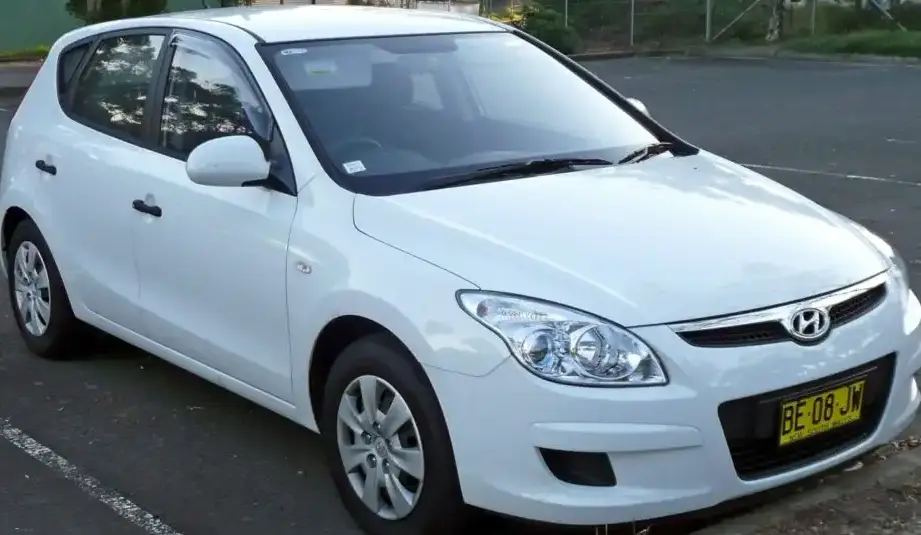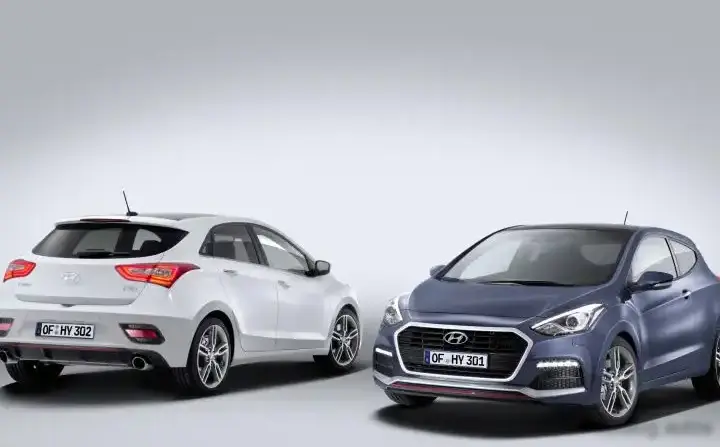
The Hyundai i30 II Coupe, specifically the facelifted version produced from 2015 to 2017, represented Hyundai’s continued push into the European C-segment market. This three-door coupe variant of the i30 aimed to offer a more stylish and sporty alternative to the five-door hatchback, appealing to buyers seeking a compact, affordable, and relatively fuel-efficient vehicle. The 1.6 GDI (Gasoline Direct Injection) engine producing 135 horsepower was a key offering within the i30 Coupe lineup, positioned as a mid-range option balancing performance and economy. It slotted between the lower-powered 1.4 MPI engine and the more potent 1.6 Turbo GDI.
Technical Specifications
| Brand | Hyundai |
| Model | i30 |
| Generation | i30 II Coupe (facelift 2015) |
| Type (Engine) | 1.6 GDI (135 Hp) |
| Start of production | 2015 |
| End of production | 2017 |
| Powertrain Architecture | Internal Combustion engine |
| Body type | Coupe |
| Seats | 5 |
| Doors | 3 |
| Fuel consumption (urban) | 7.7 l/100 km (30.5 US mpg) |
| Fuel consumption (extra urban) | 4.6 l/100 km (51.1 US mpg) |
| Fuel consumption (combined) | 5.7 l/100 km (41.3 US mpg) |
| CO2 emissions | 134 g/km |
| Fuel Type | Petrol (Gasoline) |
| Acceleration 0 – 100 km/h | 9.9 sec |
| Acceleration 0 – 62 mph | 9.9 sec |
| Acceleration 0 – 60 mph | 9.4 sec |
| Maximum speed | 195 km/h (121.17 mph) |
| Emission standard | Euro 6 |
| Weight-to-power ratio | 8.8 kg/Hp |
| Weight-to-torque ratio | 7.2 kg/Nm |
| Power | 135 Hp @ 6300 rpm |
| Torque | 164 Nm @ 4850 rpm (120.96 lb.-ft. @ 4850 rpm) |
| Engine layout | Front, Transverse |
| Engine Model/Code | G4FD |
| Engine displacement | 1591 cm3 (97.09 cu. in.) |
| Number of cylinders | 4 |
| Engine configuration | Inline |
| Cylinder Bore | 77 mm (3.03 in.) |
| Piston Stroke | 85.44 mm (3.36 in.) |
| Number of valves per cylinder | 4 |
| Fuel injection system | Direct injection |
| Engine aspiration | Naturally aspirated engine |
| Engine oil capacity | 3.6 l (3.8 US qt | 3.17 UK qt) |
| Coolant | 6.4 l (6.76 US qt | 5.63 UK qt) |
| Kerb Weight | 1188-1330 kg (2619.09 – 2932.15 lbs.) |
| Max. weight | 1820 kg (4012.41 lbs.) |
| Max load | 490-632 kg (1080.27 – 1393.32 lbs.) |
| Trunk (boot) space – minimum | 378 l (13.35 cu. ft.) |
| Trunk (boot) space – maximum | 1316 l (46.47 cu. ft.) |
| Fuel tank capacity | 53 l (14 US gal | 11.66 UK gal) |
| Max. roof load | 80 kg (176.37 lbs.) |
| Permitted trailer load with brakes (12%) | 1400 kg (3086.47 lbs.) |
| Permitted trailer load without brakes | 600 kg (1322.77 lbs.) |
| Permitted towbar download | 60 kg (132.28 lbs.) |
| Length | 4300 mm (169.29 in.) |
| Width | 1780 mm (70.08 in.) |
| Height | 1465-1470 mm (57.68 – 57.87 in.) |
| Wheelbase | 2650 mm (104.33 in.) |
| Front track | 1563-1569 mm (61.54 – 61.77 in.) |
| Rear (Back) track | 1571-1577 mm (61.85 – 62.09 in.) |
| Front overhang | 880 mm (34.65 in.) |
| Rear overhang | 770 mm (30.31 in.) |
| Ride height (ground clearance) | 140 mm (5.51 in.) |
| Minimum turning circle (turning diameter) | 10.6 m (34.78 ft.) |
| Drivetrain Architecture | Front wheel drive |
| Drive wheel | Front wheel drive |
| Number of gears and type of gearbox | 6 gears, manual transmission |
| Front suspension | Independent, type McPherson with coil spring and anti-roll bar |
| Rear suspension | Independent multi-link suspension |
| Front brakes | Ventilated discs |
| Rear brakes | Disc |
| Assisting systems | ABS (Anti-lock braking system) |
| Steering type | Steering rack and pinion |
| Power steering | Electric Steering |
| Tires size | 225/45 R17 |
| Wheel rims size | 7.0 J x 17 |
INTRODUCTION
The Hyundai i30 II Coupe, launched in 2012 and receiving a facelift in 2015, was designed to broaden the appeal of the i30 range. Hyundai aimed to capture a younger demographic with the coupe’s more dynamic styling. The 1.6 GDI variant, introduced with the facelift, represented a significant upgrade over the earlier 1.6-liter naturally aspirated engine, offering improved power and efficiency thanks to direct fuel injection. Built on the same platform (1HX0/A3) as the i30 hatchback, the Coupe distinguished itself with its three-door configuration and sleeker roofline. This particular engine and transmission combination was intended to provide a balance between affordability, fuel economy, and acceptable performance for everyday driving.
Powertrain & Engine Architecture
The heart of the i30 Coupe 1.6 GDI is the G4FD engine, a 1.6-liter inline-four cylinder gasoline engine. The “GDI” designation signifies the use of Gasoline Direct Injection, where fuel is injected directly into the combustion chamber, allowing for more precise fuel control and improved efficiency. This engine produces 135 horsepower at 6300 rpm and 164 Nm (120.96 lb-ft) of torque at 4850 rpm. The engine features a dual continuously variable valve timing (CVVT) system, optimizing valve timing for both intake and exhaust to enhance performance and fuel economy across the rev range. The 6-speed manual transmission was standard, offering a relatively direct and engaging driving experience. The transmission’s gear ratios were tuned to prioritize fuel efficiency while still providing adequate acceleration.
Driving Characteristics
The 1.6 GDI-equipped i30 Coupe offered a reasonably engaging driving experience, though it wasn’t intended to be a performance leader. Acceleration from 0-60 mph took around 9.4 seconds, and top speed was rated at 195 km/h (121.17 mph). The engine felt responsive enough for everyday driving, with adequate power for overtaking and merging onto highways. Compared to the more powerful 1.6 Turbo GDI, the naturally aspirated 1.6 GDI lacked the same level of outright punch, but it offered a smoother, more linear power delivery. The manual transmission provided good control, and the chassis felt well-balanced, offering a comfortable ride without excessive body roll. The steering was light and precise, making it easy to maneuver in urban environments.
Equipment & Trim Levels
The i30 Coupe 1.6 GDI typically came with a decent level of standard equipment. Base models included air conditioning, electric front windows, a USB audio connection, and a basic audio system. Higher trim levels added features such as alloy wheels, a touchscreen infotainment system with navigation, rear parking sensors, and climate control. Interior upholstery was typically cloth, with options for leather upgrades on higher trims. Safety features included ABS, ESC (Electronic Stability Control), and multiple airbags. Optional extras included a panoramic sunroof, heated front seats, and a premium audio system.
Chassis & Braking
The i30 Coupe utilized a McPherson strut front suspension and a multi-link rear suspension, providing a good balance of ride comfort and handling. The front suspension incorporated a stabilizer bar to reduce body roll during cornering. Braking duties were handled by ventilated discs at the front and solid discs at the rear. ABS (Anti-lock Braking System) was standard, enhancing braking performance and stability. The suspension tuning was geared towards providing a comfortable ride for everyday driving, rather than outright sporty handling.
Market Reception & Comparison
The Hyundai i30 Coupe 1.6 GDI was generally well-received by automotive critics. It was praised for its stylish design, good value for money, and fuel efficiency. However, some reviewers noted that the engine lacked the punch of its turbocharged counterpart. Compared to rivals such as the Volkswagen Scirocco and the Ford Focus Coupe, the i30 Coupe offered a more affordable option with a longer warranty. Fuel economy was competitive, with combined figures around 5.7 l/100 km (41.3 US mpg). Reliability was generally good, with few reported issues with the 1.6 GDI engine and transmission.
Legacy
The Hyundai i30 Coupe 1.6 GDI has proven to be a relatively reliable and affordable used car. The G4FD engine is known for its durability, and the manual transmission is generally robust. While not a particularly exciting car to drive, it offers a practical and economical option for buyers seeking a stylish coupe. Today, these vehicles can be found at reasonable prices, making them an attractive option for those looking for a budget-friendly and dependable compact coupe. The i30 Coupe helped establish Hyundai as a serious contender in the European C-segment market, paving the way for future models.