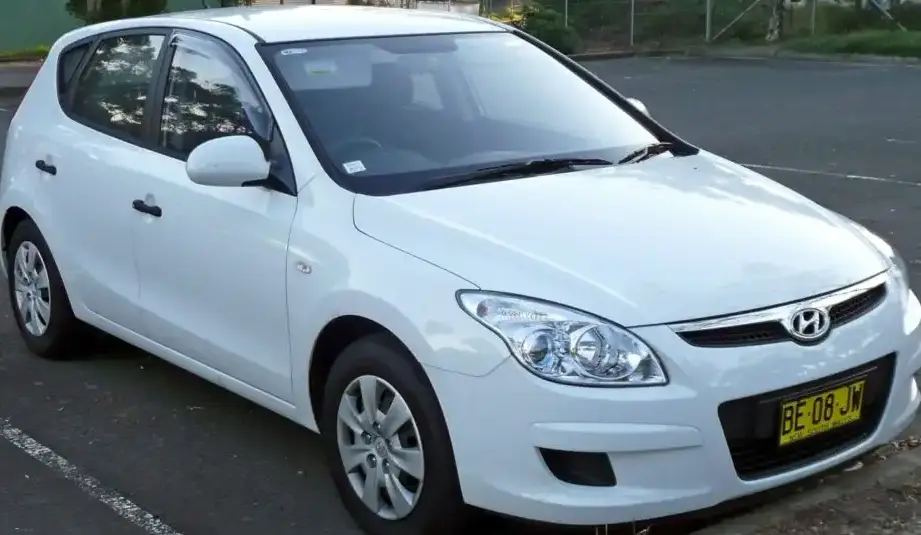
The Hyundai i30 II CW 1.4 MPI, producing 100 horsepower, was a station wagon (estate) variant of the second-generation Hyundai i30, manufactured between 2012 and 2015. Positioned as an entry-level offering within the i30 CW lineup, it aimed to provide practical family transport with reasonable fuel economy. The “CW” designation signifies the wagon body style, distinguishing it from the five-door hatchback version. This model played a significant role in Hyundai’s efforts to gain market share in the European compact wagon segment, offering a value-oriented alternative to established competitors.
Technical Specifications
| Brand | Hyundai |
| Model | i30 |
| Generation | i30 II CW |
| Type (Engine) | 1.4 MPI (100 Hp) |
| Start of production | 2012 |
| End of production | 2015 |
| Powertrain Architecture | Internal Combustion engine |
| Body type | Station wagon (estate) |
| Seats | 5 |
| Doors | 5 |
| Fuel consumption (urban) | 7.9 l/100 km (29.8 US mpg, 35.8 UK mpg, 12.7 km/l) |
| Fuel consumption (extra urban) | 4.9 l/100 km (48 US mpg, 57.6 UK mpg, 20.4 km/l) |
| Fuel consumption (combined) | 6 l/100 km (39.2 US mpg, 47.1 UK mpg, 16.7 km/l) |
| Fuel Type | Petrol (Gasoline) |
| Acceleration 0 – 100 km/h | 13.2 sec |
| Acceleration 0 – 62 mph | 13.2 sec |
| Acceleration 0 – 60 mph | 12.5 sec |
| Maximum speed | 182 km/h (113.09 mph) |
| Emission standard | Euro 5 |
| Weight-to-power ratio | 11.9 kg/Hp, 84.4 Hp/tonne |
| Weight-to-torque ratio | 8.6 kg/Nm, 115.6 Nm/tonne |
| Power | 100 Hp @ 5500 rpm |
| Power per litre | 71.6 Hp/l |
| Torque | 137 Nm @ 4200 rpm (101.05 lb.-ft. @ 4200 rpm) |
| Engine layout | Front, Transverse |
| Engine Model/Code | G4FA |
| Engine displacement | 1396 cm3 (85.19 cu. in.) |
| Number of cylinders | 4 |
| Engine configuration | Inline |
| Cylinder Bore | 77 mm (3.03 in.) |
| Piston Stroke | 75 mm (2.95 in.) |
| Compression ratio | 10.5:1 |
| Number of valves per cylinder | 4 |
| Fuel injection system | Multi-port manifold injection |
| Engine aspiration | Naturally aspirated engine |
| Valvetrain | D-CVVT |
| Engine oil capacity | 3.3 l (3.49 US qt | 2.9 UK qt) |
| Coolant | 5.8 l (6.13 US qt | 5.1 UK qt) |
| Kerb Weight | 1185 kg (2612.48 lbs.) |
| Max. weight | 1820 kg (4012.41 lbs.) |
| Max load | 635 kg (1399.94 lbs.) |
| Trunk (boot) space – minimum | 528 l (18.65 cu. ft.) |
| Trunk (boot) space – maximum | 1642 l (57.99 cu. ft.) |
| Fuel tank capacity | 53 l (14 US gal | 11.66 UK gal) |
| Length | 4485 mm (176.57 in.) |
| Width | 1780 mm (70.08 in.) |
| Height | 1500 mm (59.06 in.) |
| Wheelbase | 2650 mm (104.33 in.) |
| Front track | 1563 mm (61.54 in.) |
| Rear (Back) track | 1571 mm (61.85 in.) |
| Minimum turning circle | 10.6 m (34.78 ft.) |
| Drivetrain Architecture | Front wheel drive |
| Number of gears | 6 gears, manual transmission |
| Front suspension | Independent type McPherson |
| Rear suspension | Independent coil spring |
| Front brakes | Ventilated discs |
| Rear brakes | Disc |
| Assisting systems | ABS (Anti-lock braking system) |
| Steering type | Steering rack and pinion |
| Power steering | Electric Steering |
| Tires size | 195/65 R15; 205/55 R16; 225/45 R17 |
| Wheel rims size | 6.0J x 15; 6.5J x 16; 7.0J x 17 |
Powertrain & Engine Architecture
The i30 II CW 1.4 MPI utilized the Hyundai G4FA engine, a 1.4-liter inline-four cylinder gasoline engine. This engine featured multi-point fuel injection and Hyundai’s Dual Continuously Variable Valve Timing (D-CVVT) technology. D-CVVT optimizes valve timing for both intake and exhaust, improving fuel efficiency and torque across the rev range. The engine produced 100 horsepower at 5,500 rpm and 137 Nm (101 lb-ft) of torque at 4,200 rpm. The engine’s relatively simple design contributed to its reliability, but also limited its overall performance. The engine was transversely mounted, driving the front wheels. The standard transmission was a six-speed manual gearbox, offering precise shifts and contributing to the car’s fuel efficiency. While an automatic transmission was available on other i30 variants, it was not offered with the 1.4 MPI engine.
Driving Characteristics
The 1.4 MPI engine, paired with the six-speed manual transmission, provided adequate, but not exhilarating, performance. Acceleration from 0 to 100 km/h (0-62 mph) took approximately 13.2 seconds, and top speed was limited to 182 km/h (113 mph). The engine felt somewhat strained when accelerating hard or carrying a full load. The six-speed gearbox helped to keep the engine in its optimal power band, but the lack of low-end torque meant frequent downshifts were necessary, especially on hilly roads. Compared to the more powerful 1.6 GDI engine or the diesel variants, the 1.4 MPI felt noticeably slower. However, its lighter weight and efficient engine contributed to good fuel economy, making it a practical choice for daily commuting.
Equipment & Trim Levels
The 1.4 MPI i30 CW typically came with a base level of equipment, focusing on practicality and value. Standard features included air conditioning, power windows, central locking, and a basic audio system with USB connectivity. Safety features such as ABS, Electronic Stability Control (ESC), and multiple airbags were also standard. Higher trim levels, available with other engine options, offered features like alloy wheels, a touchscreen infotainment system, rear parking sensors, and climate control. The interior upholstery was typically cloth, with a functional, if somewhat basic, dashboard layout. Optional extras included a panoramic sunroof and upgraded audio systems.
Chassis & Braking
The i30 CW featured a McPherson strut front suspension and an independent coil spring rear suspension. This setup provided a comfortable ride quality, absorbing bumps and imperfections in the road surface effectively. The front brakes were ventilated discs, while the rear brakes were solid discs, providing adequate stopping power for the car’s weight and performance. The steering was electrically assisted, offering light and precise control. The car’s weight distribution was relatively balanced, contributing to stable handling. Stabilizer bars were fitted to both the front and rear axles to reduce body roll during cornering.
Market Reception & Comparison
The Hyundai i30 II CW 1.4 MPI was generally well-received as a practical and affordable family car. Critics praised its fuel efficiency, comfortable ride, and spacious interior. However, the engine’s lack of power was a common criticism. Compared to the 1.6 GDI engine, the 1.4 MPI offered significantly less performance, but at a lower price point. The diesel variants provided better fuel economy and torque, but were more expensive to purchase and maintain. The i30 CW competed with other compact wagons such as the Volkswagen Golf Estate, Ford Focus Estate, and Skoda Octavia Estate.
Legacy
The Hyundai i30 II CW 1.4 MPI has proven to be a reliable and durable vehicle. The G4FA engine is known for its longevity, and the car’s relatively simple mechanical design makes it relatively easy and inexpensive to maintain. On the used car market, these models are often sought after by buyers looking for an affordable and practical family car. While not a performance standout, the i30 CW 1.4 MPI remains a sensible choice for those prioritizing fuel economy, reliability, and practicality.