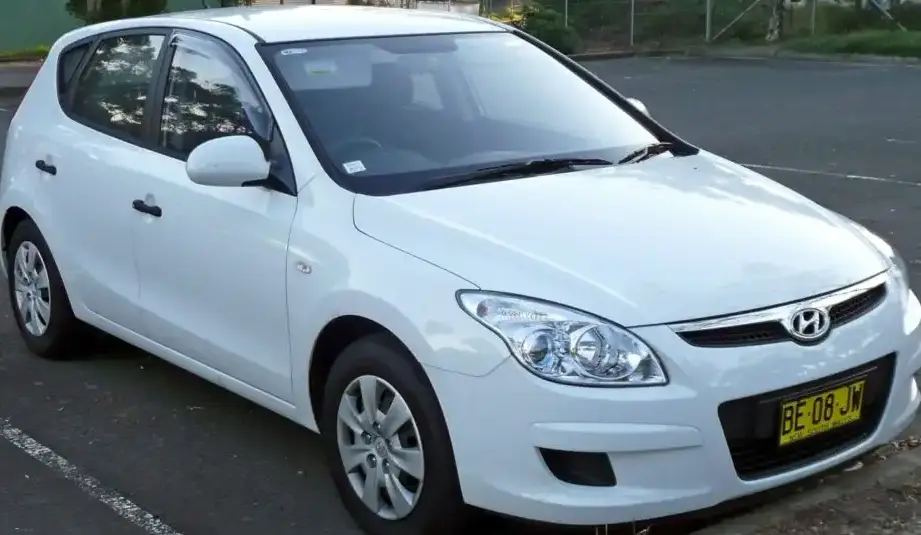
The Hyundai i30 II (facelift, produced from 2015 to 2017) 1.6 T-GDI, generating 186 horsepower, represented a significant step forward for Hyundai’s compact hatchback offering in the European market and beyond. Positioned as a mid-range to upper-mid-range trim level within the i30 II lineup, it aimed to attract buyers seeking a blend of performance, fuel efficiency, and modern features. This variant was a key component of Hyundai’s strategy to challenge established European rivals like the Volkswagen Golf, Ford Focus, and Opel Astra. The facelift brought styling updates and, crucially, the introduction of Hyundai’s new turbocharged gasoline direct injection (T-GDI) engines, enhancing the i30’s appeal.
Technical Specifications
| Brand | Hyundai |
| Model | i30 |
| Generation | i30 II (facelift 2015) |
| Type (Engine) | 1.6 T-GDI (186 Hp) |
| Start of production | 2015 |
| End of production | 2017 |
| Powertrain Architecture | Internal Combustion engine |
| Body type | Hatchback |
| Seats | 5 |
| Doors | 5 |
| Fuel consumption (urban) | 9.6 l/100 km (24.5 US mpg) |
| Fuel consumption (extra urban) | 6 l/100 km (39.2 US mpg) |
| Fuel consumption (combined) | 7.3 l/100 km (32.2 US mpg) |
| CO2 emissions | 169 g/km |
| Fuel Type | Petrol (Gasoline) |
| Acceleration 0 – 100 km/h | 8 sec |
| Acceleration 0 – 62 mph | 8 sec |
| Acceleration 0 – 60 mph | 7.6 sec |
| Maximum speed | 219 km/h (136.08 mph) |
| Emission standard | Euro 6 |
| Weight-to-power ratio | 6.9 kg/Hp |
| Weight-to-torque ratio | 4.9 kg/Nm |
| Power | 186 Hp @ 5500 rpm |
| Torque | 265 Nm @ 1500-4500 rpm (195.45 lb.-ft.) |
| Engine layout | Front, Transverse |
| Engine Model/Code | Gamma II / G4FJ |
| Engine displacement | 1591 cm3 (97.09 cu. in.) |
| Number of cylinders | 4 |
| Engine configuration | Inline |
| Cylinder Bore | 77 mm (3.03 in.) |
| Piston Stroke | 85.44 mm (3.36 in.) |
| Compression ratio | 9.5:1 |
| Number of valves per cylinder | 4 |
| Fuel injection system | Direct injection |
| Engine aspiration | Turbocharger, Intercooler |
| Valvetrain | DOHC |
| Engine oil capacity | 4.5 l (4.76 US qt | 3.96 UK qt) |
| Coolant | 6.4 l (6.76 US qt | 5.63 UK qt) |
| Kerb Weight | 1292-1394 kg (2848.37 – 3073.24 lbs.) |
| Max. weight | 1920 kg (4232.88 lbs.) |
| Max load | 526-628 kg (1159.63 – 1384.5 lbs.) |
| Trunk (boot) space – minimum | 378 l (13.35 cu. ft.) |
| Trunk (boot) space – maximum | 1316 l (46.47 cu. ft.) |
| Fuel tank capacity | 53 l (14 US gal | 11.66 UK gal) |
| Max. roof load | 80 kg (176.37 lbs.) |
| Permitted trailer load with brakes (12%) | 1400 kg (3086.47 lbs.) |
| Permitted trailer load without brakes | 600 kg (1322.77 lbs.) |
| Permitted towbar download | 60 kg (132.28 lbs.) |
| Length | 4300 mm (169.29 in.) |
| Width | 1780 mm (70.08 in.) |
| Height | 1470 mm (57.87 in.) |
| Wheelbase | 2650 mm (104.33 in.) |
| Front track | 1553 mm (61.14 in.) |
| Rear (Back) track | 1545 mm (60.83 in.) |
| Front overhang | 880 mm (34.65 in.) |
| Rear overhang | 770 mm (30.31 in.) |
| Ride height (ground clearance) | 140 mm (5.51 in.) |
| Minimum turning circle (turning diameter) | 10.6 m (34.78 ft.) |
| Drivetrain Architecture | Front wheel drive |
| Drive wheel | Front wheel drive |
| Number of gears and type of gearbox | 6 gears, manual transmission |
| Front suspension | Independent, type McPherson with coil spring and anti-roll bar |
| Rear suspension | Independent multi-link suspension |
| Front brakes | Ventilated discs |
| Rear brakes | Disc |
| Assisting systems | ABS (Anti-lock braking system) |
| Steering type | Steering rack and pinion |
| Power steering | Electric Steering |
| Tires size | 225/40 R18 |
| Wheel rims size | 7.5J x 18 |
Powertrain & Engine Architecture
The heart of the i30 1.6 T-GDI is the Gamma II engine, specifically the G4FJ code. This 1.6-liter inline-four cylinder engine utilizes direct fuel injection (DFI) and a single scroll turbocharger with an intercooler. The DFI system allows for precise fuel delivery, improving combustion efficiency and power output. The turbocharger boosts power by forcing more air into the engine, overcoming the limitations of its displacement. The engine produces 186 horsepower at 5500 rpm and 265 Nm (195 lb-ft) of torque between 1500 and 4500 rpm. This broad torque curve provides good responsiveness across a wide range of engine speeds. The engine features a dual continuously variable valve timing (CVVT) system, optimizing valve timing for improved performance and fuel economy. The engine was paired with a six-speed manual transmission as standard, delivering power to the front wheels.
Driving Characteristics
The 1.6 T-GDI i30 offered a noticeable step up in performance compared to lower-powered engine options in the range, such as the 1.4-liter naturally aspirated engine. Acceleration from 0 to 60 mph took approximately 7.6 seconds, and the car felt lively and responsive in everyday driving situations. The turbocharger provided a noticeable boost in power during acceleration, making overtaking maneuvers easier. While not a dedicated performance model, the 1.6 T-GDI offered a satisfying driving experience for those seeking a more engaging and dynamic hatchback. The six-speed manual transmission provided precise gear changes, allowing drivers to make the most of the engine’s power band. Compared to the diesel variants, the T-GDI offered quicker acceleration but typically consumed more fuel in urban driving.
Equipment & Trim Levels
The 1.6 T-GDI trim typically included features such as alloy wheels, air conditioning, a touchscreen infotainment system with Bluetooth connectivity, and electric windows. Higher trim levels added features like a reversing camera, parking sensors, automatic climate control, and upgraded interior upholstery. Optional extras included a panoramic sunroof, leather seats, and a premium sound system. The interior design was modern and functional, with a focus on ergonomics and user-friendliness. The i30 aimed to provide a comfortable and well-equipped cabin for both driver and passengers.
Chassis & Braking
The i30 II utilized a McPherson strut front suspension and a multi-link rear suspension, providing a good balance between ride comfort and handling. The suspension was tuned to offer a compliant ride on most road surfaces, while still providing adequate body control during cornering. The braking system consisted of ventilated front discs and solid rear discs, providing sufficient stopping power for everyday driving. Anti-lock Braking System (ABS) was standard, enhancing safety and stability during emergency braking situations.
Market Reception & Comparison
The Hyundai i30 1.6 T-GDI was generally well-received by automotive critics. It was praised for its responsive engine, comfortable ride, and well-equipped interior. However, some reviewers noted that the engine could be a little noisy under hard acceleration. Compared to rivals like the Volkswagen Golf, the i30 offered a more affordable price point and a longer warranty. Fuel economy was competitive, averaging around 32.2 US mpg in combined driving. Reliability was generally good, although some owners reported minor issues with the infotainment system.
Legacy
The 1.6 T-GDI engine proved to be a reliable and durable powertrain when properly maintained. The Gamma II engine family has been used in various Hyundai and Kia models, demonstrating its versatility and longevity. In the used car market, the i30 1.6 T-GDI remains a popular choice for buyers seeking a well-rounded and affordable compact hatchback. Its combination of performance, fuel efficiency, and features makes it a compelling alternative to more established European rivals. Regular maintenance, including oil changes and timing belt replacements (where applicable), is crucial to ensure the long-term reliability of this powertrain.