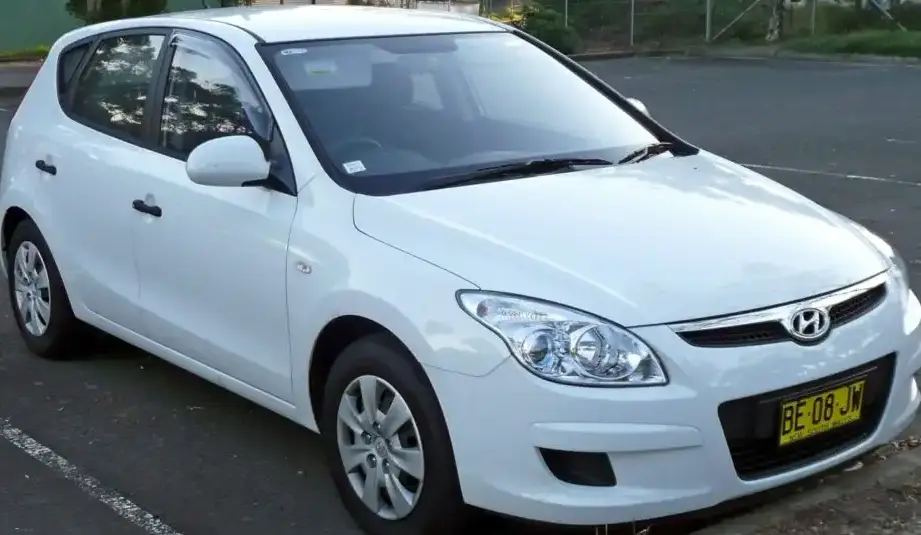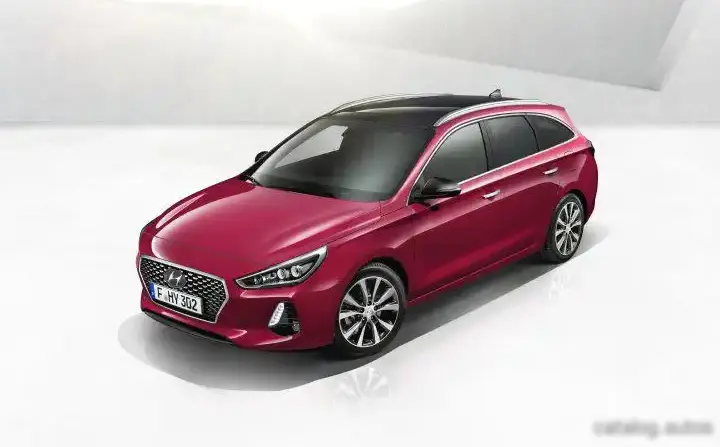
The Hyundai i30 III CW 1.0 T-GDI, produced from 2017 to 2019, represents an entry point into the third generation of Hyundai’s popular compact family car, the i30. Specifically, the “CW” designation denotes the station wagon (estate) body style. This variant was positioned as a fuel-efficient and practical option within the i30 lineup, appealing to buyers prioritizing economy and space over outright performance. It utilized Hyundai’s Kappa II 1.0-liter turbocharged gasoline engine, paired with a six-speed manual transmission, and was primarily sold in European markets where the station wagon body style remains highly favored. This model played a role in Hyundai’s continued efforts to establish itself as a mainstream competitor in the European C-segment.
Technical Specifications
| Brand | Hyundai |
| Model | i30 |
| Generation | i30 III CW |
| Type (Engine) | 1.0 T-GDI (120 Hp) |
| Start of production | 2017 |
| End of production | 2019 |
| Powertrain Architecture | Internal Combustion engine |
| Body type | Station wagon (estate) |
| Seats | 5 |
| Doors | 5 |
| Fuel consumption (urban) | 5.9-6.0 l/100 km (39.9 – 39.2 US mpg) |
| Fuel consumption (extra urban) | 4.4-4.6 l/100 km (53.5 – 51.1 US mpg) |
| Fuel consumption (combined) | 4.9-5.2 l/100 km (48 – 45.2 US mpg) |
| CO2 emissions | 115-120 g/km |
| Fuel Type | Petrol (Gasoline) |
| Acceleration 0 – 100 km/h | 11.4 sec |
| Acceleration 0 – 62 mph | 11.4 sec |
| Acceleration 0 – 60 mph | 10.8 sec |
| Maximum speed | 188 km/h (116.82 mph) |
| Emission standard | Euro 6b |
| Weight-to-power ratio | 10.4 kg/Hp |
| Weight-to-torque ratio | 7.3 kg/Nm |
| Power | 120 Hp @ 6000 rpm |
| Torque | 171 Nm @ 1500-4000 rpm (126.12 lb.-ft. @ 1500-4000 rpm) |
| Engine layout | Front, Transverse |
| Engine Model/Code | Kappa II / G3LC |
| Engine displacement | 998 cm3 (60.9 cu. in.) |
| Number of cylinders | 3 |
| Engine configuration | Inline |
| Cylinder Bore | 71 mm (2.8 in.) |
| Piston Stroke | 84 mm (3.31 in.) |
| Compression ratio | 10:1 |
| Number of valves per cylinder | 4 |
| Fuel injection system | Direct injection |
| Engine aspiration | Turbocharger, Intercooler |
| Engine oil capacity | 3.6 l (3.8 US qt | 3.17 UK qt) |
| Coolant | 6 l (6.34 US qt | 5.28 UK qt) |
| Kerb Weight | 1245-1483 kg (2744.76 – 3269.46 lbs.) |
| Max. weight | 1840 kg (4056.51 lbs.) |
| Max load | 357-595 kg (787.05 – 1311.75 lbs.) |
| Trunk (boot) space – minimum | 602 l (21.26 cu. ft.) |
| Trunk (boot) space – maximum | 1650 l (58.27 cu. ft.) |
| Fuel tank capacity | 50 l (13.21 US gal | 11 UK gal) |
| Max. roof load | 80 kg (176.37 lbs.) |
| Permitted trailer load with brakes (12%) | 1200 kg (2645.55 lbs.) |
| Permitted towbar download | 80 kg (176.37 lbs.) |
| Length | 4585 mm (180.51 in.) |
| Width | 1795 mm (70.67 in.) |
| Height | 1465-1475 mm (57.68 – 58.07 in.) |
| Wheelbase | 2650 mm (104.33 in.) |
| Front track | 1573-1559 mm (61.93 – 61.38 in.) |
| Rear (Back) track | 1581-1567 mm (62.24 – 61.69 in.) |
| Front overhang | 905 mm (35.63 in.) |
| Rear overhang | 1030 mm (40.55 in.) |
| Ride height (ground clearance) | 140 mm (5.51 in.) |
| Drivetrain Architecture | Front wheel drive |
| Number of gears and type of gearbox | 6 gears, manual transmission |
| Front suspension | Independent type McPherson |
| Rear suspension | Independent multi-link suspension |
| Front brakes | Ventilated discs |
| Rear brakes | Disc |
| Assisting systems | ABS (Anti-lock braking system) |
| Steering type | Steering rack and pinion |
| Power steering | Electric Steering |
| Tires size | 195/65 R15; 205/55 R16; 225/45 R17 |
| Wheel rims size | 6.0J x 15; 6.5J x 16; 7.0J x 17 |
Powertrain & Engine Architecture
The heart of the i30 CW 1.0 T-GDI is Hyundai’s Kappa II engine, specifically the G3LC code. This is a 998cc, three-cylinder turbocharged gasoline engine. The engine utilizes direct fuel injection, a technology that improves fuel efficiency and reduces emissions by injecting fuel directly into the combustion chamber. A single scroll turbocharger with an intercooler is employed to boost power output. The engine features a timing chain, contributing to reduced maintenance compared to timing belts. The six-speed manual transmission was the standard offering, providing a balance between fuel economy and driver engagement. The engine’s relatively small displacement and turbocharging contribute to a surprisingly responsive power delivery, despite its modest horsepower figure.
Driving Characteristics
The 120 hp output, coupled with 171 Nm of torque, provides adequate performance for everyday driving. Acceleration from 0-60 mph takes around 10.8 seconds, and top speed is rated at 188 km/h (116.82 mph). While not a sporty performer, the turbocharger provides a noticeable boost in power at lower RPMs, making it suitable for overtaking and merging onto highways. Compared to higher-output versions of the i30, such as those with the 1.4 T-GDI engine, this variant feels less eager to rev and offers a more relaxed driving experience. The manual transmission offers precise shifts, but the gear ratios are tuned for fuel efficiency rather than outright acceleration. The relatively light weight of the engine contributes to good front-end balance.
Equipment & Trim Levels
The i30 CW 1.0 T-GDI typically came with a reasonable level of standard equipment. This included air conditioning, a touchscreen infotainment system with Bluetooth connectivity, power windows, and central locking. Safety features such as ABS, ESC (Electronic Stability Control), and multiple airbags were also standard. Higher trim levels offered features like alloy wheels, a rear parking sensor, cruise control, and a more advanced infotainment system with navigation. Interior upholstery was typically cloth, with options for upgraded materials on higher trims. The dashboard layout was functional and user-friendly, with a focus on ergonomics.
Chassis & Braking
The i30 CW utilizes a front-wheel-drive layout with an independent McPherson strut suspension at the front and an independent multi-link suspension at the rear. This suspension setup provides a comfortable ride quality while maintaining reasonable handling characteristics. The front brakes are ventilated discs, while the rear brakes are solid discs. The steering is electrically assisted, providing light and precise steering feel. The car’s weight, ranging from 1245 to 1483 kg depending on equipment, is relatively low for a station wagon, contributing to its agility.
Market Reception & Comparison
The i30 CW 1.0 T-GDI was generally well-received by automotive critics as a practical and fuel-efficient option. It was praised for its spacious interior, comfortable ride, and reasonable price point. However, some critics noted that the engine could feel strained when fully loaded or driving uphill. Compared to diesel-powered i30 variants, the 1.0 T-GDI offered lower CO2 emissions but slightly less torque. Against competitors like the Volkswagen Golf Estate and Ford Focus Estate, the i30 CW offered a compelling value proposition with a generous warranty and a well-equipped interior.
Legacy
The Kappa II 1.0 T-GDI engine has proven to be a relatively reliable powertrain, with few widespread issues reported. The engine’s direct injection system requires regular maintenance to prevent carbon buildup, but overall, it is considered a durable and efficient unit. In the used car market, the i30 CW 1.0 T-GDI remains a popular choice for buyers seeking a practical and economical station wagon. Its fuel efficiency, spacious interior, and reasonable running costs make it an attractive option for families and individuals alike. The availability of spare parts and a strong dealer network further contribute to its appeal.