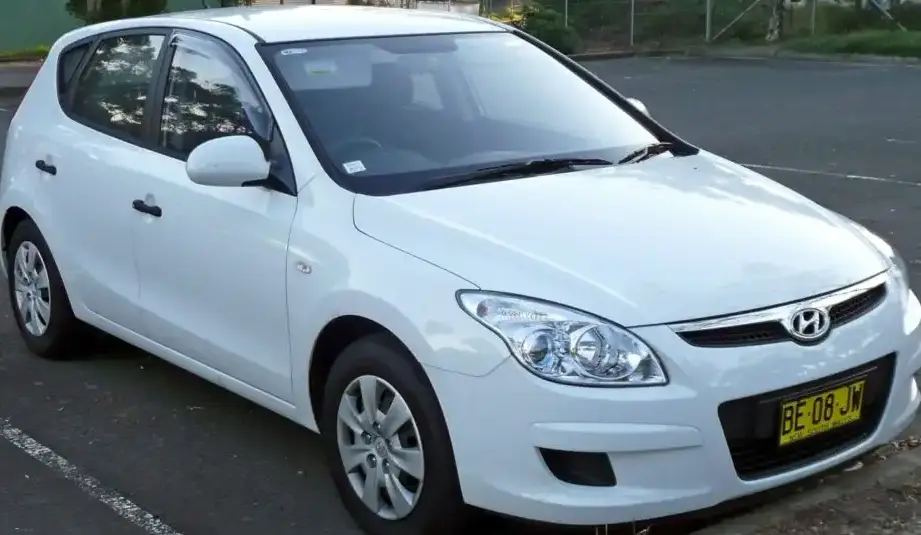
The Hyundai i30 III CW (facelift 2020) 1.0 T-GDi 120 hp Mild Hybrid DCT represents a significant iteration within the third generation of Hyundai’s globally successful i30 compact family. Introduced in May 2020 and continuing through June 2024, this variant specifically caters to the European market’s demand for fuel-efficient and practical station wagons (estate bodies). Positioned as an entry-to-mid-range offering, it combined a downsized turbocharged engine with mild hybrid technology and a dual-clutch transmission to deliver a balance of performance, economy, and affordability. The “CW” designation denotes the wagon body style, distinguishing it from the five-door hatchback version of the i30 III.
Technical Specifications
| Brand | Hyundai |
| Model | i30 |
| Generation | i30 III CW (facelift 2020) |
| Type (Engine) | 1.0 T-GDi (120 Hp) Mild Hybrid DCT |
| Start of production | May, 2020 |
| End of production | June, 2024 |
| Powertrain Architecture | MHEV (Mild Hybrid Electric Vehicle) |
| Body type | Station wagon (estate) |
| Seats | 5 |
| Doors | 5 |
| Fuel Type | Petrol (Gasoline) |
| Acceleration 0 – 100 km/h | 11.2 sec |
| Acceleration 0 – 62 mph | 11.2 sec |
| Acceleration 0 – 60 mph | 10.6 sec |
| Maximum speed | 196 km/h (121.79 mph) |
| Emission standard | EURO 6d |
| Weight-to-power ratio | 10.6 kg/Hp |
| Weight-to-torque ratio | 7.4 kg/Nm |
| Power | 120 Hp @ 6000 rpm |
| Power per litre | 120.2 Hp/l |
| Torque | 172 Nm @ 1500-4000 rpm (126.86 lb.-ft. @ 1500-4000 rpm) |
| Engine layout | Front, Transverse |
| Engine Model/Code | Kappa II / G3LC |
| Engine displacement | 998 cm3 (60.9 cu. in.) |
| Number of cylinders | 3 |
| Engine configuration | Inline |
| Number of valves per cylinder | 4 |
| Fuel injection system | Direct injection |
| Engine aspiration | Turbocharger, Intercooler |
| Engine oil capacity | 3.6 l (3.8 US qt | 3.17 UK qt) |
| Coolant capacity | 6 l (6.34 US qt | 5.28 UK qt) |
| Kerb Weight | 1271 kg (2802.08 lbs.) |
| Max. weight | 1870 kg (4122.64 lbs.) |
| Max load | 599 kg (1320.57 lbs.) |
| Trunk (boot) space – minimum | 602 l (21.26 cu. ft.) |
| Trunk (boot) space – maximum | 1650 l (58.27 cu. ft.) |
| Max. roof load | 80 kg (176.37 lbs.) |
| Permitted trailer load with brakes (12%) | 700 kg (1543.24 lbs.) |
| Permitted trailer load without brakes | 300 kg (661.39 lbs.) |
| Length | 4585 mm (180.51 in.) |
| Width | 1795 mm (70.67 in.) |
| Height | 1465-1475 mm (57.68 – 58.07 in.) |
| Wheelbase | 2650 mm (104.33 in.) |
| Drive wheel | Front wheel drive |
| Number of gears and type of gearbox | 7 gears, automatic transmission DCT |
| Front suspension | Independent, type McPherson with coil spring and anti-roll bar |
| Rear suspension | Independent multi-link suspension |
| Assisting systems | ABS (Anti-lock braking system) |
| Steering type | Steering rack and pinion |
Powertrain & Engine Architecture
At the heart of the i30 CW 1.0 T-GDi Mild Hybrid lies the Hyundai-Kia Kappa II engine family, specifically the G3LC three-cylinder unit. This 998cc engine utilizes a single-scroll turbocharger with an intercooler to boost power and efficiency. Direct fuel injection is employed for precise fuel delivery and optimized combustion. The engine produces 120 horsepower at 6000 rpm and 172 Nm (126.86 lb-ft) of torque between 1500 and 4000 rpm. The “Mild Hybrid” aspect comes from a 48V integrated starter generator (ISG) which assists the engine during acceleration and allows for extended engine-off coasting, improving fuel economy. The ISG also enables a smoother and quieter start-stop system. The engine is paired with a 7-speed dual-clutch transmission (DCT), offering quick and seamless gear changes. This DCT is a crucial component in maximizing the engine’s efficiency and providing a responsive driving experience.
Driving Characteristics
The 1.0 T-GDi engine, while offering respectable performance for its size, is not designed for outright speed. The 0-60 mph time of around 10.6 seconds reflects this. However, the turbocharger provides a noticeable boost in mid-range power, making it suitable for everyday driving and highway cruising. The DCT transmission contributes to a smooth and efficient power delivery, although some drivers may find it slightly less engaging than a traditional manual gearbox. Compared to the more powerful 1.6L gasoline or diesel variants of the i30, this version prioritizes fuel economy over outright performance. The mild hybrid system helps to mitigate turbo lag and provides a small but noticeable improvement in responsiveness. The gear ratios are tuned for fuel efficiency, meaning the engine doesn’t rev as high as some performance-oriented models.
Equipment & Trim Levels
The i30 CW 1.0 T-GDi Mild Hybrid DCT typically came equipped with a solid base level of features. Standard equipment often included air conditioning, a touchscreen infotainment system with Apple CarPlay and Android Auto compatibility, Bluetooth connectivity, and a suite of safety features such as lane keeping assist, forward collision avoidance assist, and automatic emergency braking. Interior upholstery was typically cloth, with options for upgraded materials available. Higher trim levels added features like heated seats, a larger touchscreen display, a premium sound system, and parking sensors. Optional extras included a panoramic sunroof, leather upholstery, and advanced driver-assistance systems.
Chassis & Braking
The i30 CW utilizes a McPherson strut front suspension and a multi-link rear suspension, providing a comfortable and controlled ride. Stabilizer bars are fitted to both axles to reduce body roll during cornering. Braking systems varied depending on the specific trim level, but typically included disc brakes on the front wheels and either disc or drum brakes on the rear. The steering is a rack and pinion system, offering precise and responsive handling. The suspension tuning is geared towards comfort and practicality, rather than sporty handling, making it well-suited for everyday driving conditions.
Market Reception & Comparison
The i30 CW 1.0 T-GDi Mild Hybrid DCT was generally well-received by automotive critics for its fuel efficiency and practicality. It offered a compelling alternative to other compact station wagons in the European market, such as the Volkswagen Golf Estate and the Skoda Octavia Combi. Compared to the diesel-powered i30 variants, the 1.0 T-GDi offered lower emissions and a quieter driving experience, although it lacked the diesel’s low-end torque. Fuel economy figures were competitive, typically ranging from 45 to 55 mpg (depending on driving conditions). Reliability reports have been generally positive, with few major issues reported with the powertrain.
Legacy
The Hyundai i30 CW 1.0 T-GDi Mild Hybrid DCT represents a key step in Hyundai’s push towards electrification and fuel efficiency. The Kappa engine family, while not without its critics, proved to be a reliable and versatile powerplant. The combination of a downsized turbocharged engine, mild hybrid technology, and a DCT transmission demonstrated Hyundai’s commitment to innovation. On the used car market, these models are generally sought after for their fuel economy and practicality. The 48V mild hybrid system, while not a full hybrid, provides a tangible benefit in terms of fuel savings and reduced emissions, making it an attractive option for environmentally conscious buyers. The powertrain has proven to be relatively durable, with proper maintenance, ensuring a long service life for many vehicles.