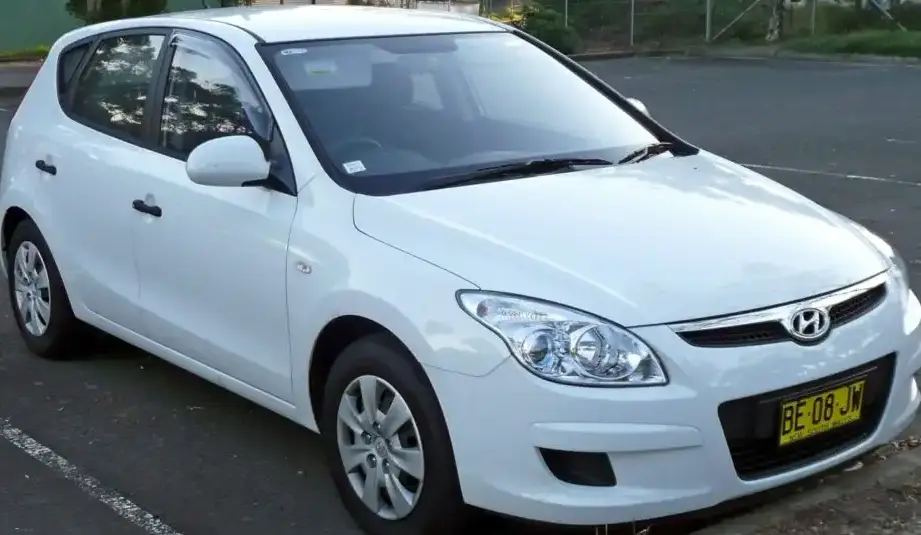
The Hyundai i30 III CW (facelift 2020) 1.6 CRDi (136 hp) Mild Hybrid DCT represents a significant iteration within the third generation of Hyundai’s globally successful i30 compact family. Introduced in September 2020 and remaining in production until January 2022, this variant combined a diesel engine with mild hybrid technology and a dual-clutch transmission, specifically tailored for the European market where fuel efficiency and practicality are highly valued. Positioned as a mid-range offering within the i30 CW (Combined Wagon) lineup, it aimed to bridge the gap between more affordable base models and the higher-performance trims. This model is built on the PD platform, shared with the Kia Ceed and other Hyundai models.
Technical Specifications
| Brand | Hyundai |
| Model | i30 |
| Generation | i30 III CW (facelift 2020) |
| Type (Engine) | 1.6 CRDi (136 Hp) Mild Hybrid DCT |
| Start of production | September, 2020 |
| End of production | January, 2022 |
| Powertrain Architecture | MHEV (Mild Hybrid Electric Vehicle) |
| Body type | Station wagon (estate) |
| Seats | 5 |
| Doors | 5 |
| Fuel Type | Diesel |
| Acceleration 0 – 100 km/h | 9.9 sec |
| Acceleration 0 – 62 mph | 9.9 sec |
| Acceleration 0 – 60 mph | 9.4 sec |
| Maximum speed | 200 km/h (124.27 mph) |
| Emission standard | EURO 6d TEMP |
| Weight-to-power ratio | 10.1 kg/Hp |
| Weight-to-torque ratio | 4.3 kg/Nm |
| Power | 136 Hp @ 4000 rpm |
| Power per litre | 85.1 Hp/l |
| Torque | 320 Nm @ 2000-2250 rpm (236.02 lb.-ft.) |
| Engine layout | Front, Transverse |
| Engine Model/Code | D4FE |
| Engine displacement | 1598 cm3 (97.52 cu. in.) |
| Number of cylinders | 4 |
| Engine configuration | Inline |
| Number of valves per cylinder | 4 |
| Fuel injection system | Diesel Commonrail |
| Engine aspiration | Turbocharger, Intercooler |
| Engine oil capacity | 4.4 l (4.65 US qt | 3.87 UK qt) |
| Coolant capacity | 6.2 l (6.55 US qt | 5.46 UK qt) |
| Kerb Weight | 1370 kg (3020.33 lbs) |
| Max. weight | 1950 kg (4299.01 lbs) |
| Max load | 580 kg (1278.68 lbs) |
| Trunk (boot) space – minimum | 602 l (21.26 cu. ft.) |
| Trunk (boot) space – maximum | 1650 l (58.27 cu. ft.) |
| Max. roof load | 80 kg (176.37 lbs) |
| Permitted trailer load with brakes (12%) | 1500 kg (3306.93 lbs) |
| Permitted trailer load without brakes | 650 kg (1433 lbs) |
| Length | 4585 mm (180.51 in) |
| Width | 1795 mm (70.67 in) |
| Height | 1465-1475 mm (57.68 – 58.07 in) |
| Wheelbase | 2650 mm (104.33 in) |
| Drivetrain Architecture | Front wheel drive, MHEV |
| Number of gears | 7 |
| Gearbox type | Automatic transmission DCT |
| Front suspension | Independent, McPherson with coil spring and anti-roll bar |
| Rear suspension | Independent multi-link suspension |
| Assisting systems | ABS (Anti-lock braking system) |
| Steering type | Steering rack and pinion |
Powertrain & Engine Architecture
At the heart of the i30 CW 1.6 CRDi Mild Hybrid lies the D4FE engine, a 1.6-liter inline-four cylinder diesel. This engine utilizes a second-generation common-rail direct injection system, delivering fuel at extremely high pressures for optimized combustion. A turbocharger with an intercooler further enhances performance, boosting power and torque output. The engine’s mild hybrid system incorporates a 48V starter-generator, which assists the engine during acceleration and allows for regenerative braking, capturing energy normally lost during deceleration to recharge the battery. This system doesn’t provide full electric drive capability but improves fuel economy and reduces emissions. The seven-speed dual-clutch transmission (DCT) provides quick and smooth gear changes, contributing to a more engaging driving experience compared to a traditional automatic.
Driving Characteristics
The 136 hp output and 320 Nm (236 lb-ft) of torque provide adequate performance for everyday driving. Acceleration from 0-60 mph takes approximately 9.4 seconds, and the car feels responsive in most situations. However, compared to higher-output i30 variants like the 1.6 T-GDi gasoline engine, the diesel feels less eager to rev. The DCT transmission is well-programmed, offering both automatic and manual shifting modes. The gear ratios are tuned for fuel efficiency, meaning the engine doesn’t always feel as powerful as the numbers suggest, particularly when fully loaded. The mild hybrid system provides a subtle boost during acceleration, but its primary benefit is improved fuel economy.
Equipment & Trim Levels
The 1.6 CRDi Mild Hybrid DCT trim typically included a generous level of standard equipment. This generally encompassed features such as air conditioning, a touchscreen infotainment system with Apple CarPlay and Android Auto compatibility, Bluetooth connectivity, and a suite of safety systems including lane keeping assist, forward collision avoidance assist, and automatic emergency braking. Interior upholstery was typically cloth, with options for leather upgrades. Higher trim levels offered additional features like heated seats, a panoramic sunroof, and a premium audio system. The i30 CW aimed for a balance of practicality and comfort, offering a well-equipped interior without the premium price tag of luxury competitors.
Chassis & Braking
The i30 CW utilizes a McPherson strut front suspension and a multi-link rear suspension, providing a comfortable and controlled ride. The suspension is tuned to prioritize comfort over outright sportiness, making it well-suited for long journeys. Braking duties are handled by disc brakes on all four wheels, with ABS (Anti-lock Braking System) and Electronic Stability Control (ESC) as standard features. The weight distribution is relatively balanced, contributing to predictable handling. The steering is light and precise, making it easy to maneuver in urban environments.
Market Reception & Comparison
The Hyundai i30 CW 1.6 CRDi Mild Hybrid DCT was generally well-received by automotive critics. It was praised for its fuel efficiency, comfortable ride, and generous equipment levels. However, some reviewers noted that the diesel engine could be somewhat noisy and that the performance wasn’t as exhilarating as some of its gasoline-powered rivals. Compared to the 1.6 T-GDi gasoline version, the diesel offered significantly better fuel economy but less outright power. Against competitors like the Volkswagen Golf Estate, Ford Focus Estate, and Skoda Octavia Combi, the i30 CW offered a compelling value proposition, often undercutting its rivals on price while offering a similar level of features and practicality.
Legacy
The D4FE engine, while not without its complexities, has proven to be a relatively reliable unit when properly maintained. The mild hybrid system adds a layer of complexity, but early reports suggest it has also been durable. In the used car market, the i30 CW 1.6 CRDi Mild Hybrid DCT represents a sensible and economical choice. Its fuel efficiency and practicality make it a good option for those seeking a versatile family vehicle. However, potential buyers should be aware of the potential maintenance costs associated with the diesel particulate filter (DPF) and the dual-clutch transmission, ensuring regular servicing is carried out to maintain optimal performance and longevity.