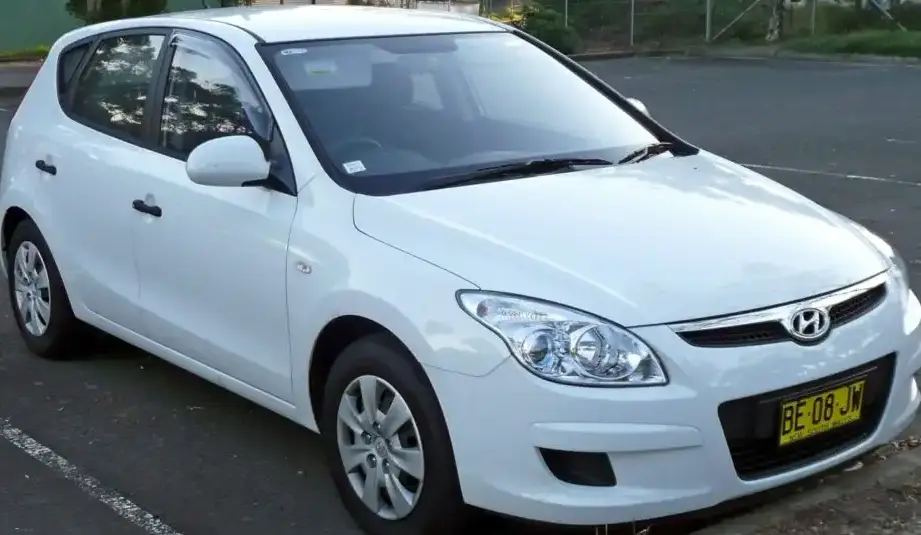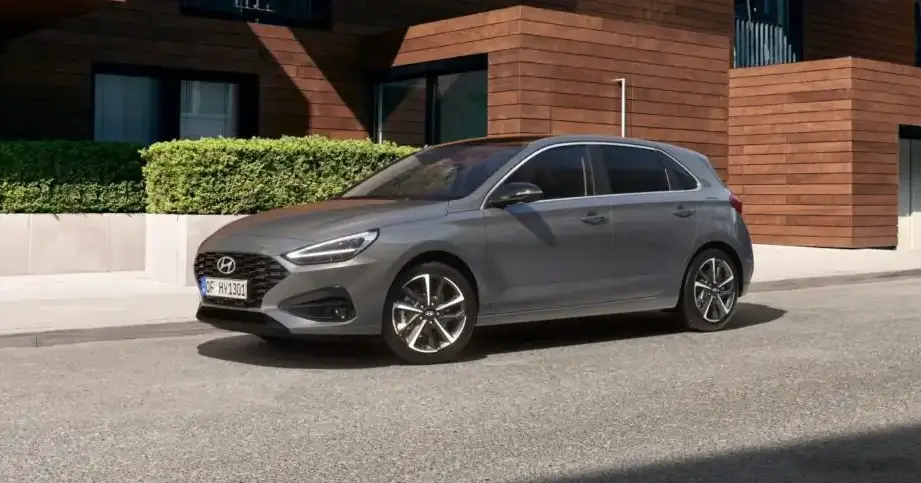
The Hyundai i30 III (facelift, introduced in June 2024) 1.5 T-GDI 140 hp Mild Hybrid DCT represents a key offering within Hyundai’s popular C-segment hatchback lineup. Positioned as a mid-range trim, it balances fuel efficiency with respectable performance, appealing to buyers seeking a practical and modern daily driver. This variant builds upon the foundation of the PD generation i30, incorporating Hyundai’s Smartstream engine technology and a 48V mild-hybrid system to enhance fuel economy and reduce emissions. The facelift brought styling updates and revised technology features, solidifying the i30’s position in a competitive market segment.
Technical Specifications
| Brand | Hyundai |
| Model | i30 |
| Generation | i30 III (facelift 2024) |
| Type (Engine) | 1.5 T-GDI (140 Hp) Mild Hybrid DCT |
| Start of production | June, 2024 |
| Powertrain Architecture | MHEV (Mild Hybrid Electric Vehicle) |
| Body type | Hatchback |
| Seats | 5 |
| Doors | 5 |
| Combined fuel consumption (WLTP) | 5.8-6.4 l/100 km (40.6 – 36.8 US mpg, 48.7 – 44.1 UK mpg, 17.2 – 15.6 km/l) |
| CO2 emissions (WLTP) | 131-145 g/km |
| Fuel Type | Petrol (Gasoline) |
| Acceleration 0 – 100 km/h | 9.7 sec |
| Acceleration 0 – 62 mph | 9.7 sec |
| Acceleration 0 – 60 mph | 9.2 sec |
| Maximum speed | 197 km/h (122.41 mph) |
| Emission standard | Euro 6e |
| Weight-to-power ratio | 9.4 kg/Hp, 106.7 Hp/tonne |
| Weight-to-torque ratio | 5.2 kg/Nm, 192.8 Nm/tonne |
| Battery voltage | 48 V |
| Power | 140 Hp @ 5500 rpm |
| Power per litre | 94.5 Hp/l |
| Torque | 253 Nm @ 1500-3000 rpm (186.6 lb.-ft. @ 1500-3000 rpm) |
| Engine layout | Front, Transverse |
| Engine Model/Code | G4LK |
| Engine displacement | 1482 cm3 (90.44 cu. in.) |
| Number of cylinders | 4 |
| Engine configuration | Inline |
| Cylinder Bore | 71.5 mm (2.81 in.) |
| Piston Stroke | 92 mm (3.62 in.) |
| Number of valves per cylinder | 4 |
| Fuel injection system | Direct injection |
| Engine aspiration | Turbocharger, Intercooler |
| Engine oil capacity | 4.2 l (4.44 US qt | 3.7 UK qt) |
| Coolant | 6.6 l (6.97 US qt | 5.81 UK qt) |
| Kerb Weight | 1312-1445 kg (2892.46 – 3185.68 lbs.) |
| Max. weight | 1870 kg (4122.64 lbs.) |
| Max load | 425-558 kg (936.96 – 1230.18 lbs.) |
| Trunk (boot) space – minimum | 395 l (13.95 cu. ft.) |
| Trunk (boot) space – maximum | 1301 l (45.94 cu. ft.) |
| Fuel tank capacity | 50 l (13.21 US gal | 11 UK gal) |
| Max. roof load | 80 kg (176.37 lbs.) |
| Permitted trailer load with brakes (12%) | 1210 kg (2667.59 lbs.) |
| Permitted trailer load without brakes | 610 kg (1344.82 lbs.) |
| Permitted towbar download | 80 kg (176.37 lbs.) |
| Length | 4340 mm (170.87 in.) |
| Width | 1795 mm (70.67 in.) |
| Height | 1455 mm (57.28 in.) |
| Wheelbase | 2650 mm (104.33 in.) |
| Front track | 1555-1559 mm (61.22 – 61.38 in.) |
| Rear (Back) track | 1563-1567 mm (61.54 – 61.69 in.) |
| Front overhang | 905 mm (35.63 in.) |
| Rear overhang | 785 mm (30.91 in.) |
| Ride height (ground clearance) | 140 mm (5.51 in.) |
| Drivetrain Architecture | ICE and electric motor drive front wheels, mixed mode operation |
| Drive wheel | Front wheel drive |
| Number of gears and type of gearbox | 7 gears, automatic transmission DCT |
| Front suspension | Independent type McPherson |
| Rear suspension | Independent multi-link suspension |
| Front brakes | Disc |
| Rear brakes | Disc |
| Assisting systems | ABS (Anti-lock braking system) |
| Steering type | Steering rack and pinion |
| Power steering | Electric Steering |
| Tires size | 225/45 R17; 225/40 R18 |
| Wheel rims size | 7.0J x 17; 7.5J x 18 |
Powertrain & Engine Architecture
At the heart of the i30 1.5 T-GDI Mild Hybrid is Hyundai’s G4LK engine, a 1.482-liter turbocharged inline-four cylinder. This engine utilizes direct injection and a twin-scroll turbocharger to deliver a balance of power and efficiency. The ‘Smartstream’ designation indicates Hyundai’s latest engine technology, focusing on thermal efficiency and reduced friction. The mild-hybrid system incorporates a 48V lithium-ion battery and a belt-driven starter generator (BSG). The BSG allows for extended stop/start operation, regenerative braking to recapture energy, and a small power boost during acceleration. The engine produces 140 horsepower at 5,500 rpm and 253 Nm (186.6 lb-ft) of torque between 1,500 and 3,000 rpm. This power is delivered to the front wheels through a 7-speed dual-clutch transmission (DCT). The DCT provides quick and smooth gear changes, contributing to both performance and fuel economy.
Driving Characteristics
The 1.5 T-GDI with the 7-speed DCT offers a refined driving experience. Acceleration from 0 to 60 mph takes approximately 9.2 seconds, and the car reaches a top speed of 197 km/h (122.41 mph). While not a performance-oriented variant, the engine provides adequate power for everyday driving situations. The DCT transmission is responsive, and the mild-hybrid system provides a subtle boost during acceleration. Compared to the base 1.0 T-GDI engine, the 1.5 T-GDI offers noticeably more power and torque, resulting in improved responsiveness and easier overtaking. Compared to higher-output versions, such as those found in the Hyundai Elantra N Line, this i30 prioritizes fuel efficiency and comfort over outright performance. The DCT’s gear ratios are tuned for a balance between acceleration and fuel economy, with taller gears for highway cruising.
Equipment & Trim Levels
The 1.5 T-GDI Mild Hybrid typically comes well-equipped, often positioned as a mid-range trim level. Standard features generally include air conditioning, a touchscreen infotainment system with Apple CarPlay and Android Auto compatibility, Bluetooth connectivity, and a suite of safety features such as lane keeping assist, forward collision avoidance assist, and automatic emergency braking. Interior upholstery is typically cloth, with options for leather upgrades. Higher trim levels may add features such as a larger touchscreen, a premium sound system, heated seats, and a panoramic sunroof. The facelifted model introduced updated interior materials and a more modern dashboard design.
Chassis & Braking
The i30 utilizes a front-wheel-drive platform with independent suspension at all four corners. The front suspension employs a McPherson strut design, while the rear features a multi-link setup. This configuration provides a comfortable ride and good handling characteristics. The braking system consists of disc brakes on all four wheels, providing adequate stopping power. ABS (Anti-lock Braking System) is standard, along with electronic stability control. The suspension tuning is geared towards comfort, but the i30 still offers a reasonably engaging driving experience. Stabilizer bars are fitted front and rear to reduce body roll during cornering.
Market Reception & Comparison
The Hyundai i30 1.5 T-GDI Mild Hybrid has been generally well-received by automotive critics. It’s praised for its fuel efficiency, comfortable ride, and well-equipped interior. Compared to rivals like the Volkswagen Golf, Ford Focus, and Opel Astra, the i30 offers a competitive package with a strong warranty and a good value proposition. Fuel economy figures of 5.8-6.4 l/100 km (40.6 – 36.8 US mpg) are competitive within its class. Reliability has been generally good, although some owners have reported minor issues with the infotainment system.
Legacy
The G4LK engine and 7-speed DCT combination represent a significant step forward in Hyundai’s powertrain technology. The mild-hybrid system helps to reduce emissions and improve fuel economy, making the i30 a more environmentally friendly option. On the used car market, the 2024 i30 1.5 T-GDI Mild Hybrid is expected to hold its value well due to its modern features, fuel efficiency, and Hyundai’s reputation for reliability. The powertrain is anticipated to be durable and relatively maintenance-free, making it an attractive option for buyers seeking a practical and economical hatchback.