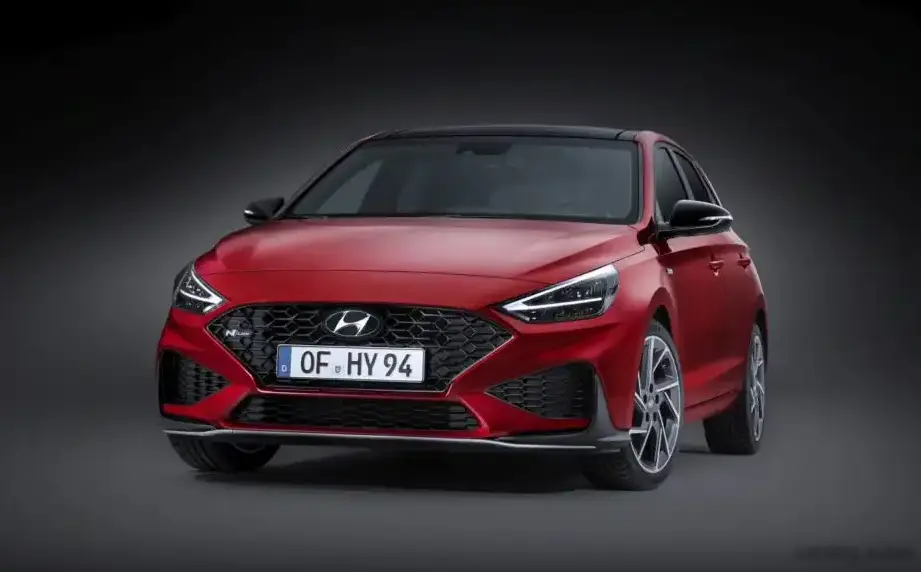
The Hyundai i30 III N Performance 2.0 T-GDi DCT, produced from May 2021 to June 2024, represents the highest performance variant of the third-generation i30 (codenamed PD). Positioned as the flagship model, it aimed to deliver a genuine hot hatch experience, competing with established rivals like the Volkswagen Golf GTI and Ford Focus ST. This facelifted version, introduced in 2020, brought styling updates and refinements to the already potent N Performance model. The i30 N Performance was not initially sold in the North American market, focusing instead on European and Asian markets where the compact hot hatch segment is particularly popular.
Technical Specifications
| Brand | Hyundai |
| Model | i30 |
| Generation | i30 III (facelift 2020) |
| Type (Engine) | N Performance 2.0 T-GDi (280 Hp) DCT |
| Start of production | May, 2021 |
| End of production | June, 2024 |
| Powertrain Architecture | Internal Combustion engine |
| Body type | Hatchback |
| Seats | 5 |
| Doors | 5 |
| Fuel Type | Petrol (Gasoline) |
| Maximum speed | 249 km/h (154.72 mph) |
| 0-100 km/h | 3.46 s |
| Emission standard | Euro 6d |
| Weight-to-power ratio | 5.2 kg/Hp, 192.4 Hp/tonne |
| Weight-to-torque ratio | 3.7 kg/Nm, 269.4 Nm/tonne |
| Power | 280 Hp @ 6000 rpm |
| Power per litre | 140.1 Hp/l |
| Torque | 392 Nm @ 2100-4700 rpm (289.12 lb.-ft. @ 2100-4700 rpm) |
| Engine layout | Front, Transverse |
| Engine Model/Code | G4KH |
| Engine displacement | 1998 cm3 (121.93 cu. in.) |
| Number of cylinders | 4 |
| Engine configuration | Inline |
| Cylinder Bore | 86 mm (3.39 in.) |
| Piston Stroke | 86 mm (3.39 in.) |
| Compression ratio | 9.5:1 |
| Number of valves per cylinder | 4 |
| Fuel injection system | Direct injection |
| Engine aspiration | Turbocharger, Intercooler |
| Valvetrain | DOHC, E-CVVT |
| Engine oil capacity | 4.8 l (5.07 US qt | 4.22 UK qt) |
| Coolant | 8.5 l (8.98 US qt | 7.48 UK qt) |
| Kerb Weight | 1455-1535 kg (3207.73 – 3384.1 lbs.) |
| Max. weight | 1970 kg (4343.11 lbs.) |
| Max load | 435-515 kg (959.01 – 1135.38 lbs.) |
| Trunk (boot) space – minimum | 381 l (13.45 cu. ft.) |
| Trunk (boot) space – maximum | 1287 l (45.45 cu. ft.) |
| Fuel tank capacity | 50 l (13.21 US gal | 11 UK gal) |
| Max. roof load | 80 kg (176.37 lbs.) |
| Permitted trailer load with brakes (12%) | 1600 kg (3527.4 lbs.) |
| Permitted trailer load without brakes | 700 kg (1543.24 lbs.) |
| Permitted towbar download | 80 kg (176.37 lbs.) |
| Length | 4340 mm (170.87 in.) |
| Width | 1795 mm (70.67 in.) |
| Height | 1419 mm (55.87 in.) |
| Wheelbase | 2650 mm (104.33 in.) |
| Minimum turning circle | 11.66 m (38.25 ft.) |
| Drivetrain Architecture | Front wheel drive |
| Number of gears and type of gearbox | 8 gears, automatic transmission DCT |
| Front suspension | Independent type McPherson |
| Rear suspension | Independent multi-link suspension |
| Front brakes | Disc, 345 mm |
| Rear brakes | Disc, 314 mm |
| Assisting systems | ABS (Anti-lock braking system) |
| Steering type | Steering rack and pinion |
| Power steering | Electric Steering |
| Tires size | 235/35 R19 Y |
| Wheel rims size | 8.0J x 19 |
Powertrain & Engine Architecture
At the heart of the i30 N Performance lies the Hyundai-Kia G4KH 2.0-liter turbocharged inline-four engine. This engine is a heavily modified version of the unit found in other Hyundai/Kia models, but with significant upgrades to handle the increased power output. Key features include a twin-scroll turbocharger, direct injection, and a reinforced crankshaft and connecting rods. The engine utilizes Hyundai’s E-CVVT (Electronic Continuously Variable Valve Timing) system for both intake and exhaust valves, optimizing performance and efficiency. The engine code ‘G4KH’ signifies its high-performance nature within the Hyundai engine family. The 280 horsepower and 392 Nm (289 lb-ft) of torque are delivered across a broad rev range, thanks to the turbocharger and optimized engine mapping. The engine is paired with a Hyundai-developed 8-speed dual-clutch transmission (DCT). This DCT offers quick and precise gear changes, crucial for maximizing performance. Unlike some DCTs, the i30 N Performance’s transmission is tuned for more aggressive shifts and includes features like launch control.
Driving Characteristics
The i30 N Performance delivers a noticeably engaging driving experience. The 280 hp engine provides strong acceleration, with the DCT ensuring minimal power loss during gear changes. The car feels responsive and eager, particularly in ‘N’ mode, which sharpens throttle response, steering feel, and suspension damping. The DCT’s gear ratios are optimized for both acceleration and track performance. While the automatic transmission offers convenience, some enthusiasts prefer the more direct control of a manual gearbox, which was also available on other i30 N models. Compared to lower-powered i30 variants, the N Performance offers a significantly more visceral and sporty driving experience. The suspension is firmer, and the steering is more direct, resulting in a more connected feel with the road.
Equipment & Trim Levels
The i30 N Performance came generously equipped as standard. Key features included sport seats upholstered in a combination of suede and leather, a leather-wrapped steering wheel, and a comprehensive infotainment system with navigation and Apple CarPlay/Android Auto compatibility. Unique to the N Performance were N-branded details throughout the interior and exterior, including badging, stitching, and exterior accents. Optional extras included a panoramic sunroof, premium sound system, and advanced driver-assistance systems like adaptive cruise control and lane-keeping assist. The interior design focused on a driver-centric layout, with controls positioned for easy access during spirited driving.
Chassis & Braking
The i30 N Performance features a reinforced chassis and upgraded suspension components compared to standard i30 models. The front suspension utilizes a McPherson strut design, while the rear employs a multi-link setup. Stiffer springs and dampers, along with larger stabilizer bars, contribute to reduced body roll and improved handling. Braking performance is enhanced by larger disc brakes on all four wheels – 345mm at the front and 314mm at the rear – providing ample stopping power. The car is equipped with ABS (Anti-lock Braking System) and Electronic Stability Control (ESC), which can be partially deactivated for track use. The steering system is a rack-and-pinion type with electric power assistance, offering precise and responsive steering feel.
Market Reception & Comparison
The Hyundai i30 N Performance was generally well-received by automotive critics. It was praised for its engaging driving dynamics, powerful engine, and competitive price point. Compared to rivals like the Volkswagen Golf GTI, the i30 N Performance offered a more raw and visceral driving experience, while the GTI prioritized refinement and everyday usability. Fuel economy was respectable for a performance hatchback, but naturally lower than that of less powerful i30 variants. Reliability reports have been generally positive, with few major issues reported. The i30 N Performance offered a compelling alternative in the hot hatch segment, challenging established players with its performance and value.
Legacy
The i30 N Performance marked a significant step forward for Hyundai’s N performance division, demonstrating the brand’s commitment to creating genuinely engaging and capable sports cars. The G4KH engine and DCT transmission proved to be robust and reliable, and the car has maintained a strong following among enthusiasts. In the used car market, the i30 N Performance holds its value well, reflecting its desirability and performance credentials. It remains a popular choice for drivers seeking a thrilling and practical hot hatch experience.