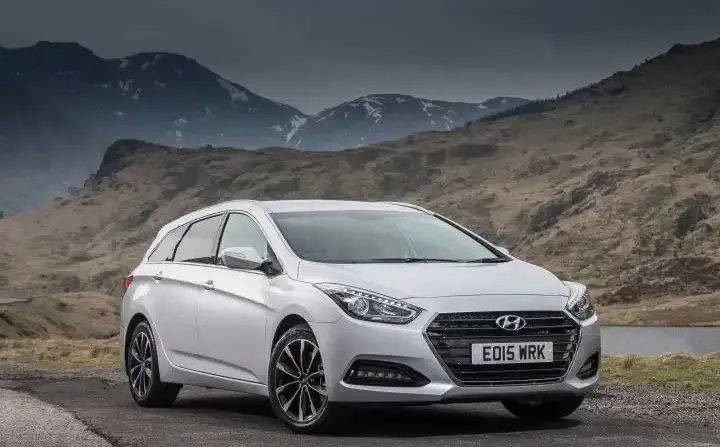
The Hyundai i40 Combi (facelift, produced from 2015 to 2018) represented Hyundai’s continued push into the European station wagon market. Positioned as a practical and stylish alternative to established competitors, the i40 Combi aimed to offer a compelling blend of space, comfort, and value. The 2.0 GDI (Gasoline Direct Injection) variant, producing 165 horsepower, was a mid-range offering within the i40 Combi lineup, bridging the gap between the more economical base engines and the higher-performance options. This version was primarily targeted at buyers seeking a balance of fuel efficiency and adequate power for long-distance cruising and family transport.
Technical Specifications
| Brand | Hyundai |
| Model | i40 |
| Generation | i40 Combi (facelift 2015) |
| Type (Engine) | 2.0 GDI (165 Hp) |
| Start of production | 2015 |
| End of production | 2018 |
| Powertrain Architecture | Internal Combustion engine |
| Body type | Station wagon (estate) |
| Seats | 5 |
| Doors | 5 |
| Fuel consumption (urban) | 9.4-9.7 l/100 km (25 – 24.2 US mpg) |
| Fuel consumption (extra urban) | 5.8-6.2 l/100 km (40.6 – 37.9 US mpg) |
| Fuel consumption (combined) | 7.1-7.5 l/100 km (33.1 – 31.4 US mpg) |
| CO2 emissions | 165-175 g/km |
| Fuel Type | Petrol (Gasoline) |
| Acceleration 0 – 100 km/h | 9.9 sec |
| Acceleration 0 – 62 mph | 9.9 sec |
| Acceleration 0 – 60 mph | 9.4 sec |
| Maximum speed | 210 km/h (130.49 mph) |
| Emission standard | Euro 6 |
| Weight-to-power ratio | 8.9 kg/Hp, 112.6 Hp/tonne |
| Weight-to-torque ratio | 7.2 kg/Nm, 138.5 Nm/tonne |
| Power | 165 Hp @ 6200 rpm |
| Power per litre | 82.5 Hp/l |
| Torque | 203 Nm @ 4700 rpm (149.73 lb.-ft. @ 4700 rpm) |
| Engine layout | Front, Transverse |
| Engine Model/Code | G4NC |
| Engine displacement | 1999 cm3 (121.99 cu. in.) |
| Number of cylinders | 4 |
| Engine configuration | Inline |
| Cylinder Bore | 81 mm (3.19 in.) |
| Piston Stroke | 97 mm (3.82 in.) |
| Compression ratio | 11.5:1 |
| Number of valves per cylinder | 4 |
| Fuel injection system | Direct injection |
| Engine aspiration | Naturally aspirated engine |
| Valvetrain | DOHC |
| Engine oil capacity | 4 l (4.23 US qt | 3.52 UK qt) |
| Coolant | 7.1 l (7.5 US qt | 6.25 UK qt) |
| Kerb Weight | 1466 kg (3231.98 lbs.) |
| Max. weight | 2060 kg (4541.52 lbs.) |
| Max load | 594 kg (1309.55 lbs.) |
| Trunk (boot) space – minimum | 506 l (17.87 cu. ft.) |
| Trunk (boot) space – maximum | 1672 l (59.05 cu. ft.) |
| Fuel tank capacity | 70 l (18.49 US gal | 15.4 UK gal) |
| Max. roof load | 100 kg (220.46 lbs.) |
| Length | 4775 mm (187.99 in.) |
| Width | 1815 mm (71.46 in.) |
| Height | 1470 mm (57.87 in.) |
| Wheelbase | 2770 mm (109.06 in.) |
| Front track | 1591 mm (62.64 in.) |
| Rear (Back) track | 1597 mm (62.87 in.) |
| Ride height (ground clearance) | 140 mm (5.51 in.) |
| Minimum turning circle | 10.94 m (35.89 ft.) |
| Drivetrain Architecture | Front wheel drive |
| Drive wheel | Front wheel drive |
| Number of gears | 6 gears, manual transmission |
| Front suspension | Independent type McPherson |
| Rear suspension | Independent coil spring |
| Front brakes | Ventilated discs |
| Rear brakes | Disc |
| Assisting systems | ABS (Anti-lock braking system) |
| Steering type | Steering rack and pinion |
| Tires size | 205/60 R16; 215/50 R17; 225/45 R18 |
| Wheel rims size | 7.0J x 16; 7.5J x 17; 8.0J x 18 |
Powertrain & Engine Architecture
The heart of the i40 Combi 2.0 GDI is the Hyundai G4NC engine, a 1.999-liter (2.0L) inline-four cylinder gasoline engine. This engine utilizes direct fuel injection (GDI) technology, where fuel is injected directly into the combustion chamber, improving efficiency and power output. The G4NC features a double overhead camshaft (DOHC) valvetrain with four valves per cylinder, optimizing airflow for enhanced performance. The engine produces 165 horsepower at 6,200 rpm and 203 Nm (149.73 lb-ft) of torque at 4,700 rpm. The engine’s design prioritizes a balance between power and fuel economy, making it suitable for everyday driving. The 2.0 GDI was paired with either a six-speed manual or a six-speed automatic transmission. The automatic transmission was designed to provide smooth gear changes and contribute to overall driving comfort.
Driving Characteristics
The i40 Combi 2.0 GDI offered a comfortable and composed driving experience. While not a particularly sporty vehicle, the 165 hp engine provided adequate power for overtaking and highway cruising. Acceleration from 0 to 60 mph took approximately 9.4 seconds, which was competitive within its class. The automatic transmission, while smooth, wasn’t particularly quick to downshift, which could sometimes be noticeable during more spirited driving. The suspension was tuned for comfort, absorbing bumps and imperfections in the road well. The steering was light and precise, making it easy to maneuver in urban environments. Compared to the base 1.6L engine, the 2.0 GDI offered a significant improvement in performance, while the manual transmission versions provided even quicker acceleration and more driver engagement.
Equipment & Trim Levels
The i40 Combi 2.0 GDI typically came well-equipped, even in its base trim levels. Standard features often included air conditioning, a touchscreen infotainment system with Bluetooth connectivity, power windows and mirrors, and alloy wheels. Higher trim levels added features such as leather upholstery, a panoramic sunroof, heated front seats, and a more advanced infotainment system with navigation. Safety features like ABS, Electronic Stability Control (ESC), and multiple airbags were standard across the range. Optional extras included parking sensors, a rearview camera, and adaptive cruise control.
Chassis & Braking
The i40 Combi featured a front-wheel-drive layout with an independent McPherson strut suspension at the front and an independent coil spring suspension at the rear. This setup provided a good balance of ride comfort and handling. The braking system consisted of ventilated discs at the front and solid discs at the rear, providing adequate stopping power. ABS (Anti-lock Braking System) was standard, enhancing safety during emergency braking situations. The chassis was designed to provide a stable and predictable driving experience, even when fully loaded.
Market Reception & Comparison
The Hyundai i40 Combi 2.0 GDI was generally well-received by automotive critics. It was praised for its spacious interior, comfortable ride, and generous equipment levels. The 2.0 GDI engine was considered a good compromise between performance and fuel economy. However, some critics noted that the interior design was somewhat conservative and that the driving experience wasn’t as engaging as some of its rivals. Compared to competitors like the Ford Focus Estate and Volkswagen Golf Estate, the i40 Combi offered a strong value proposition, often undercutting them in price while offering similar levels of equipment. Fuel economy was competitive, averaging around 33 mpg in combined driving.
Legacy
The Hyundai i40 Combi, including the 2.0 GDI variant, has proven to be a relatively reliable vehicle in the used car market. The G4NC engine is known for its durability, and the automatic transmission has generally held up well over time. Common issues are relatively minor, often related to wear and tear on suspension components or electrical glitches. The i40 Combi remains a practical and affordable option for buyers seeking a spacious and comfortable station wagon. Its blend of value, reliability, and practicality has ensured its continued presence on roads today.