
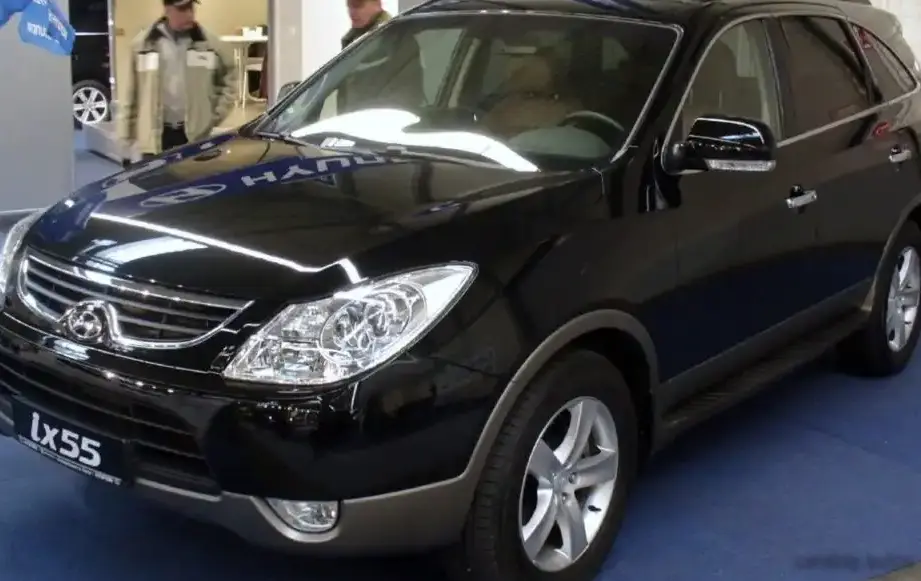
The Hyundai ix55 3.8 V6 24V, produced from 2008 to 2012, represented Hyundai’s initial foray into the mid-size crossover SUV segment, primarily aimed at the North American and European markets. Positioned as a more premium offering than Hyundai’s existing Santa Fe, the ix55 sought to compete with established players like the Honda Pilot and Toyota Highlander. This particular variant, equipped with the 3.8-liter V6 engine and a six-speed automatic transmission, served as the flagship powertrain for the model, offering a balance of power and convenience. The ix55 was notable for its standard seven-passenger seating and a relatively luxurious interior for its price point.
Technical Specifications
| Brand | Hyundai |
| Model | ix55 |
| Generation | ix55 |
| Type (Engine) | 3.8 V6 24V (264 Hp) |
| Start of production | 2008 |
| End of production | 2012 |
| Powertrain Architecture | Internal Combustion engine |
| Body type | SUV |
| Seats | 7 |
| Doors | 5 |
| Fuel consumption (urban) | 17.6 l/100 km (13.4 US mpg) |
| Fuel consumption (extra urban) | 9.1 l/100 km (25.8 US mpg) |
| Fuel consumption (combined) | 12.2 l/100 km (19.3 US mpg) |
| Fuel Type | Petrol (Gasoline) |
| Acceleration 0 – 100 km/h | 8.3 sec |
| Acceleration 0 – 62 mph | 8.3 sec |
| Acceleration 0 – 60 mph | 7.9 sec |
| Maximum speed | 190 km/h (118.06 mph) |
| Weight-to-power ratio | 8.4 kg/Hp |
| Weight-to-torque ratio | 6.4 kg/Nm |
| Power | 264 Hp @ 6000 rpm |
| Torque | 348 Nm (256.67 lb.-ft.) |
| Engine layout | Front, Transverse |
| Engine Model/Code | Lambda / G6DA |
| Engine displacement | 3778 cm3 (230.55 cu. in.) |
| Number of cylinders | 6 |
| Engine configuration | V-engine |
| Number of valves per cylinder | 4 |
| Fuel injection system | Multi-port manifold injection |
| Engine aspiration | Naturally aspirated engine |
| Valvetrain | DOHC |
| Engine oil capacity | 5.2 l (5.49 US qt | 4.58 UK qt) |
| Coolant capacity | 10.5 l (11.1 US qt | 9.24 UK qt) |
| Kerb Weight | 2220 kg (4894.26 lbs.) |
| Max. weight | 2780 kg (6128.85 lbs.) |
| Max load | 560 kg (1234.59 lbs.) |
| Trunk (boot) space – minimum | 598 l (21.12 cu. ft.) |
| Trunk (boot) space – maximum | 1746 l (61.66 cu. ft.) |
| Fuel tank capacity | 78 l (20.61 US gal | 17.16 UK gal) |
| Length | 4840 mm (190.55 in.) |
| Width | 1945 mm (76.57 in.) |
| Height | 1750 mm (68.9 in.) |
| Wheelbase | 2805 mm (110.43 in.) |
| Front track | 1670 mm (65.75 in.) |
| Rear track | 1670 mm (65.75 in.) |
| Drive wheel | All wheel drive (4×4) |
| Number of gears | 6 |
| Gearbox type | Automatic transmission |
| Front suspension | Independent, McPherson with coil spring and anti-roll bar |
| Rear suspension | Independent multi-link spring suspension with stabilizer |
| Front brakes | Ventilated discs |
| Rear brakes | Disc |
| Assisting systems | ABS (Anti-lock braking system) |
| Tires size | 245/60 R18 |
Introduction
The Hyundai ix55 3.8 V6 24V, launched in 2008, marked a significant step forward for Hyundai in terms of design, features, and overall refinement. Built on the Hyundai-Kia Y6 platform (also known as the 1HX0), the ix55 aimed to provide a more upscale experience compared to the brand’s existing offerings. It was initially marketed as a premium crossover, attempting to bridge the gap between mainstream SUVs and luxury models. Production continued through 2012, with the model eventually being replaced by the Hyundai Santa Fe XL in some markets. The 3.8L V6 automatic configuration was the top-tier trim, offering the most power and a comfortable driving experience.
Powertrain & Engine Architecture
At the heart of the ix55 3.8 V6 is Hyundai’s Lambda engine, specifically the G6DA variant. This 3.8-liter (3778 cc) naturally aspirated V6 engine utilizes a 60-degree V-angle configuration. It features a dual overhead camshaft (DOHC) valvetrain with four valves per cylinder, contributing to its respectable power output. The engine employs multi-point fuel injection, delivering fuel directly into the intake ports. The Lambda engine was known for its relatively smooth operation and decent reliability. Paired with the engine is a six-speed automatic transmission, providing smooth shifts and adequate responsiveness for everyday driving. This transmission was designed to balance fuel efficiency with performance, offering both manual shift control and an automatic mode. The transmission’s gear ratios were tuned for comfortable cruising and reasonable acceleration.
Driving Characteristics
The ix55 3.8 V6 Automatic delivered a comfortable and composed driving experience. With 264 horsepower and 256.67 lb-ft of torque, acceleration was adequate for merging onto highways and passing other vehicles, achieving 0-60 mph in around 7.9 seconds. While not a sports SUV, the powertrain provided sufficient power for most driving situations. Compared to lower-trim ix55 models with smaller engines, the 3.8L V6 offered a noticeable improvement in performance. The automatic transmission generally shifted smoothly, although it could occasionally feel hesitant during quick acceleration. The all-wheel-drive system provided enhanced traction in inclement weather conditions, making it a capable vehicle for year-round use. The suspension was tuned for comfort, absorbing bumps and road imperfections effectively.
Equipment & Trim Levels
The 3.8 V6 trim of the ix55 typically came well-equipped with standard features. These included leather upholstery, heated front seats, a power-adjustable driver’s seat, automatic climate control, a premium audio system, and alloy wheels. Optional extras often included a navigation system, a sunroof, and rear-seat entertainment systems. The interior design focused on providing a spacious and comfortable cabin for passengers. The third-row seats, while suitable for children or shorter adults, were somewhat limited in space. The dashboard layout was generally straightforward and user-friendly.
Chassis & Braking
The ix55 utilized a robust chassis with an independent suspension setup at all four corners. The front suspension employed a McPherson strut design with coil springs and an anti-roll bar, while the rear suspension featured a multi-link configuration with a stabilizer bar. This setup provided a good balance of ride comfort and handling stability. Braking duties were handled by ventilated disc brakes at the front and solid disc brakes at the rear. The vehicle was equipped with an Anti-lock Braking System (ABS) as standard, enhancing safety during emergency braking situations. The steering was hydraulically assisted, providing a reasonably responsive feel.
Market Reception & Comparison
The Hyundai ix55 3.8 V6 received generally positive reviews from automotive critics. It was praised for its spacious interior, comfortable ride, and generous standard features. However, some critics noted that its fuel economy was not particularly competitive compared to other SUVs in its class. Compared to the base 3.5L V6 model, the 3.8L offered a significant performance boost, but at a higher price point. Against rivals like the Honda Pilot and Toyota Highlander, the ix55 offered a compelling value proposition, often undercutting their prices while providing similar levels of equipment. Reliability reports were generally favorable, although some owners reported minor issues with electronic components.
Legacy
The Hyundai ix55 3.8 V6, while discontinued in 2012, remains a relatively reliable and affordable option in the used car market. The Lambda engine, in particular, has proven to be durable and long-lasting when properly maintained. Common maintenance items include regular oil changes, timing belt replacements (depending on mileage), and inspection of the cooling system. The six-speed automatic transmission is also generally reliable, but fluid changes should be performed according to the manufacturer’s recommendations. Today, the ix55 represents a significant milestone in Hyundai’s history, demonstrating the brand’s ability to produce a competitive and well-equipped mid-size crossover SUV. Its blend of space, comfort, and value continues to appeal to budget-conscious buyers seeking a seven-passenger vehicle.
