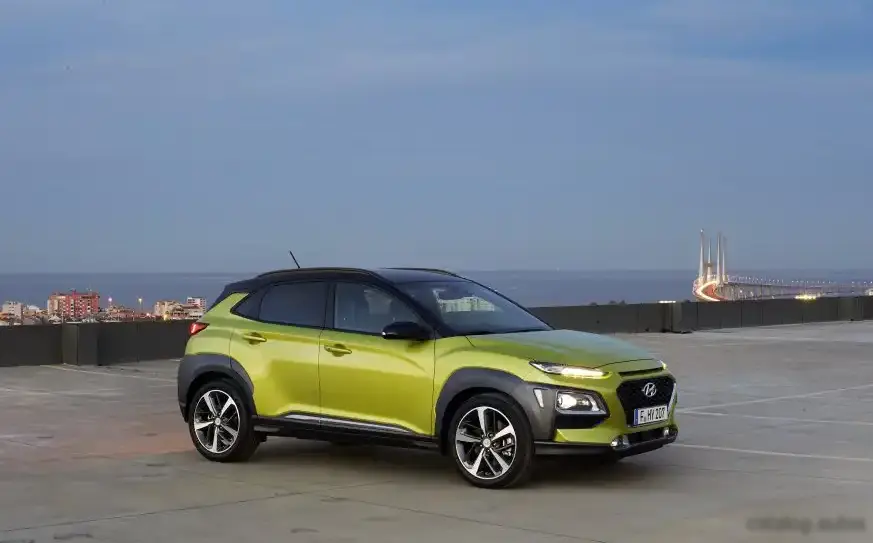
Technical Specifications
| Brand | Hyundai |
| Model | Kona |
| Generation | Kona I |
| Type (Engine) | 1.6 CRDi (136 Hp) DCT |
| Start of production | 2018 |
| End of production | September, 2020 |
| Powertrain Architecture | Internal Combustion engine |
| Body type | SUV |
| Seats | 5 |
| Doors | 5 |
| Fuel consumption (urban) | 4.5-4.8 l/100 km (52.3 – 49 US mpg) |
| Fuel consumption (extra urban) | 4.1-4.3 l/100 km (57.4 – 54.7 US mpg) |
| Fuel consumption (combined) | 4.2-4.5 l/100 km (56 – 52.3 US mpg) |
| CO2 emissions | 112-115 g/km |
| Fuel Type | Diesel |
| Acceleration 0 – 100 km/h | 10.2 sec |
| Acceleration 0 – 62 mph | 10.2 sec |
| Acceleration 0 – 60 mph | 9.7 sec |
| Maximum speed | 191 km/h (118.68 mph) |
| Emission standard | Euro 6d |
| Weight-to-power ratio | 10.4 kg/Hp |
| Weight-to-torque ratio | 4.4 kg/Nm |
| Power | 136 Hp @ 4000 rpm |
| Torque | 320 Nm @ 1750-2250 rpm (236.02 lb.-ft. @ 1750-2250 rpm) |
| Engine layout | Front, Transverse |
| Engine Model/Code | Smartstream / D4FE |
| Engine displacement | 1598 cm3 (97.52 cu. in.) |
| Number of cylinders | 4 |
| Engine configuration | Inline |
| Cylinder Bore | 77 mm (3.03 in.) |
| Piston Stroke | 85.8 mm (3.38 in.) |
| Compression ratio | 15.9:1 |
| Number of valves per cylinder | 4 |
| Fuel injection system | Diesel Commonrail |
| Engine aspiration | Turbocharger, Intercooler |
| Engine oil capacity | 5.3 l (5.6 US qt | 4.66 UK qt) |
| Coolant | 7.8 l (8.24 US qt | 6.86 UK qt) |
| Kerb Weight | 1417-1535 kg (3123.95 – 3384.1 lbs.) |
| Max. weight | 1880 kg (4144.69 lbs.) |
| Max load | 345-463 kg (760.59 – 1020.74 lbs.) |
| Trunk (boot) space – minimum | 361 l (12.75 cu. ft.) |
| Trunk (boot) space – maximum | 1143 l (40.36 cu. ft.) |
| Fuel tank capacity | 50 l (13.21 US gal | 11 UK gal) |
| Max. roof load | 80 kg (176.37 lbs.) |
| Permitted trailer load with brakes (12%) | 1250 kg (2755.78 lbs.) |
| Permitted trailer load without brakes | 600 kg (1322.77 lbs.) |
| Permitted towbar download | 80 kg (176.37 lbs.) |
| Length | 4165 mm (163.98 in.) |
| Width | 1800 mm (70.87 in.) |
| Width including mirrors | 2070 mm (81.5 in.) |
| Height | 1565 mm (61.61 in.) |
| Wheelbase | 2600 mm (102.36 in.) |
| Front track | 1559-1575 mm (61.38 – 62.01 in.) |
| Rear (Back) track | 1568-1584 mm (61.73 – 62.36 in.) |
| Front overhang | 845 mm (33.27 in.) |
| Rear overhang | 720 mm (28.35 in.) |
| Ride height (ground clearance) | 171 mm (6.73 in.) |
| Drag coefficient (Cd) | 0.33 |
| Minimum turning circle (turning diameter) | 10.6 m (34.78 ft.) |
| Approach angle | 15.7° |
| Departure angle | 29.0° |
| Ramp-over (brakeover) angle | 16.0° |
| Wading depth | 500 mm (19.69 in.) |
| Drivetrain Architecture | Front wheel drive |
| Number of gears and type of gearbox | 7 gears, automatic transmission DCT |
| Front suspension | Independent, type McPherson with coil spring and anti-roll bar |
| Rear suspension | independent torsion suspension |
| Front brakes | Ventilated discs |
| Rear brakes | Disc |
| Assisting systems | ABS (Anti-lock braking system) |
| Steering type | Steering rack and pinion |
| Power steering | Electric Steering |
| Tires size | 205/60 R16; 215/55 R17; 235/45 R18 |
| Wheel rims size | 6.5J x 16; 7.0J x 17; 7.5J x 18 |
The Hyundai Kona I 1.6 CRDi (136 Hp) DCT represents a significant entry point into the first generation of Hyundai’s popular subcompact SUV, the Kona. Introduced in 2018 and continuing through September 2020, this variant was primarily aimed at European and other international markets where fuel efficiency and reasonable performance were highly valued. It occupied a mid-range position within the Kona I lineup, offering a balance between the more basic gasoline engines and the more powerful petrol options. The Kona I, built on the Hyundai-Kia B-platform, was a crucial model for Hyundai, designed to appeal to a younger demographic seeking a stylish and practical urban vehicle. This specific diesel-powered, dual-clutch transmission (DCT) combination aimed to provide a refined driving experience with lower running costs.
Powertrain & Engine Architecture
The heart of the Kona I 1.6 CRDi DCT is Hyundai’s Smartstream 1.6-liter four-cylinder diesel engine, designated the D4FE. This engine utilizes a common-rail direct injection system, delivering fuel at extremely high pressure for optimized combustion. A turbocharger with an intercooler is employed to boost power and torque, mitigating turbo lag and improving responsiveness. The engine produces 136 horsepower at 4,000 rpm and a substantial 320 Nm (236 lb-ft) of torque between 1750 and 2250 rpm. This torque curve provides strong low-end and mid-range acceleration, making it well-suited for everyday driving. The engine features a cast iron block and aluminum cylinder head, contributing to its durability. The 7-speed Dual Clutch Transmission (DCT) provides quick and smooth gear changes, enhancing both performance and fuel efficiency. This DCT is a key component in delivering a more engaging driving experience compared to a traditional automatic transmission.
Driving Characteristics
The 1.6 CRDi DCT variant of the Kona I offers a comfortable and refined driving experience. While not a performance-oriented model, the 136 hp engine and 7-speed DCT provide adequate power for most driving situations. Acceleration from 0-60 mph takes approximately 9.7 seconds, and the top speed is around 118.68 mph. The DCT transmission contributes to a responsive feel, with quick shifts and minimal torque interruption. The gear ratios are tuned for fuel efficiency, but still provide sufficient power for overtaking maneuvers. Compared to the base gasoline engines, the 1.6 CRDi offers significantly more torque, resulting in stronger acceleration at lower speeds. However, it lacks the outright punch of the more powerful gasoline options. The front-wheel-drive configuration provides predictable handling, and the suspension is tuned for comfort, absorbing bumps and imperfections in the road well.
Equipment & Trim Levels
The Kona I 1.6 CRDi DCT typically came equipped with a respectable level of standard features. These included air conditioning, a touchscreen infotainment system with Apple CarPlay and Android Auto compatibility, Bluetooth connectivity, and a suite of safety features such as ABS, ESC (Electronic Stability Control), and multiple airbags. Higher trim levels offered additional features like a larger touchscreen display, navigation system, a rearview camera, parking sensors, and premium interior upholstery. Optional extras included a panoramic sunroof, heated seats, and advanced driver-assistance systems like lane departure warning and automatic emergency braking.
Chassis & Braking
The Kona I utilizes a McPherson strut front suspension and a torsion beam rear suspension. This setup provides a good balance between ride comfort and handling. The front suspension incorporates a stabilizer bar to reduce body roll during cornering. Braking duties are handled by ventilated discs at the front and solid discs at the rear. The ABS system ensures optimal braking performance in various conditions. The steering is electrically assisted, providing a light and responsive feel.
Market Reception & Comparison
The Hyundai Kona I 1.6 CRDi DCT was generally well-received by automotive critics. It was praised for its fuel efficiency, comfortable ride, and well-equipped interior. However, some reviewers noted that the engine could feel strained when fully loaded or driving uphill. Compared to the gasoline-powered Kona variants, the 1.6 CRDi offered superior fuel economy and torque. However, it was slightly more expensive to purchase and maintain due to the complexity of the diesel engine and DCT transmission. Against competitors like the Nissan Juke and Renault Captur, the Kona I 1.6 CRDi DCT offered a compelling combination of value, features, and fuel efficiency.
Legacy
The 1.6 CRDi engine, while generally reliable, can be susceptible to issues with the diesel particulate filter (DPF) if not driven on longer journeys regularly. The DCT transmission, while offering smooth shifts, requires regular maintenance to ensure optimal performance. In the used car market, the Kona I 1.6 CRDi DCT remains a popular choice for buyers seeking a fuel-efficient and practical subcompact SUV. Its relatively low running costs and comfortable driving experience continue to appeal to a wide range of drivers. However, potential buyers should be aware of the potential maintenance costs associated with the diesel engine and DCT transmission.