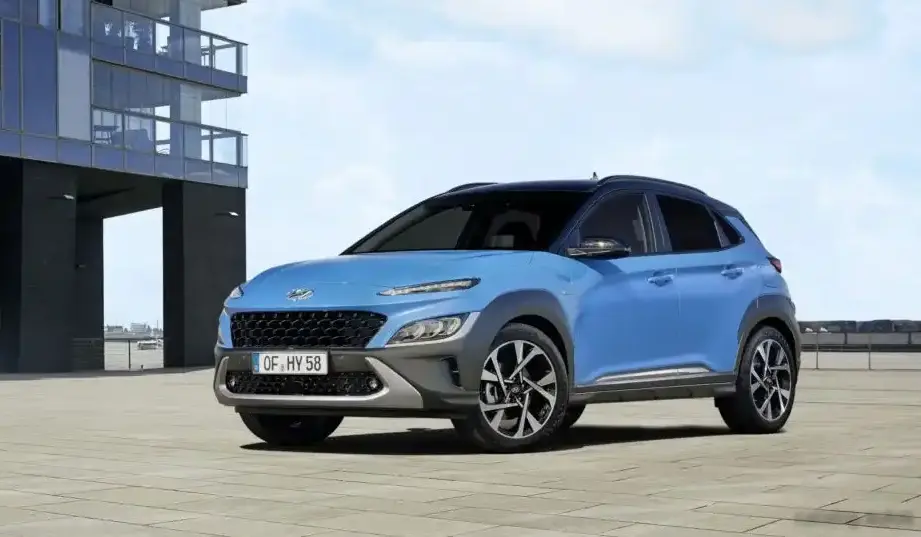
The Hyundai Kona I (facelift, introduced in 2020) 2.0 MPI (147 hp) with all-wheel drive (AWD) and an Intelligent Variable Transmission (IVT) represents a significant offering within the subcompact SUV segment. Production of this specific configuration ran from 2021 through April 2023. Positioned as a mid-range trim, it bridged the gap between the base engine options and the higher-performance N Line variants, appealing to buyers seeking a balance of fuel efficiency, practicality, and all-weather capability. This model is part of the first generation Kona (internal designation OS), which debuted in 2017 and received a substantial facelift for the 2021 model year, incorporating revised styling, updated technology, and powertrain refinements.
Technical Specifications
| Brand | Hyundai |
| Model | Kona |
| Generation | Kona I (facelift 2020) |
| Type (Engine) | 2.0 MPI (147 Hp) AWD IVT |
| Start of production | 2021 |
| End of production | April, 2023 |
| Powertrain Architecture | Internal Combustion engine |
| Body type | SUV |
| Seats | 5 |
| Doors | 5 |
| Fuel Type | Petrol (Gasoline) |
| Weight-to-power ratio | 9.5 kg/Hp, 105.8 Hp/tonne |
| Weight-to-torque ratio | 7.8 kg/Nm, 128.8 Nm/tonne |
| Power | 147 Hp @ 6200 rpm |
| Power per litre | 73.5 Hp/l |
| Torque | 179 Nm @ 4500 rpm (132.02 lb.-ft. @ 4500 rpm) |
| Engine layout | Front, Transverse |
| Engine Model/Code | Smartstream / G4NS |
| Engine displacement | 1999 cm3 (121.99 cu. in.) |
| Number of cylinders | 4 |
| Engine configuration | Inline |
| Cylinder Bore | 81 mm (3.19 in.) |
| Piston Stroke | 97 mm (3.82 in.) |
| Compression ratio | 12.5:1 |
| Number of valves per cylinder | 4 |
| Fuel injection system | Multi-port manifold injection |
| Valvetrain | DOHC, DCVVT |
| Engine oil capacity | 4.3 l (4.54 US qt | 3.78 UK qt) |
| Coolant capacity | 6 l (6.34 US qt | 5.28 UK qt) |
| Kerb Weight | 1390-1453 kg (3064.43 – 3203.32 lbs.) |
| Max. weight | 1875 kg (4133.67 lbs.) |
| Max load | 422-485 kg (930.35 – 1069.24 lbs.) |
| Trunk (boot) space – minimum | 544 l (19.21 cu. ft.) |
| Trunk (boot) space – maximum | 1297 l (45.8 cu. ft.) |
| Fuel tank capacity | 50 l (13.21 US gal | 11 UK gal) |
| Length | 4206 mm (165.59 in.) |
| Width | 1801 mm (70.91 in.) |
| Height | 1565 mm (61.61 in.) |
| Wheelbase | 2601 mm (102.4 in.) |
| Front track | 1560-1575 mm (61.42 – 62.01 in.) |
| Rear (Back) track | 1567-1585 mm (61.69 – 62.4 in.) |
| Front overhang | 871 mm (34.29 in.) |
| Rear overhang | 734 mm (28.9 in.) |
| Ride height (ground clearance) | 170 mm (6.69 in.) |
| Drag coefficient (Cd) | 0.32 |
| Minimum turning circle (turning diameter) | 10.6 m (34.78 ft.) |
| Drivetrain Architecture | All wheel drive (4×4). ICE drives front wheels, rear wheels engaged via clutch. |
| Number of gears and type of gearbox | automatic transmission IVT |
| Front suspension | Independent, McPherson with coil spring and anti-roll bar |
| Rear suspension | Independent multi-link spring suspension with stabilizer |
| Front brakes | Ventilated discs, 305×25 mm |
| Rear brakes | Disc, 284×10 mm |
| Assisting systems | ABS (Anti-lock braking system) |
| Steering type | Steering rack and pinion |
| Power steering | Electric Steering |
| Tires size | 205/60 R16 92H; 215/55 R17 94V |
| Wheel rims size | 6.5J x 16; 7J x 17 |
Powertrain & Engine Architecture
At the heart of the Kona 2.0 MPI AWD IVT lies the Hyundai Smartstream G4NS engine, a naturally aspirated 2.0-liter inline-four cylinder gasoline engine. This engine utilizes multi-point fuel injection and a double overhead camshaft (DOHC) valvetrain with Dual Continuous Variable Valve Timing (DCVVT) to optimize efficiency and power delivery. The G4NS engine produces 147 horsepower at 6,200 rpm and 179 Nm (132 lb-ft) of torque at 4,500 rpm. The high compression ratio of 12.5:1 contributes to its thermal efficiency. The engine is transversely mounted in the front of the vehicle.
The IVT (Intelligent Variable Transmission) replaces a traditional automatic transmission with a belt-and-pulley system. This allows for a continuously variable gear ratio, optimizing engine speed for fuel efficiency and smooth acceleration. While not offering the direct feel of a traditional automatic or the efficiency of a dual-clutch transmission, the IVT provides a comfortable and refined driving experience. The IVT is programmed with simulated shift points to mimic the feel of a conventional automatic for drivers accustomed to that experience.
Driving Characteristics
The 2.0-liter MPI engine paired with the IVT delivers adequate, though not exhilarating, performance. Acceleration from 0 to 60 mph takes approximately 9.5 seconds. The IVT prioritizes fuel economy, and while it can hold lower gears for longer during acceleration, it doesn’t provide the immediate response of a traditional automatic or a dual-clutch transmission. The all-wheel-drive system provides enhanced traction in inclement weather and on slippery surfaces, making it a practical choice for regions with challenging driving conditions. Compared to the more powerful turbocharged engines available in the Kona lineup, this variant offers a more relaxed and fuel-efficient driving experience. The manual transmission versions of the 2.0L offered a slightly more engaging drive, but the IVT prioritizes ease of use.
Equipment & Trim Levels
The 2.0 MPI AWD IVT trim typically included standard features such as air conditioning, a touchscreen infotainment system with Apple CarPlay and Android Auto compatibility, a rearview camera, and a suite of safety features including lane keeping assist and forward collision avoidance assist. Interior upholstery was typically cloth, with options for upgraded materials available. Higher trim levels within the 2.0 MPI range added features like heated seats, a sunroof, and upgraded audio systems. Optional extras included a navigation system, premium sound system, and various cosmetic enhancements.
Chassis & Braking
The Kona utilizes a front independent McPherson strut suspension and a rear independent multi-link suspension, providing a comfortable ride and predictable handling. Stabilizer bars are fitted to both the front and rear axles to reduce body roll during cornering. The braking system consists of ventilated discs on the front wheels (305x25mm) and solid discs on the rear wheels (284x10mm). Anti-lock braking system (ABS) is standard. The steering is electrically assisted, providing light and precise control.
Market Reception & Comparison
The Kona 2.0 MPI AWD IVT was generally well-received by critics as a practical and affordable subcompact SUV. It was praised for its comfortable ride, spacious interior, and comprehensive safety features. However, some reviewers noted that the engine and IVT combination lacked the punch of the turbocharged options. Fuel economy was a strong point, with EPA estimates around 28 mpg combined. Compared to the 1.6L Turbo models, the 2.0L offered a lower price point but sacrificed some performance. The 2.0L was also seen as a more reliable option than the more complex turbocharged engines, potentially leading to lower long-term maintenance costs.
Legacy
The Hyundai Kona 2.0 MPI AWD IVT has proven to be a reliable and durable powertrain. The Smartstream engine is known for its longevity, and the IVT, while not as sporty as other transmissions, has demonstrated good reliability in real-world use. On the used car market, these models represent a good value proposition, offering a well-equipped and practical SUV at a competitive price. Regular maintenance, including fluid changes for the IVT, is crucial for ensuring long-term reliability. The Kona’s popularity has continued to grow, establishing it as a strong contender in the subcompact SUV segment.