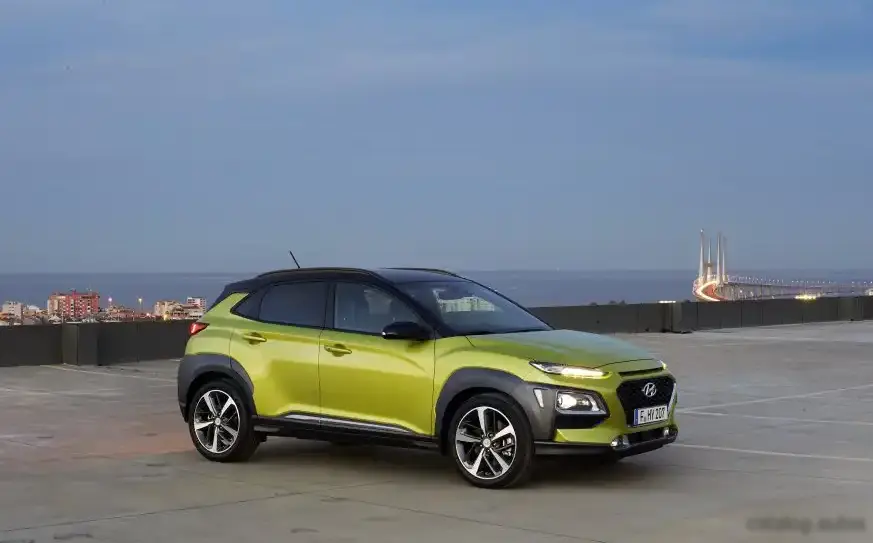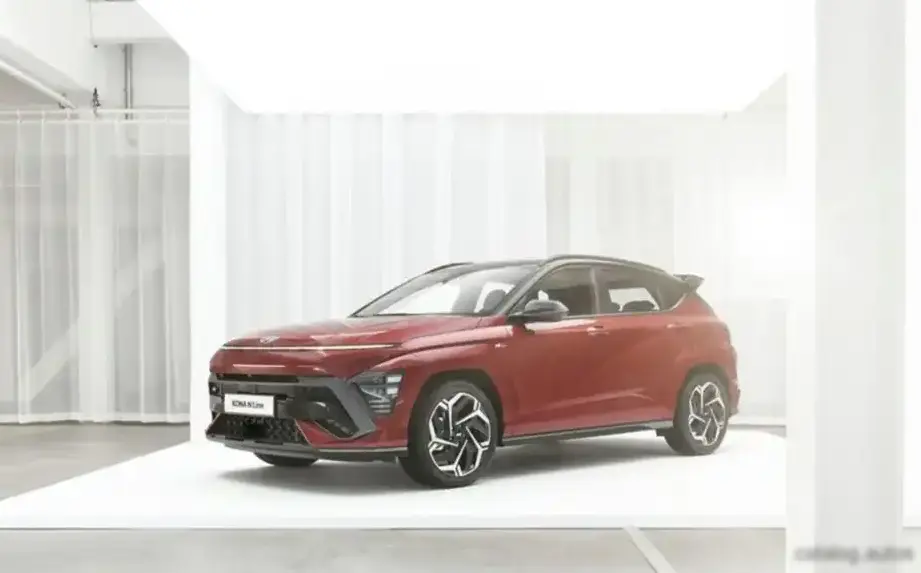
The Hyundai Kona II 1.0 T-GDI, producing 115 horsepower, represents an entry point into the second generation of Hyundai’s popular subcompact SUV. Introduced in August 2025, this variant is positioned as a fuel-efficient and accessible option within the Kona II lineup, which is built on the PF3 platform. It caters to buyers prioritizing economy and practicality over outright performance. The Kona, since its initial release, has become a significant model for Hyundai, particularly in the European and increasingly in the North American market, offering a stylish and well-equipped package in a competitive segment.
Technical Specifications
| Brand | Hyundai |
| Model | Kona |
| Generation | Kona II |
| Type (Engine) | 1.0 T-GDI (115 Hp) |
| Start of production | August, 2025 |
| Powertrain Architecture | Internal Combustion engine |
| Body type | SUV |
| Seats | 5 |
| Doors | 5 |
| Combined fuel consumption (WLTP) | 5.8 l/100 km (40.6 US mpg, 48.7 UK mpg, 17.2 km/l) |
| CO2 emissions (WLTP) | 132 g/km |
| Fuel Type | Petrol (Gasoline) |
| Acceleration 0 – 100 km/h | 11.9 sec |
| Acceleration 0 – 62 mph | 11.9 sec |
| Acceleration 0 – 60 mph | 11.3 sec |
| Maximum speed | 178 km/h (110.6 mph) |
| Emission standard | Euro 6e-bis |
| Weight-to-power ratio | 11.3 kg/Hp, 88.8 Hp/tonne |
| Weight-to-torque ratio | 6.5 kg/Nm, 154.4 Nm/tonne |
| Power | 115 Hp @ 6000 rpm |
| Power per litre | 115.2 Hp/l |
| Torque | 200 Nm @ 2000-2500 rpm (147.51 lb.-ft. @ 2000-2500 rpm) |
| Engine layout | Front, Transverse |
| Engine Model/Code | G3LE |
| Engine displacement | 998 cm3 (60.9 cu. in.) |
| Number of cylinders | 3 |
| Engine configuration | Inline |
| Cylinder Bore | 71 mm (2.8 in.) |
| Piston Stroke | 84 mm (3.31 in.) |
| Number of valves per cylinder | 4 |
| Fuel injection system | Direct injection |
| Engine aspiration | Turbocharger, Intercooler |
| Engine oil capacity | 3.1 l (3.28 US qt | 2.73 UK qt) |
| Coolant | 6.37 l (6.73 US qt | 5.6 UK qt) |
| Kerb Weight | 1295-1435 kg (2854.99 – 3163.63 lbs.) |
| Max. weight | 1860 kg (4100.6 lbs.) |
| Max load | 425-565 kg (936.96 – 1245.61 lbs.) |
| Trunk (boot) space – minimum | 466 l (16.46 cu. ft.) |
| Trunk (boot) space – maximum | 1300 l (45.91 cu. ft.) |
| Fuel tank capacity | 47 l (12.42 US gal | 10.34 UK gal) |
| Max. roof load | 100 kg (220.46 lbs.) |
| Permitted trailer load with brakes (12%) | 1210 kg (2667.59 lbs.) |
| Permitted trailer load without brakes | 600 kg (1322.77 lbs.) |
| Permitted towbar download | 80 kg (176.37 lbs.) |
| Length | 4350 mm (171.26 in.) |
| Width | 1825 mm (71.85 in.) |
| Height | 1585 mm (62.4 in.) |
| Wheelbase | 2660 mm (104.72 in.) |
| Front track | 1602 mm (63.07 in.) |
| Rear (Back) track | 1611 mm (63.43 in.) |
| Ride height (ground clearance) | 160 mm (6.3 in.) |
| Drivetrain Architecture | The Internal combustion engine (ICE) drives the front wheels of the vehicle. |
| Drive wheel | Front wheel drive |
| Number of gears and type of gearbox | 6 gears, manual transmission |
| Front suspension | Independent type McPherson |
| Rear suspension | Torsion |
| Front brakes | Ventilated discs |
| Rear brakes | Disc |
| Assisting systems | ABS (Anti-lock braking system) |
| Steering type | Steering rack and pinion |
| Power steering | Electric Steering |
| Tires size | 205/65 R16 |
| Wheel rims size | 6.5J x 16 |
INTRODUCTION
The Hyundai Kona II 1.0 T-GDI is a front-wheel-drive subcompact SUV that debuted with the second generation of the Kona in August 2025. This variant utilizes a three-cylinder turbocharged gasoline engine paired with a 6-speed manual transmission. It’s designed to offer a balance of affordability, fuel efficiency, and practicality for urban driving. Within the Kona II range, it serves as the entry-level powertrain option, positioned below the more powerful 1.6 T-GDI and hybrid variants. The Kona II, as a whole, aims to build upon the success of the first-generation model, offering a more refined and technologically advanced package.
Powertrain & Engine Architecture
At the heart of the Kona II 1.0 T-GDI lies the Hyundai-Kia G3LE engine, a 998cc inline-three cylinder gasoline engine. This engine features direct fuel injection and is equipped with a single scroll turbocharger and intercooler to enhance power and efficiency. The G3LE engine is part of Hyundai’s “Smartstream” engine family, designed for improved thermal efficiency and reduced emissions. The engine utilizes a timing chain for durability. The 6-speed manual transmission is chosen for its simplicity and efficiency, contributing to the vehicle’s overall fuel economy. The transmission’s gear ratios are tuned for everyday drivability, prioritizing acceleration in lower gears and comfortable cruising at highway speeds. The engine’s control unit (ECU) manages fuel delivery, ignition timing, and turbocharger boost pressure to optimize performance and minimize emissions, meeting Euro 6e-bis standards.
Driving Characteristics
The 115 hp and 200 Nm (147.51 lb-ft) of torque produced by the 1.0 T-GDI engine provide adequate performance for typical urban and suburban driving. Acceleration from 0-60 mph takes approximately 11.3 seconds, and the top speed is 178 km/h (110.6 mph). While not a performance-oriented variant, the turbocharger provides a noticeable boost in power during acceleration, making overtaking maneuvers manageable. The 6-speed manual transmission allows for precise control over gear selection, enabling drivers to optimize engine performance for different driving conditions. Compared to the higher-output 1.6 T-GDI, the 1.0 T-GDI feels less responsive, particularly at higher speeds. However, its lighter weight and efficient engine contribute to better fuel economy. The front-wheel-drive configuration provides predictable handling, but it lacks the all-weather capability of all-wheel-drive variants.
Equipment & Trim Levels
The Kona II 1.0 T-GDI typically comes standard with a respectable level of equipment. Base trims generally include air conditioning, a touchscreen infotainment system with Apple CarPlay and Android Auto compatibility, Bluetooth connectivity, and a suite of safety features such as lane keeping assist, forward collision avoidance assist, and automatic emergency braking. Interior upholstery is typically cloth, with a functional and durable design. Higher trim levels offer upgrades such as a larger touchscreen display, a premium sound system, heated seats, and a sunroof. Optional extras may include navigation, parking sensors, and a rearview camera. The dashboard layout is modern and driver-focused, with intuitive controls and a clear instrument cluster.
Chassis & Braking
The Kona II utilizes a McPherson strut front suspension and a torsion beam rear suspension. This setup provides a good balance of ride comfort and handling. The front suspension is designed to absorb bumps and irregularities in the road surface, while the torsion beam rear suspension contributes to stability and minimizes body roll. The braking system consists of ventilated discs at the front and solid discs at the rear, providing adequate stopping power for the vehicle’s weight and performance. Anti-lock braking system (ABS) is standard, enhancing safety during emergency braking situations. The electric power steering provides light and precise steering feel, making it easy to maneuver in tight spaces.
Market Reception & Comparison
The Hyundai Kona II 1.0 T-GDI has been generally well-received by automotive critics as a practical and fuel-efficient option in the subcompact SUV segment. Reviewers have praised its stylish design, comfortable interior, and comprehensive safety features. However, some have noted that the 1.0 T-GDI engine can feel underpowered, particularly when fully loaded or driving uphill. Compared to the 1.6 T-GDI variant, the 1.0 T-GDI offers significantly better fuel economy, but at the expense of performance. The 1.0 T-GDI is also more affordable than the 1.6 T-GDI, making it an attractive option for budget-conscious buyers. Its fuel consumption of 5.8 l/100 km (40.6 US mpg) is competitive within its class.
Legacy
The Hyundai G3LE engine, while relatively new, has demonstrated good reliability in other Hyundai-Kia models. The 6-speed manual transmission is also a proven and durable unit. However, long-term reliability data for the Kona II 1.0 T-GDI specifically is still emerging. On the used car market, the Kona II 1.0 T-GDI is expected to hold its value reasonably well, thanks to its fuel efficiency, practicality, and Hyundai’s reputation for reliability. Regular maintenance, including oil changes and timely servicing, will be crucial to ensuring the longevity of the powertrain. The Kona II 1.0 T-GDI represents a sensible and economical choice for buyers seeking a versatile and affordable subcompact SUV.