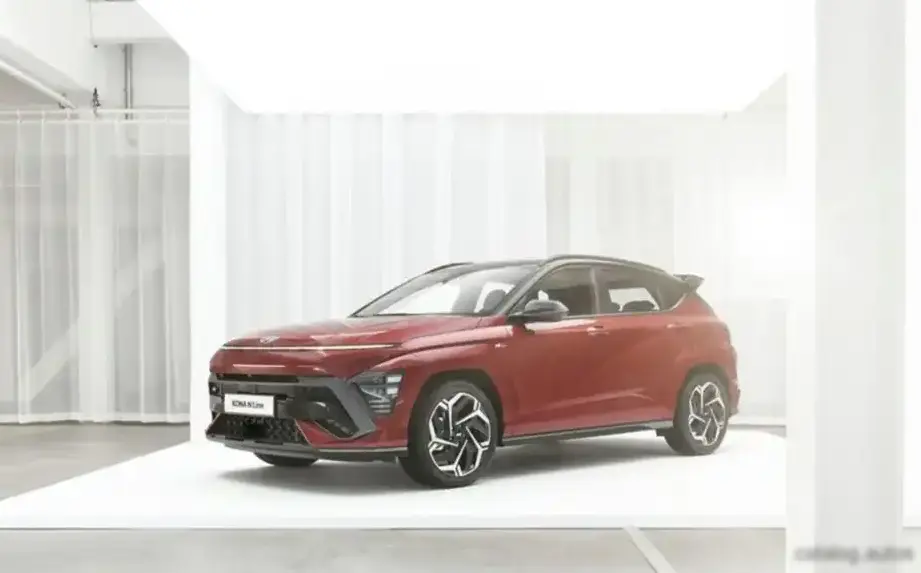
The Hyundai Kona II 1.6 T-GDI, producing 150 horsepower, represents a key variant within the second generation of Hyundai’s popular subcompact SUV. Introduced in August 2025, this model serves as a strong contender in the increasingly competitive crossover market, particularly appealing to buyers seeking a balance between fuel efficiency, modern features, and a relatively accessible price point. It’s built on the PF platform, shared with other Hyundai and Kia models, and positioned as a mid-range offering within the Kona II lineup, slotting between the base engine options and the more performance-oriented N-Line trims. This version aims to provide a practical and enjoyable driving experience for everyday use.
Technical Specifications
| Brand | Hyundai |
| Model | Kona |
| Generation | Kona II |
| Type (Engine) | 1.6 T-GDI (150 Hp) |
| Start of production | August, 2025 |
| Powertrain Architecture | Internal Combustion engine |
| Body type | SUV |
| Seats | 5 |
| Doors | 5 |
| Combined fuel consumption (WLTP) | 6.4-6.7 l/100 km (36.8 – 35.1 US mpg, 44.1 – 42.2 UK mpg, 15.6 – 14.9 km/l) |
| CO2 emissions (WLTP) | 146-153 g/km |
| Fuel Type | Petrol (Gasoline) |
| Acceleration 0 – 100 km/h | 9.8 sec |
| Acceleration 0 – 62 mph | 9.8 sec |
| Acceleration 0 – 60 mph | 9.3 sec |
| Maximum speed | 199 km/h (123.65 mph) |
| Emission standard | Euro 6e-bis |
| Weight-to-power ratio | 9 kg/Hp, 111.5 Hp/tonne |
| Weight-to-torque ratio | 5.4 kg/Nm, 185.9 Nm/tonne |
| Power | 150 Hp @ 6000 rpm |
| Power per litre | 93.9 Hp/l |
| Torque | 250 Nm @ 1500-4000 rpm (184.39 lb.-ft. @ 1500-4000 rpm) |
| Engine layout | Front, Transverse |
| Engine Model/Code | G4FP |
| Engine displacement | 1598 cm3 (97.52 cu. in.) |
| Number of cylinders | 4 |
| Engine configuration | Inline |
| Cylinder Bore | 75.6 mm (2.98 in.) |
| Piston Stroke | 89 mm (3.5 in.) |
| Number of valves per cylinder | 4 |
| Fuel injection system | Direct injection |
| Engine aspiration | Turbocharger, Intercooler |
| Engine oil capacity | 4.8 l (5.07 US qt | 4.22 UK qt) |
| Coolant | 8.6 l (9.09 US qt | 7.57 UK qt) |
| Kerb Weight | 1345-1475 kg (2965.22 – 3251.82 lbs.) |
| Max. weight | 1900 kg (4188.78 lbs.) |
| Max load | 425-555 kg (936.96 – 1223.57 lbs.) |
| Trunk (boot) space – minimum | 466 l (16.46 cu. ft.) |
| Trunk (boot) space – maximum | 1300 l (45.91 cu. ft.) |
| Fuel tank capacity | 47 l (12.42 US gal | 10.34 UK gal) |
| Max. roof load | 100 kg (220.46 lbs.) |
| Permitted trailer load with brakes (12%) | 1310 kg (2888.06 lbs.) |
| Permitted trailer load without brakes | 600 kg (1322.77 lbs.) |
| Permitted towbar download | 80 kg (176.37 lbs.) |
| Length | 4350 mm (171.26 in.) |
| Width | 1825 mm (71.85 in.) |
| Height | 1585 mm (62.4 in.) |
| Wheelbase | 2660 mm (104.72 in.) |
| Front track | 1591 mm (62.64 in.) |
| Rear (Back) track | 1600 mm (62.99 in.) |
| Ride height (ground clearance) | 170 mm (6.69 in.) |
| Drivetrain Architecture | The Internal combustion engine (ICE) drives the front wheels of the vehicle. |
| Drive wheel | Front wheel drive |
| Number of gears and type of gearbox | 6 gears, manual transmission |
| Front suspension | Independent type McPherson |
| Rear suspension | Torsion |
| Front brakes | Ventilated discs |
| Rear brakes | Disc |
| Assisting systems | ABS (Anti-lock braking system) |
| Steering type | Steering rack and pinion |
| Power steering | Electric Steering |
| Tires size | 215/60 R17; 215/55 R18 |
| Wheel rims size | 7.0J x 17; 7.0J x 18 |
Powertrain & Engine Architecture
At the heart of the Kona II 1.6 T-GDI lies the Hyundai-Kia G4FP engine, a 1.6-liter turbocharged inline-four cylinder gasoline engine. This engine utilizes direct injection technology, contributing to improved fuel efficiency and power delivery. The turbocharger, coupled with an intercooler, helps to mitigate turbo lag and maintain consistent boost across the engine’s operating range. The G4FP engine is known for its relatively compact design and lightweight construction, aiding in the Kona’s overall agility. The 6-speed manual transmission is standard, offering drivers a direct connection to the engine. The engine’s control unit (ECU) is tuned for a balance of performance and economy, prioritizing smooth operation in typical driving scenarios.
Driving Characteristics
The 150 hp 1.6 T-GDI engine provides adequate performance for daily commuting and highway driving. Acceleration from 0-60 mph takes approximately 9.3 seconds, making it competitive within its class. While not a sports-oriented engine, the turbocharger provides a noticeable boost in power during acceleration, offering a more engaging driving experience than naturally aspirated alternatives. The 6-speed manual transmission allows for precise gear selection, and the gear ratios are well-matched to the engine’s torque curve. Compared to higher-output Kona trims, this variant prioritizes fuel economy and a more relaxed driving style. The manual transmission provides a more involved driving experience than the optional dual-clutch transmission (DCT) available on some trims.
Equipment & Trim Levels
The 1.6 T-GDI trim typically includes standard features such as air conditioning, a touchscreen infotainment system with Apple CarPlay and Android Auto compatibility, Bluetooth connectivity, and a suite of safety features including lane departure warning, forward collision avoidance assist, and automatic emergency braking. Interior upholstery is generally cloth, with options for upgraded materials available. Higher trim levels within the 1.6 T-GDI range may add features like heated seats, a sunroof, and a premium audio system. Exterior features typically include alloy wheels, body-colored door handles and mirrors, and automatic headlights.
Chassis & Braking
The Kona II utilizes a front-wheel-drive platform with an independent McPherson strut suspension in the front and a torsion beam suspension in the rear. This setup provides a comfortable ride quality while maintaining reasonable handling characteristics. The front brakes are ventilated discs, while the rear brakes are solid discs. ABS (Anti-lock Braking System) is standard, enhancing braking performance and stability. The steering system is an electric power-assisted rack and pinion, providing light and precise steering feel. Stabilizer bars are included both front and rear to reduce body roll during cornering.
Market Reception & Comparison
The Hyundai Kona II 1.6 T-GDI has been generally well-received by automotive critics, praised for its stylish design, spacious interior, and fuel-efficient engine. Compared to other subcompact SUVs in its class, the Kona offers a compelling combination of features and value. Its fuel economy of 6.4-6.7 l/100 km is competitive, and its reliability has been generally good. Compared to the base engine options, the 1.6 T-GDI provides a noticeable performance upgrade, while remaining more affordable than the higher-output N-Line models. Some reviewers have noted that the interior materials could be of higher quality, but overall, the Kona II 1.6 T-GDI represents a strong contender in its segment.
Legacy
The G4FP engine has proven to be a relatively reliable powertrain in various Hyundai and Kia models. While long-term durability data is still emerging for the Kona II specifically, the engine’s direct injection system and turbocharger require regular maintenance to ensure optimal performance and longevity. On the used car market, the Kona II 1.6 T-GDI is expected to hold its value well due to its fuel efficiency, modern features, and Hyundai’s reputation for reliability. Properly maintained examples should provide years of dependable service, making it a practical and appealing choice for budget-conscious buyers.