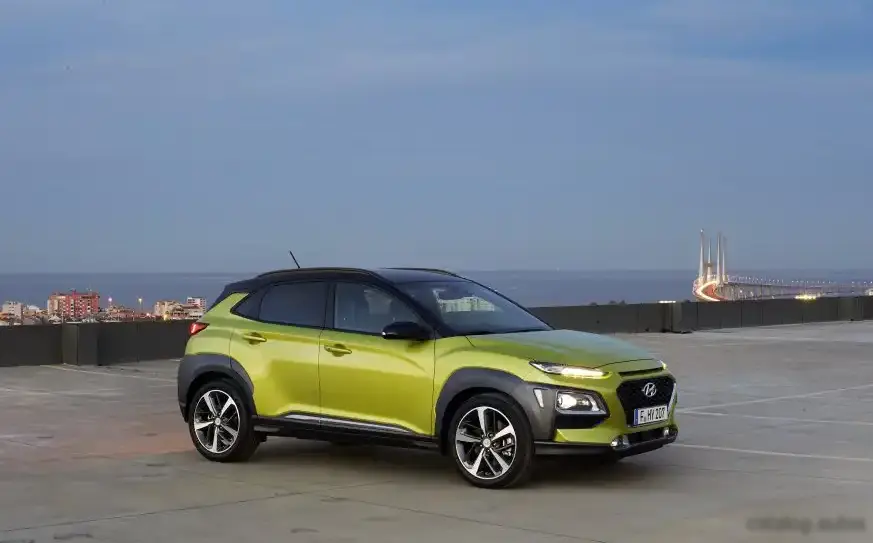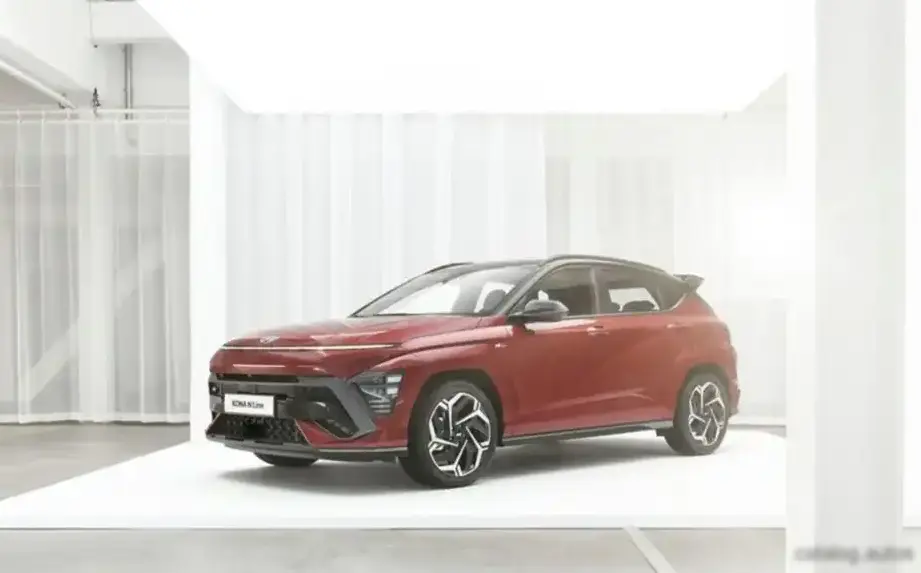
The Hyundai Kona II 1.6 T-GDI Automatic, launched in April 2023, represents a significant iteration of Hyundai’s popular subcompact SUV. This variant, powered by a 1.6-liter turbocharged gasoline direct injection (T-GDI) engine producing 190 horsepower, occupies a mid-range position within the Kona II lineup, offering a balance between performance and fuel efficiency. It’s built on the second generation Kona platform, aiming to provide a more refined driving experience and updated technology compared to its predecessor. The Kona II is primarily marketed towards consumers seeking a stylish, practical, and technologically advanced small SUV, particularly in markets where fuel economy and urban maneuverability are prioritized.
Technical Specifications
| Brand | Hyundai |
| Model | Kona |
| Generation | Kona II |
| Type (Engine) | 1.6 T-GDI (190 Hp) Automatic |
| Start of production | April, 2023 |
| Powertrain Architecture | Internal Combustion engine |
| Body type | SUV |
| Seats | 5 |
| Doors | 5 |
| Fuel consumption (economy) – urban (EPA) | 9 l/100 km (26.1 US mpg, 31.4 UK mpg, 11.1 km/l) |
| Fuel consumption (economy) – extra urban (EPA) | 7.4 l/100 km (31.8 US mpg, 38.2 UK mpg, 13.5 km/l) |
| Fuel consumption (economy) – combined (EPA) | 8.4 l/100 km (28 US mpg, 33.6 UK mpg, 11.9 km/l) |
| Fuel Type | Petrol (Gasoline) |
| Emission standard | WCC + UCC / SULEV 30 |
| Weight-to-power ratio | 7.8 kg/Hp, 128.2 Hp/tonne |
| Weight-to-torque ratio | 5.6 kg/Nm, 178.1 Nm/tonne |
| Power | 190 Hp @ 6000 rpm |
| Power per litre | 118.9 Hp/l |
| Torque | 264 Nm @ 1700-4500 rpm (194.72 lb.-ft. @ 1700-4500 rpm) |
| Engine layout | Front, Transverse |
| Engine Model/Code | Gamma II |
| Engine displacement | 1598 cm3 (97.52 cu. in.) |
| Number of cylinders | 4 |
| Engine configuration | Inline |
| Cylinder Bore | 75.6 mm (2.98 in.) |
| Piston Stroke | 89 mm (3.5 in.) |
| Compression ratio | 10:1 |
| Number of valves per cylinder | 4 |
| Fuel injection system | Direct injection |
| Engine aspiration | Turbocharger, Intercooler |
| Valvetrain | DOHC |
| Engine systems | Start & Stop System |
| Kerb Weight | 1482-1505 kg (3267.25 – 3317.96 lbs.) |
| Max. weight | 1940 kg (4276.97 lbs.) |
| Max load | 435-458 kg (959.01 – 1009.72 lbs.) |
| Trunk (boot) space – minimum | 722 l (25.5 cu. ft.) |
| Trunk (boot) space – maximum | 1804 l (63.71 cu. ft.) |
| Fuel tank capacity | 50 l (13.21 US gal | 11 UK gal) |
| Max. roof load | 100 kg (220.46 lbs.) |
| Length | 4384 mm (172.6 in.) |
| Width | 1826 mm (71.89 in.) |
| Height | 1585-1590 mm (62.4 – 62.6 in.) |
| Wheelbase | 2659 mm (104.69 in.) |
| Front track | 1582-1590 mm (62.28 – 62.6 in.) |
| Rear (Back) track | 1598-1600 mm (62.91 – 62.99 in.) |
| Front overhang | 866 mm (34.09 in.) |
| Rear overhang | 861 mm (33.9 in.) |
| Ride height (ground clearance) | 170-175 mm (6.69 – 6.89 in.) |
| Drag coefficient (Cd) | 0.302 |
| Minimum turning circle (turning diameter) | 10.6 m (34.78 ft.) |
| Drivetrain Architecture | The Internal combustion engine (ICE) drives the front wheels of the vehicle. |
| Drive wheel | Front wheel drive |
| Number of gears and type of gearbox | 8 gears, automatic transmission |
| Front suspension | Independent type McPherson, Transverse stabilizer |
| Rear suspension | Torsion |
| Front brakes | Ventilated discs, 304.8 mm |
| Rear brakes | Disc, 284.48 mm |
| Assisting systems | ABS (Anti-lock braking system) |
| Steering type | Steering rack and pinion |
| Power steering | Electric Steering |
| Tires size | 215/60 R17; 215/55 R18; 235/50 R18; 235/45 R19 |
| Wheel rims size | 7J x 17; 7J x 18; 7.5J x 18; 8J x 19 |
Powertrain & Engine Architecture
At the heart of the Kona II 1.6 T-GDI Automatic lies the Hyundai Gamma II engine, a 1.6-liter inline-four cylinder gasoline engine. This engine utilizes direct injection technology, injecting fuel directly into the combustion chamber for improved efficiency and power delivery. The engine is turbocharged, employing a twin-scroll turbocharger and intercooler to mitigate turbo lag and enhance boost pressure. The engine’s code is a key identifier for service and parts, and variations exist depending on specific market regulations. The engine is paired with an 8-speed automatic transmission, designed for smooth shifting and optimized fuel economy. This transmission features electronically controlled shift logic, adapting to driving conditions and driver input. The combination of direct injection, turbocharging, and an eight-speed automatic contributes to a responsive and relatively efficient powertrain.
Driving Characteristics
The 190 horsepower and 264 Nm (194.72 lb-ft) of torque produced by the 1.6 T-GDI engine provide adequate performance for everyday driving. While not a performance-oriented trim, the Kona II 1.6 T-GDI Automatic offers brisk acceleration and sufficient power for highway merging and overtaking. The 8-speed automatic transmission is tuned for comfort and efficiency, with gear ratios optimized for fuel economy. Compared to lower-powered Kona variants, such as those with naturally aspirated engines, the 1.6 T-GDI delivers a noticeably more responsive driving experience. However, it doesn’t match the outright performance of the higher-output engine options available in some markets. The front-wheel-drive configuration provides predictable handling, while the suspension setup prioritizes ride comfort over sporty handling.
Equipment & Trim Levels
The Kona II 1.6 T-GDI Automatic typically comes standard with a comprehensive suite of features, including a touchscreen infotainment system with Apple CarPlay and Android Auto compatibility, a rearview camera, and various driver-assistance systems such as lane keeping assist and forward collision avoidance. Interior upholstery is generally cloth, with options for leather upgrades on higher trim levels. Available options include a sunroof, heated and ventilated seats, a premium audio system, and advanced safety features like blind-spot monitoring and rear cross-traffic alert. The specific trim levels and available options vary depending on the market.
Chassis & Braking
The Kona II utilizes a McPherson strut front suspension and a torsion beam rear suspension. This setup provides a good balance between ride comfort and handling. The front brakes are ventilated discs, providing ample stopping power, while the rear brakes are solid discs. The electronic stability control (ESC) system and anti-lock braking system (ABS) are standard features, enhancing safety and control. Steering is provided by an electric power steering system, offering light and precise steering feel.
Market Reception & Comparison
The Hyundai Kona II 1.6 T-GDI Automatic has been generally well-received by automotive critics, praised for its stylish design, comfortable interior, and efficient powertrain. Fuel economy figures are competitive within the subcompact SUV segment. Compared to other trims in the Kona lineup, the 1.6 T-GDI Automatic offers a compelling balance between performance and price. It’s a step up in performance from the base engine options but remains more affordable than the higher-output variants. Reliability reports suggest that the Gamma II engine is generally reliable, although regular maintenance is crucial for optimal performance.
Legacy
The Hyundai Kona II 1.6 T-GDI Automatic represents a significant step forward in Hyundai’s subcompact SUV offerings. The combination of a turbocharged engine, an eight-speed automatic transmission, and a well-equipped interior has made it a popular choice among consumers. As the Kona II ages, its long-term reliability will become more apparent, but initial indications suggest that the powertrain is durable and capable. On the used car market, the 1.6 T-GDI Automatic is expected to hold its value well, particularly among buyers seeking a stylish, efficient, and technologically advanced small SUV.