Technical Specifications
| Brand | Hyundai |
| Model | Kona |
| Generation | Kona II |
| Type (Engine) | 1.6 T-GDI (190 Hp) AWD Automatic |
| Start of production | April, 2023 |
| Powertrain Architecture | Internal Combustion engine |
| Body type | SUV |
| Seats | 5 |
| Doors | 5 |
| Fuel consumption (economy) – urban (EPA) | 9.8 l/100 km (24 US mpg, 28.8 UK mpg, 10.2 km/l) |
| Fuel consumption (economy) – extra urban (EPA) | 8.1 l/100 km (29 US mpg, 34.9 UK mpg, 12.3 km/l) |
| Fuel consumption (economy) – combined (EPA) | 9 l/100 km (26.1 US mpg, 31.4 UK mpg, 11.1 km/l) |
| Fuel Type | Petrol (Gasoline) |
| Emission standard | WCC + UCC / SULEV 30 |
| Weight-to-power ratio | 8.3 kg/Hp, 120.3 Hp/tonne |
| Weight-to-torque ratio | 6 kg/Nm, 167.1 Nm/tonne |
| Power | 190 Hp @ 6000 rpm |
| Power per litre | 118.9 Hp/l |
| Torque | 264 Nm @ 1700-4500 rpm (194.72 lb.-ft. @ 1700-4500 rpm) |
| Engine layout | Front, Transverse |
| Engine Model/Code | Gamma II |
| Engine displacement | 1598 cm3 (97.52 cu. in.) |
| Number of cylinders | 4 |
| Engine configuration | Inline |
| Cylinder Bore | 75.6 mm (2.98 in.) |
| Piston Stroke | 89 mm (3.5 in.) |
| Compression ratio | 10:1 |
| Number of valves per cylinder | 4 |
| Fuel injection system | Direct injection |
| Engine aspiration | Turbocharger, Intercooler |
| Valvetrain | DOHC |
| Engine systems | Start & Stop System |
| Kerb Weight | 1580-1590 kg (3483.3 – 3505.35 lbs.) |
| Max. weight | 2020 kg (4453.34 lbs.) |
| Max load | 430-440 kg (947.99 – 970.03 lbs.) |
| Trunk (boot) space – minimum | 722 l (25.5 cu. ft.) |
| Trunk (boot) space – maximum | 1804 l (63.71 cu. ft.) |
| Fuel tank capacity | 50 l (13.21 US gal | 11 UK gal) |
| Max. roof load | 100 kg (220.46 lbs.) |
| Length | 4384 mm (172.6 in.) |
| Width | 1826 mm (71.89 in.) |
| Height | 1610-1615 mm (63.39 – 63.58 in.) |
| Wheelbase | 2659 mm (104.69 in.) |
| Front track | 1590 mm (62.6 in.) |
| Rear (Back) track | 1598-1600 mm (62.91 – 62.99 in.) |
| Front overhang | 866 mm (34.09 in.) |
| Rear overhang | 861 mm (33.9 in.) |
| Ride height (ground clearance) | 206-211 mm (8.11 – 8.31 in.) |
| Drag coefficient (Cd) | 0.302 |
| Minimum turning circle (turning diameter) | 10.6 m (34.78 ft.) |
| Drivetrain Architecture | The Internal combustion engine (ICE) drives the front wheels permanently, and the rear wheels are driven through an electrically or mechanically operated clutch if necessary. |
| Drive wheel | All wheel drive (4×4) |
| Number of gears and type of gearbox | 8 gears, automatic transmission |
| Front suspension | Independent type McPherson, Transverse stabilizer |
| Rear suspension | Independent multi-link spring suspension with stabilizer |
| Front brakes | Ventilated discs, 304.8 mm |
| Rear brakes | Disc, 284.48 mm |
| Assisting systems | ABS (Anti-lock braking system) |
| Steering type | Steering rack and pinion |
| Power steering | Electric Steering |
| Tires size | 215/60 R17; 215/55 R18; 235/50 R18; 235/45 R19 |
| Wheel rims size | 7J x 17; 7J x 18; 7.5J x 18; 8J x 19 |
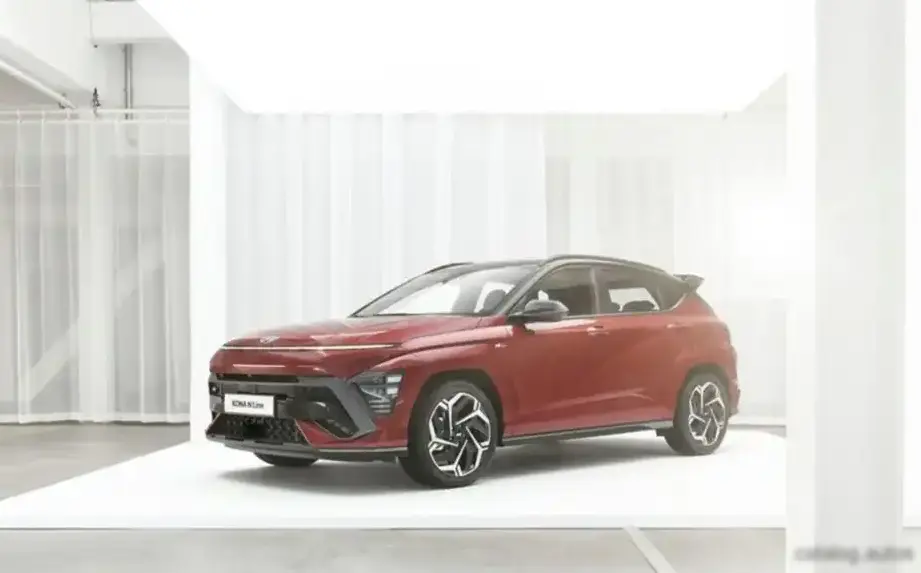
The Hyundai Kona II 1.6 T-GDI AWD Automatic, introduced in April 2023, is a key variant within the second-generation Kona lineup (internally designated as the Kona II). This model year marked a significant redesign for the Kona, moving to a more mature and sophisticated aesthetic while retaining its playful character. The 1.6 T-GDI engine, paired with an eight-speed automatic transmission and all-wheel drive, offers a compelling blend of performance and efficiency, targeting buyers who desire a versatile and capable subcompact SUV. It slots into the Kona range above the base 2.0-liter naturally aspirated engine and below the more performance-oriented N Line models.
Powertrain & Engine Architecture
At the heart of this Kona variant lies the Hyundai Gamma II 1.6-liter turbocharged gasoline direct injection (T-GDI) engine. This engine, identified by its internal code, delivers 190 horsepower at 6,000 rpm and 264 Nm (194.72 lb-ft) of torque between 1,700 and 4,500 rpm. The Gamma II engine utilizes a direct injection system, enhancing fuel efficiency and responsiveness. The turbocharger, coupled with an intercooler, provides increased power output without significantly increasing engine displacement. The engine features a dual overhead camshaft (DOHC) valvetrain with four valves per cylinder, optimizing airflow for improved performance. The eight-speed automatic transmission is a crucial component, offering smooth and efficient gear changes. It’s designed to work seamlessly with the engine’s torque curve, providing adequate acceleration and maintaining reasonable fuel economy. The transmission features a wide gear ratio spread, contributing to both fuel efficiency and responsive acceleration.
Driving Characteristics
The 1.6 T-GDI AWD Automatic Kona delivers a noticeably more spirited driving experience compared to the base 2.0-liter engine. The turbocharger provides a readily available boost, resulting in strong acceleration in everyday driving situations. While not a sports SUV, the 190 hp output and the eight-speed automatic provide sufficient power for highway merging and overtaking. The all-wheel-drive system enhances traction, particularly in inclement weather conditions, providing a secure and confident feel. The automatic transmission is generally smooth and responsive, although some drivers may find it occasionally hesitant during quick downshifts. Compared to a manual transmission equipped Kona, the automatic prioritizes convenience and ease of use over outright driver engagement. The gear ratios are tuned for a balance between fuel economy and performance, with taller gears for highway cruising and shorter gears for quicker acceleration.
Equipment & Trim Levels
The 1.6 T-GDI AWD Automatic trim typically includes a generous array of standard features. These commonly include automatic climate control, a touchscreen infotainment system with Apple CarPlay and Android Auto compatibility, a rearview camera, and a suite of advanced driver-assistance systems (ADAS) such as lane-keeping assist, forward collision avoidance assist, and adaptive cruise control. Interior upholstery is typically cloth, with available upgrades to leatherette or leather depending on optional packages. Higher trim levels within the 1.6 T-GDI range may add features like a sunroof, heated and ventilated front seats, a premium audio system, and larger alloy wheels. Optional extras often include a navigation system, wireless charging, and a head-up display.
Chassis & Braking
The Kona II utilizes a front McPherson strut suspension and a rear multi-link suspension, providing a comfortable and controlled ride. The suspension is tuned to balance handling and ride quality, offering a good compromise for everyday driving. Stabilizer bars are fitted to both the front and rear axles to reduce body roll during cornering. Braking duties are handled by ventilated discs at the front and solid discs at the rear. The braking system is equipped with ABS (Anti-lock Braking System) and electronic brake-force distribution (EBD) for enhanced safety. The all-wheel-drive system contributes to improved braking performance, particularly on slippery surfaces.
Market Reception & Comparison
The Hyundai Kona II 1.6 T-GDI AWD Automatic has been generally well-received by automotive critics. Reviewers have praised its stylish design, spacious interior, and engaging driving experience. The combination of the turbocharged engine and all-wheel drive has been highlighted as a significant strength, making it a competitive option in the subcompact SUV segment. Compared to the base 2.0-liter Kona, the 1.6 T-GDI offers a substantial performance upgrade. Fuel economy is comparable to other turbocharged engines in its class, with combined figures around 26.1 US mpg. Reliability reports have been generally positive, although long-term data is still emerging for the second-generation model.
Legacy
The Hyundai Kona II 1.6 T-GDI AWD Automatic represents a step forward in Hyundai’s commitment to delivering stylish, well-equipped, and capable subcompact SUVs. The Gamma II engine, while not without its potential for long-term maintenance concerns common to turbocharged engines (such as carbon buildup), has proven to be relatively reliable in other Hyundai and Kia applications. As the second-generation Kona matures, its long-term reliability will become clearer. On the used car market, these models are expected to hold their value reasonably well, particularly those with low mileage and a well-maintained service history. The combination of all-wheel drive, a turbocharged engine, and a comprehensive feature set makes it a desirable option for buyers seeking a versatile and modern subcompact SUV.