
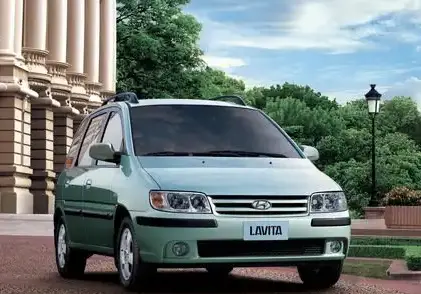
The Hyundai Lavita 1.5 CRDi, producing 82 horsepower, was a compact minivan marketed primarily in Europe and select other markets from 2001 to 2010. Positioned as an entry-level offering within the Lavita range, it aimed to provide affordable and fuel-efficient transportation for small families. The Lavita itself was a rebadged version of the Daewoo Nubira Wagon, following Hyundai’s acquisition of Daewoo Motors in 1998. This variant, with its small-displacement diesel engine and manual transmission, represented a focus on economy and practicality rather than outright performance. It competed with other small MPVs like the Opel/Vauxhall Meriva and Renault Modus.
Technical Specifications
| Brand | Hyundai |
| Model | Lavita |
| Generation | Lavita |
| Type (Engine) | 1.5 CRDi (82 Hp) |
| Start of production | 2001 |
| End of production | 2010 |
| Powertrain Architecture | Internal Combustion engine |
| Body type | Minivan |
| Seats | 5 |
| Doors | 4 |
| Fuel consumption (urban) | 7.6 l/100 km (30.9 US mpg) |
| Fuel consumption (extra urban) | 5 l/100 km (47 US mpg) |
| Fuel consumption (combined) | 6 l/100 km (39.2 US mpg) |
| Fuel Type | Diesel |
| Acceleration 0 – 100 km/h | 17.9 sec |
| Acceleration 0 – 62 mph | 17.9 sec |
| Acceleration 0 – 60 mph | 17 sec |
| Maximum speed | 157 km/h (97.56 mph) |
| Weight-to-power ratio | 16.7 kg/Hp |
| Weight-to-torque ratio | 7.3 kg/Nm |
| Power | 82 Hp @ 4000 rpm |
| Power per litre | 54.9 Hp/l |
| Torque | 187 Nm @ 2000 rpm (137.92 lb.-ft. @ 2000 rpm) |
| Engine layout | Front, Transverse |
| Engine Model/Code | D / D3EA |
| Engine displacement | 1493 cm3 (91.11 cu. in.) |
| Number of cylinders | 3 |
| Engine configuration | Inline |
| Cylinder Bore | 83 mm (3.27 in.) |
| Piston Stroke | 92 mm (3.62 in.) |
| Compression ratio | 17.7:1 |
| Number of valves per cylinder | 4 |
| Fuel injection system | Diesel Commonrail |
| Engine aspiration | Turbocharger, Intercooler |
| Valvetrain | OHC |
| Engine oil capacity | 4.8 l (5.07 US qt | 4.22 UK qt) |
| Coolant | 6.3 l (6.66 US qt | 5.54 UK qt) |
| Kerb Weight | 1370 kg (3020.33 lbs.) |
| Max. weight | 1840 kg (4056.51 lbs.) |
| Max load | 470 kg (1036.17 lbs.) |
| Trunk (boot) space – minimum | 350 l (12.36 cu. ft.) |
| Trunk (boot) space – maximum | 1284 l (45.34 cu. ft.) |
| Fuel tank capacity | 55 l (14.53 US gal | 12.1 UK gal) |
| Length | 4025 mm (158.46 in.) |
| Width | 1740 mm (68.5 in.) |
| Height | 1635 mm (64.37 in.) |
| Wheelbase | 2600 mm (102.36 in.) |
| Front track | 1485 mm (58.46 in.) |
| Rear (Back) track | 1485 mm (58.46 in.) |
| Drivetrain Architecture | Front wheel drive |
| Drive wheel | Front wheel drive |
| Number of gears and type of gearbox | 5 gears, manual transmission |
| Front suspension | Wishbone |
| Rear suspension | Double wishbone |
| Front brakes | Ventilated discs |
| Rear brakes | Drum |
| Assisting systems | ABS (Anti-lock braking system) |
| Steering type | Steering rack and pinion |
| Power steering | Hydraulic Steering |
| Tires size | 185/65 R14 |
INTRODUCTION
The Hyundai Lavita, launched in 2001, was a key model for Hyundai as it sought to establish itself as a mainstream automotive manufacturer in Europe. Based on the Daewoo Nubira Wagon platform, the Lavita offered a practical and affordable alternative to more established European MPVs. The 1.5 CRDi variant, equipped with an 82 horsepower diesel engine, was introduced to cater to buyers prioritizing fuel economy and low running costs. This trim level served as the entry point to the Lavita range, appealing to budget-conscious consumers and those seeking a utilitarian vehicle for daily commuting and family duties. Production continued until 2010, with minor updates throughout its lifespan.
Powertrain & Engine Architecture
The heart of the Lavita 1.5 CRDi is the D3EA engine, a 1.5-liter inline-three cylinder diesel. This engine utilizes a common rail direct injection (CRDi) system, which delivers fuel directly into the combustion chamber at extremely high pressure, improving combustion efficiency and reducing emissions. The D3EA engine is a turbocharged and intercooled unit, enhancing power output and torque. The turbocharger forces more air into the engine, while the intercooler cools the compressed air, further increasing density and performance. The engine features an overhead camshaft (OHC) valvetrain with four valves per cylinder. The five-speed manual transmission was the only gearbox option available with this engine, chosen for its efficiency and simplicity. The engine code ‘D’ is sometimes used interchangeably with ‘D3EA’.
Driving Characteristics
The 82 horsepower output of the 1.5 CRDi engine translates to modest performance. Acceleration from 0 to 60 mph takes approximately 17 seconds, and the top speed is around 97 mph. The engine delivers its peak torque of 187 Nm (137.92 lb-ft) at 2000 rpm, providing adequate pulling power for everyday driving situations. However, it feels strained when fully loaded or attempting to overtake at higher speeds. The five-speed manual transmission is well-matched to the engine’s characteristics, with gear ratios optimized for fuel efficiency. Compared to higher-output versions of the Lavita, such as those equipped with a 1.8-liter gasoline engine, the 1.5 CRDi offers significantly less power but superior fuel economy. The manual transmission provides more driver engagement than an automatic would, but also requires more effort in stop-and-go traffic.
Equipment & Trim Levels
The Lavita 1.5 CRDi typically came with a relatively basic level of equipment, reflecting its position as the entry-level model. Standard features generally included power steering, central locking, electric front windows, and an adjustable steering column. Air conditioning was often an optional extra. Interior upholstery was typically cloth, and the dashboard featured a functional but unpretentious design. Higher trim levels offered upgrades such as alloy wheels, a CD player, and more comprehensive interior trim. Safety features were limited, typically including ABS brakes and driver and passenger airbags.
Chassis & Braking
The Lavita 1.5 CRDi utilizes a front-wheel-drive layout with independent wishbone suspension at the front and a double wishbone suspension at the rear. This suspension setup provides a reasonably comfortable ride, although it can feel somewhat unsettled on uneven surfaces. The front brakes are ventilated discs, offering good stopping power, while the rear brakes are drums, a cost-saving measure common in this class of vehicle. The steering is rack and pinion, providing precise and responsive handling. The tires are typically 185/65 R14, offering a balance of comfort and grip.
Market Reception & Comparison
The Lavita 1.5 CRDi was generally well-received by critics for its fuel efficiency and affordability. However, its modest performance and basic interior were often criticized. Compared to other small MPVs in its class, the Lavita offered a competitive price point but lacked the refinement and features of some of its rivals. Fuel economy was a key selling point, with the 1.5 CRDi achieving around 39.2 US mpg on the combined cycle. Reliability was generally good, although some owners reported issues with the diesel particulate filter (DPF) and the common rail injection system.
Legacy
The Hyundai Lavita 1.5 CRDi has become a relatively affordable and practical used car option. The D3EA engine, while not known for its blistering performance, is generally considered to be reliable if properly maintained. Regular servicing, including oil changes and filter replacements, is crucial to ensure longevity. The availability of spare parts is generally good, although some components may be becoming increasingly difficult to find. Today, the Lavita 1.5 CRDi represents a budget-friendly option for those seeking a small, fuel-efficient MPV for basic transportation needs. Its simple mechanicals make it relatively easy to maintain, and its practicality continues to appeal to a wide range of buyers.
