
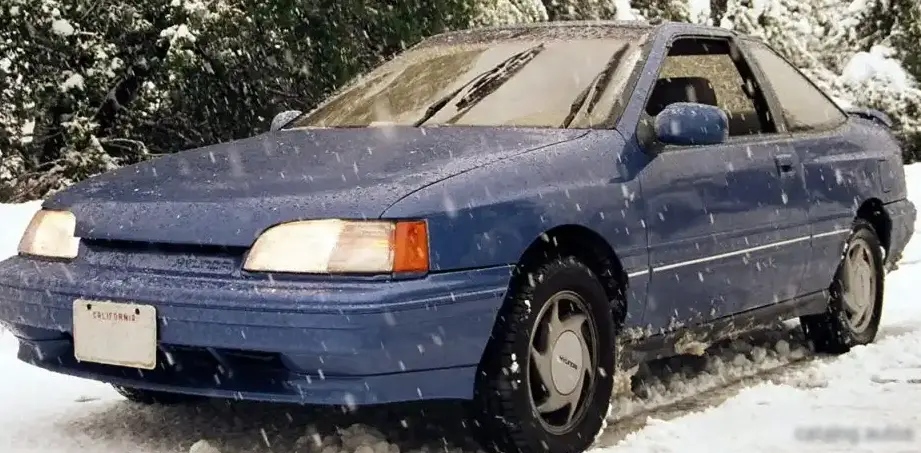
The Hyundai S-Coupe, internally designated SLC, was a compact coupe produced by the South Korean automaker Hyundai from 1989 to 1993. Representing Hyundai’s early foray into more stylish and performance-oriented vehicles, the S-Coupe aimed to broaden the brand’s appeal beyond purely utilitarian offerings. The 1.5 i variant, producing 84 horsepower, served as the entry-level model in the S-Coupe lineup, offering a more affordable and fuel-efficient option compared to the higher-specification trims. It was a key model in establishing Hyundai’s presence in emerging export markets, particularly in Europe and Australia, where it competed with vehicles like the Ford Escort and Opel Astra coupes.
Technical Specifications
| Brand | Hyundai |
| Model | S-Coupe |
| Generation | S-Coupe (SLC) |
| Type (Engine) | 1.5 i (84 Hp) |
| Start of production | 1989 |
| End of production | 1993 |
| Powertrain Architecture | Internal Combustion engine |
| Body type | Coupe |
| Seats | 4 |
| Doors | 2 |
| Fuel Type | Petrol (Gasoline) |
| Power | 84 Hp |
| Engine aspiration | Naturally aspirated engine |
| Drivetrain | Front wheel drive |
| Number of gears | 5 |
| Gearbox type | Manual transmission |
Powertrain & Engine Architecture
The 1.5 i S-Coupe was powered by the Hyundai G4HB engine, a 1.5-liter inline-four cylinder gasoline engine. This engine, a mainstay in several early Hyundai models, featured a single overhead camshaft (SOHC) valvetrain with eight valves. Fuel delivery was managed by a multi-point fuel injection system, a relatively modern feature for its time, contributing to improved fuel efficiency and reduced emissions compared to carbureted engines. The engine’s modest 84 horsepower output at 6,000 rpm and 98 lb-ft of torque at 3,600 rpm were typical for a vehicle of its class and displacement in the late 1980s and early 1990s. The engine block was constructed from cast iron, while the cylinder head was made of aluminum alloy. The five-speed manual transmission was a standard feature, providing a relatively engaging driving experience. The transmission was a conventional design, known for its durability and ease of maintenance.
Driving Characteristics
The S-Coupe 1.5 i offered a comfortable, if not particularly sporty, driving experience. The 84 horsepower engine provided adequate power for everyday driving, but acceleration was modest. Zero to sixty mph times were estimated to be around 12-13 seconds. The five-speed manual transmission allowed drivers to keep the engine in its optimal power band, but the relatively long gearing emphasized fuel economy over outright performance. Handling was generally predictable, with a front-wheel-drive configuration providing good traction in most conditions. Compared to the later 1.6L and 2.0L versions of the S-Coupe, the 1.5 i felt noticeably less powerful, particularly when fully loaded with passengers or cargo. The steering was light and easy to use, making it well-suited for urban driving. The suspension, while not particularly sophisticated, provided a reasonably comfortable ride, absorbing most road imperfections without excessive body roll.
Equipment & Trim Levels
The 1.5 i S-Coupe was positioned as the entry-level model, and as such, its standard equipment list was relatively basic. Standard features typically included cloth upholstery, a basic AM/FM radio, and manual windows and door locks. Power steering was often included, but air conditioning was typically an optional extra. Interior trim was generally functional and durable, with a focus on practicality rather than luxury. Optional extras included upgraded audio systems, alloy wheels, and a sunroof. The dashboard layout was simple and straightforward, with clearly labeled controls. The S-Coupe 1.5 i’s interior was designed to appeal to budget-conscious buyers who prioritized value and reliability over lavish features.
Chassis & Braking
The S-Coupe utilized a front-wheel-drive chassis with independent front suspension featuring MacPherson struts and a torsion beam rear suspension. This configuration provided a good balance between ride comfort and handling. The braking system consisted of disc brakes on the front wheels and drum brakes on the rear wheels. While adequate for the vehicle’s weight and performance, the rear drum brakes were a cost-saving measure compared to the all-disc setups found on higher-specification trims. The steering system was a rack-and-pinion setup, providing precise and responsive steering feel. The chassis was relatively lightweight, contributing to the S-Coupe’s fuel efficiency. Stabilizer bars were fitted to both the front and rear axles to reduce body roll during cornering.
Market Reception & Comparison
The S-Coupe 1.5 i received mixed reviews from automotive critics. While praised for its affordability and fuel efficiency, it was often criticized for its lack of power and relatively basic interior. Compared to its rivals, such as the Ford Escort and Opel Astra coupes, the S-Coupe offered a competitive price point but lacked the refinement and performance of some of its competitors. Fuel economy was a strong point, with the 1.5 i achieving around 35-40 mpg on the highway. Reliability was generally good, although some owners reported minor issues with the fuel injection system. The 1.6L and 2.0L S-Coupe variants offered significantly more performance, but at a higher price. The 1.5 i appealed to buyers who prioritized economy and practicality over sporty driving dynamics.
Legacy
The Hyundai S-Coupe 1.5 i, while not a groundbreaking vehicle, played an important role in establishing Hyundai as a credible automaker in international markets. The G4HB engine proved to be a durable and reliable powerplant, and many examples of the 1.5 i S-Coupe remain on the road today. In the used car market, the 1.5 i is often sought after by enthusiasts looking for an affordable and classic Korean coupe. Parts availability can be a challenge, but many components are still available through aftermarket suppliers. The S-Coupe 1.5 i represents a significant milestone in Hyundai’s history, demonstrating the company’s ambition to produce stylish and well-equipped vehicles that could compete with established European and Japanese brands. Its simple mechanical design and relatively low maintenance costs make it an appealing option for those seeking a classic and affordable coupe.
