
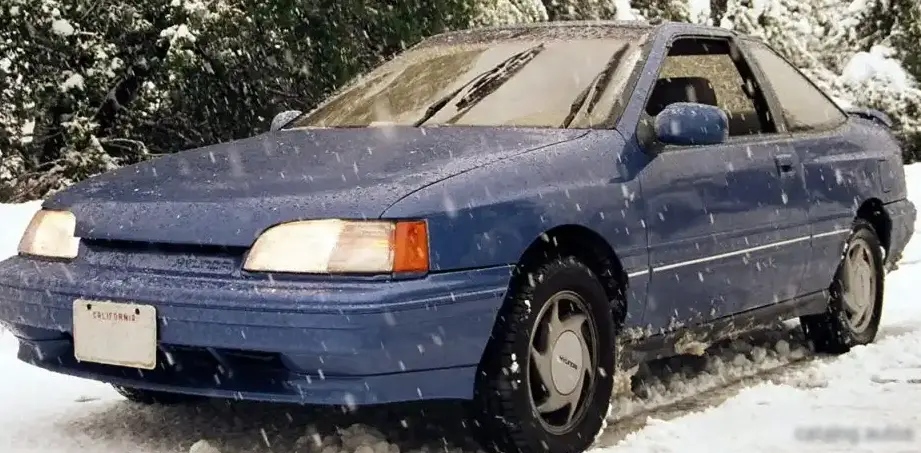
The Hyundai S-Coupe, internally designated SLC, represented Hyundai’s foray into the compact coupe market during the early to mid-1990s. Produced between 1993 and 1996, the S-Coupe was primarily aimed at the European market, offering an affordable and stylish alternative to established European and Japanese competitors. The 1.5 i variant, powered by a 1.5-liter inline-four engine producing 90 horsepower, served as the entry-level model in the S-Coupe lineup. It was positioned as a fuel-efficient and accessible option for younger drivers or those seeking a budget-friendly coupe.
Technical Specifications
| Brand | Hyundai |
| Model | S-Coupe |
| Generation | S-Coupe (SLC) |
| Type (Engine) | 1.5 i (90 Hp) |
| Start of production | 1993 |
| End of production | 1996 |
| Powertrain Architecture | Internal Combustion engine |
| Body type | Coupe |
| Seats | 4 |
| Doors | 2 |
| Fuel consumption (combined) | 7.7 l/100 km (30.5 US mpg, 36.7 UK mpg, 13 km/l) |
| Fuel Type | Petrol (Gasoline) |
| Acceleration 0 – 100 km/h | 11.4 sec |
| Acceleration 0 – 62 mph | 11.4 sec |
| Acceleration 0 – 60 mph | 10.8 sec |
| Maximum speed | 178 km/h (110.6 mph) |
| Weight-to-power ratio | 10.8 kg/Hp, 92.3 Hp/tonne |
| Weight-to-torque ratio | 7.5 kg/Nm, 133.3 Nm/tonne |
| Power | 90 Hp @ 5600 rpm |
| Power per litre | 60.2 Hp/l |
| Torque | 130 Nm @ 3050 rpm (95.88 lb.-ft. @ 3050 rpm) |
| Engine layout | Front, Transverse |
| Engine displacement | 1495 cm3 (91.23 cu. in.) |
| Number of cylinders | 4 |
| Engine configuration | Inline |
| Cylinder Bore | 75.5 mm (2.97 in.) |
| Piston Stroke | 83.5 mm (3.29 in.) |
| Compression ratio | 10:1 |
| Number of valves per cylinder | 3 |
| Fuel injection system | Multi-port manifold injection |
| Engine aspiration | Naturally aspirated engine |
| Valvetrain | OHC |
| Kerb Weight | 975 kg (2149.51 lbs.) |
| Max. weight | 1440 kg (3174.66 lbs.) |
| Max load | 465 kg (1025.15 lbs.) |
| Trunk (boot) space – maximum | 262 l (9.25 cu. ft.) |
| Fuel tank capacity | 45 l (11.89 US gal | 9.9 UK gal) |
| Length | 4215 mm (165.94 in.) |
| Width | 1640 mm (64.57 in.) |
| Height | 1328 mm (52.28 in.) |
| Wheelbase | 2383 mm (93.82 in.) |
| Front track | 1390 mm (54.72 in.) |
| Rear (Back) track | 1343 mm (52.87 in.) |
| Drivetrain Architecture | The Internal combustion engine (ICE) drives the front wheels of the vehicle. |
| Drive wheel | Front wheel drive |
| Number of gears and type of gearbox | 5 gears, manual transmission |
| Front suspension | Spring Strut |
| Rear suspension | Transverse stabilizer |
| Front brakes | Disc |
| Rear brakes | Drum |
| Assisting systems | ABS (Anti-lock braking system) |
| Steering type | Steering rack and pinion |
| Power steering | Hydraulic Steering |
| Tires size | 185/60 R14 |
Powertrain & Engine Architecture
The heart of the S-Coupe 1.5 i is the Hyundai G4CR engine, a 1.5-liter inline-four cylinder gasoline engine. This engine utilizes a single overhead camshaft (OHC) valvetrain with three valves per cylinder (two intake, one exhaust). Fuel delivery is managed by a multi-port fuel injection system, providing a balance between efficiency and performance. The engine’s 10:1 compression ratio contributes to its modest power output. The engine was known for its relative simplicity and ease of maintenance. The 1.5L engine was paired with a 5-speed manual transmission, which was the standard offering. While an automatic transmission was available in some markets, it was less common with the 1.5L engine.
Driving Characteristics
The 90 horsepower and 130 Nm (95.88 lb-ft) of torque produced by the 1.5-liter engine resulted in a 0-60 mph time of around 10.8 seconds and a top speed of 110.6 mph. While not particularly quick, the S-Coupe 1.5 i offered adequate performance for everyday driving. The manual transmission provided a more engaging driving experience compared to the optional automatic, allowing drivers to better utilize the engine’s limited power band. The gear ratios were tuned for fuel efficiency rather than outright acceleration. Compared to the more powerful S-Coupe variants, such as those equipped with the 1.6L or 1.8L engines, the 1.5 i felt noticeably slower, particularly when accelerating or overtaking. However, it offered a more economical and accessible entry point into the S-Coupe range.
Equipment & Trim Levels
The S-Coupe 1.5 i typically came with a fairly basic level of equipment, reflecting its position as the entry-level model. Standard features generally included power steering, central locking, and a basic audio system. Interior upholstery was typically cloth, and the dashboard featured a functional, if somewhat spartan, design. Optional extras included power windows, a sunroof, and upgraded audio systems. The trim levels varied slightly depending on the market, but the 1.5 i generally represented the most affordable and minimally equipped version of the S-Coupe.
Chassis & Braking
The S-Coupe utilized a front-wheel-drive layout with a MacPherson strut suspension in the front and a torsion beam suspension in the rear. The front brakes were disc brakes, providing adequate stopping power, while the rear brakes were drum brakes, a cost-saving measure common in this class of vehicle. Anti-lock braking system (ABS) was available as an option, enhancing safety. The chassis was designed to provide a comfortable ride, prioritizing everyday usability over sporty handling. The relatively lightweight construction of the 1.5 i model (975 kg / 2149.51 lbs) helped to mitigate the effects of its modest power output.
Market Reception & Comparison
The S-Coupe 1.5 i was generally well-received as an affordable and stylish coupe. Critics praised its attractive design and reasonable fuel economy. However, its performance was often criticized as being underwhelming, particularly when compared to more powerful competitors. In terms of fuel economy, the 1.5 i offered a competitive advantage over larger-engined S-Coupe variants, achieving around 30.5 US mpg on combined cycles. Reliability was generally good, although some owners reported minor issues with the fuel injection system. Compared to the 1.6L and 1.8L S-Coupe models, the 1.5 i appealed to a different demographic – those prioritizing affordability and fuel efficiency over outright performance.
Legacy
The Hyundai S-Coupe, including the 1.5 i variant, represents an important milestone in Hyundai’s history. It was one of the first Hyundai models to gain significant traction in the European market, demonstrating the company’s growing ambition and design capabilities. While the 1.5 i engine isn’t known for exceptional longevity, it’s generally considered a reliable unit when properly maintained. Today, the S-Coupe 1.5 i is a relatively rare sight on the roads, but it has gained a following among enthusiasts who appreciate its retro styling and affordability. Parts availability can be a challenge, but the engine’s simplicity makes it relatively easy to repair. The S-Coupe 1.5 i remains a testament to Hyundai’s early efforts to establish itself as a major player in the global automotive market.
