
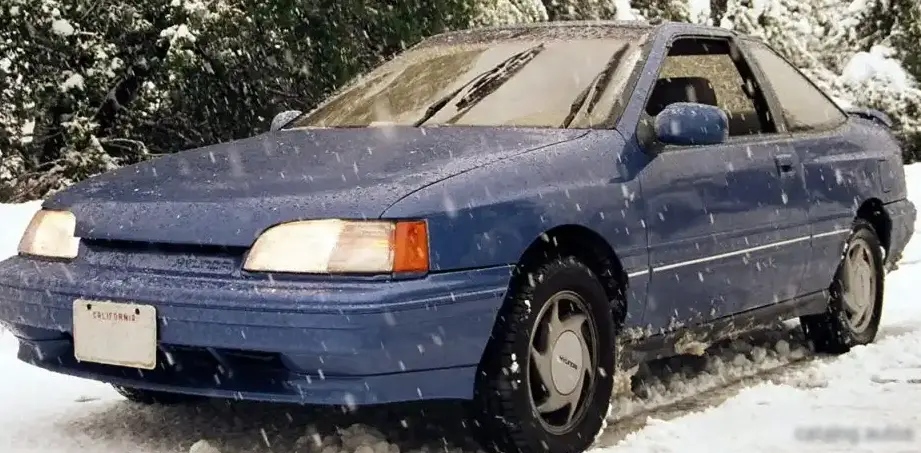
The Hyundai S-Coupe, internally designated SLC, represented Hyundai’s foray into the compact coupe market during the early to mid-1990s. Produced between 1993 and 1996, the S-Coupe aimed to offer affordable style and practicality to buyers, particularly in Europe and Asia where the demand for sporty, yet economical vehicles was growing. The 1.5 i GT variant, powered by a 1.5-liter turbocharged engine producing 115 horsepower, occupied a middle ground within the S-Coupe lineup, offering a balance between performance and fuel efficiency. It was positioned above the base 1.5 GL models and below the more powerful 1.6 and 2.0-liter options.
Technical Specifications
| Brand | Hyundai |
| Model | S-Coupe |
| Generation | S-Coupe (SLC) |
| Type (Engine) | 1.5 i GT (115 Hp) |
| Start of production | 1993 |
| End of production | 1996 |
| Powertrain Architecture | Internal Combustion engine |
| Body type | Coupe |
| Seats | 4 |
| Doors | 2 |
| Fuel consumption (combined) | 8.5 l/100 km |
| Fuel consumption (US mpg) | 27.7 US mpg |
| Fuel consumption (UK mpg) | 33.2 UK mpg |
| Fuel consumption (km/l) | 11.8 km/l |
| Fuel Type | Petrol (Gasoline) |
| Acceleration 0 – 100 km/h | 9.5 sec |
| Acceleration 0 – 62 mph | 9.5 sec |
| Acceleration 0 – 60 mph | 9 sec |
| Maximum speed | 195 km/h (121.17 mph) |
| Weight-to-power ratio | 8.6 kg/Hp |
| Weight-to-torque ratio | 5.8 kg/Nm |
| Power | 115 Hp @ 5600 rpm |
| Power per litre | 76.9 Hp/l |
| Torque | 171 Nm @ 4300 rpm (126.12 lb.-ft. @ 4300 rpm) |
| Engine layout | Front, Transverse |
| Engine displacement | 1495 cm3 (91.23 cu. in.) |
| Number of cylinders | 4 |
| Engine configuration | Inline |
| Cylinder Bore | 75.5 mm (2.97 in.) |
| Piston Stroke | 83.5 mm (3.29 in.) |
| Compression ratio | 7.5:1 |
| Number of valves per cylinder | 3 |
| Fuel injection system | Multi-port manifold injection |
| Engine aspiration | Turbocharger |
| Valvetrain | OHC |
| Kerb Weight | 985 kg (2171.55 lbs.) |
| Max. weight | 1440 kg (3174.66 lbs.) |
| Max load | 455 kg (1003.1 lbs.) |
| Trunk (boot) space – maximum | 262 l (9.25 cu. ft.) |
| Fuel tank capacity | 45 l (11.89 US gal | 9.9 UK gal) |
| Length | 4215 mm (165.94 in.) |
| Width | 1640 mm (64.57 in.) |
| Height | 1328 mm (52.28 in.) |
| Wheelbase | 2383 mm (93.82 in.) |
| Front track | 1390 mm (54.72 in.) |
| Rear (Back) track | 1343 mm (52.87 in.) |
| Drivetrain Architecture | The Internal combustion engine (ICE) drives the front wheels of the vehicle. |
| Drive wheel | Front wheel drive |
| Number of gears and type of gearbox | 5 gears, manual transmission |
| Front suspension | Spring Strut |
| Rear suspension | Transverse stabilizer |
| Front brakes | Ventilated discs |
| Rear brakes | Drum |
| Assisting systems | ABS (Anti-lock braking system) |
| Steering type | Steering rack and pinion |
| Power steering | Hydraulic Steering |
| Tires size | 185/60 R14 |
Powertrain & Engine Architecture
The heart of the S-Coupe 1.5 i GT is its 1495cc inline-four cylinder engine. This engine, utilizing a single overhead camshaft (OHC) valvetrain with three valves per cylinder, was notable for being turbocharged. The turbocharger, a Garrett unit, provided a significant boost in power compared to the naturally aspirated 1.5-liter engines available in other S-Coupe trims. Fuel delivery was managed by a multi-port fuel injection system, ensuring precise fuel metering for optimal combustion. The engine produced 115 horsepower at 5600 rpm and 171 Nm (126.12 lb-ft) of torque at 4300 rpm. This power was transmitted to the front wheels through a five-speed manual transmission, the only gearbox option available for this variant. The engine’s relatively low 7.5:1 compression ratio was a necessity due to the turbocharging system.
Driving Characteristics
The S-Coupe 1.5 i GT offered a noticeable step up in performance compared to the base models. The turbocharger provided a surge of power in the mid-range, making overtaking maneuvers easier and more confident. While not a sports car by any means, the 1.5 i GT offered a reasonably engaging driving experience for its class. Acceleration from 0 to 60 mph took approximately 9 seconds, and it could reach a top speed of 195 km/h (121 mph). The five-speed manual transmission allowed drivers to keep the engine in its optimal power band. Compared to the larger 1.6 and 2.0-liter S-Coupe models, the 1.5 i GT felt less powerful, but its lighter weight and responsive turbocharger helped to compensate. The gear ratios were tuned for a balance of acceleration and fuel economy.
Equipment & Trim Levels
The 1.5 i GT trim level typically included features such as power steering, alloy wheels, and a more comprehensive instrument cluster compared to the base GL model. Interior appointments included cloth upholstery, and a basic stereo system. Optional extras could include a sunroof, upgraded sound system, and central locking. The dashboard layout was functional and straightforward, prioritizing usability over luxury. The GT trim also featured slightly sportier exterior styling cues, such as a rear spoiler and body-colored bumpers.
Chassis & Braking
The S-Coupe utilized a front-wheel-drive layout with a MacPherson strut suspension in the front and a transverse stabilizer in the rear. The front brakes were ventilated discs, providing adequate stopping power, while the rear brakes were drums. The suspension setup was tuned for comfort, offering a relatively smooth ride, but it wasn’t particularly sporty. The steering was rack and pinion, providing reasonable precision. The car rode on 185/60 R14 tires, which offered a good balance of grip and ride comfort.
Market Reception & Comparison
The S-Coupe 1.5 i GT was generally well-received by automotive critics as an affordable and stylish coupe. It was praised for its turbocharged engine, which provided a noticeable performance boost. However, some critics noted that the interior was somewhat basic and lacked the refinement of some of its competitors. In terms of fuel economy, the 1.5 i GT offered a respectable 8.5 l/100 km (27.7 US mpg). Compared to the naturally aspirated 1.5 GL, the GT offered significantly better performance, but at a slightly higher price point. The larger 1.6 and 2.0-liter S-Coupe models offered even more power, but they were also more expensive and less fuel-efficient.
Legacy
The Hyundai S-Coupe, particularly the 1.5 i GT variant, has developed a modest following among enthusiasts. The turbocharged engine is considered a highlight, and the car’s affordability makes it an attractive entry point into the world of classic coupes. While not known for being particularly complex mechanically, regular maintenance is crucial to ensure the longevity of the turbocharger and engine. Today, well-maintained examples of the S-Coupe 1.5 i GT can be found on the used car market, offering a unique and affordable alternative to more mainstream coupes of the era. The engine, while not without its quirks, is generally considered reliable if properly cared for, and parts availability remains reasonable.
