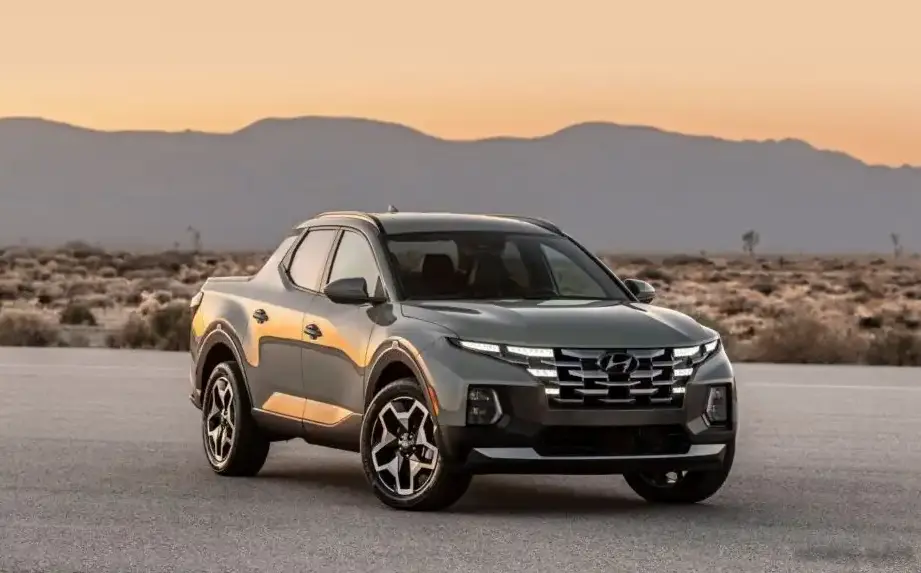
The Hyundai Santa Cruz 2.5 GDI MPI Automatic, produced from June 2021 through March 2024, represents a key variant within the first generation of Hyundai’s compact pickup truck. Introduced as a novel offering in the American market, the Santa Cruz aimed to bridge the gap between traditional trucks and smaller crossover SUVs, appealing to buyers seeking utility with a more manageable size and improved fuel efficiency. The 2.5-liter engine paired with an eight-speed automatic transmission served as the mainstream powertrain option, positioned between the base 2.5-liter naturally aspirated engine and the more powerful turbocharged 2.5-liter variant. This configuration targeted buyers prioritizing a balance of affordability, everyday usability, and reasonable performance.
Technical Specifications
| Brand | Hyundai |
| Model | Santa Cruz |
| Generation | Santa Cruz |
| Type (Engine) | 2.5 GDI MPI (191 Hp) Automatic |
| Start of production | June, 2021 |
| End of production | March, 2024 |
| Powertrain Architecture | Internal Combustion engine |
| Body type | Pick-up |
| Seats | 5 |
| Doors | 4 |
| Fuel consumption (economy) – urban (EPA) | 10.7 l/100 km (22 US mpg, 26.4 UK mpg, 9.3 km/l) |
| Fuel consumption (economy) – extra urban (EPA) | 9 l/100 km (26.1 US mpg, 31.4 UK mpg, 11.1 km/l) |
| Fuel consumption (economy) – combined (EPA) | 10.2 l/100 km (23.1 US mpg, 27.7 UK mpg, 9.8 km/l) |
| Fuel Type | Petrol (Gasoline) |
| Emission standard | ULEV |
| Weight-to-power ratio | 8.9 kg/Hp, 112.2 Hp/tonne |
| Weight-to-torque ratio | 7 kg/Nm, 143.9 Nm/tonne |
| Power | 191 Hp @ 6100 rpm |
| Power per litre | 76.5 Hp/l |
| Torque | 245 Nm @ 4000 rpm (180.7 lb.-ft. @ 4000 rpm) |
| Engine layout | Front, Transverse |
| Engine Model/Code | Smartstream / G4KN |
| Engine displacement | 2497 cm3 (152.38 cu. in.) |
| Number of cylinders | 4 |
| Engine configuration | Inline |
| Cylinder Bore | 88.5 mm (3.48 in.) |
| Piston Stroke | 101.5 mm (4 in.) |
| Compression ratio | 13:1 |
| Number of valves per cylinder | 4 |
| Fuel injection system | Direct injection and Multi-port manifold injection |
| Engine aspiration | Naturally aspirated engine |
| Valvetrain | DOHC, CVVT |
| Engine oil capacity | 5.8 l (6.13 US qt | 5.1 UK qt) |
| Coolant | 9.46 l (10 US qt | 8.32 UK qt) |
| Kerb Weight | 1703-1711 kg (3754.47 – 3772.11 lbs.) |
| Max. weight | 2475 kg (5456.44 lbs.) |
| Max load | 764-772 kg (1684.33 – 1701.97 lbs.) |
| Trunk (boot) space – maximum | 765 l (27.02 cu. ft.) |
| Fuel tank capacity | 67 l (17.7 US gal | 14.74 UK gal) |
| Max. roof load | 100 kg (220.46 lbs.) |
| Permitted trailer load with brakes (12%) | 1588 kg (3500.94 lbs.) |
| Permitted trailer load without brakes | 750 kg (1653.47 lbs.) |
| Length | 4971 mm (195.71 in.) |
| Width | 1905 mm (75 in.) |
| Height | 1694 mm (66.69 in.) |
| Wheelbase | 3005 mm (118.31 in.) |
| Front track | 1643 mm (64.69 in.) |
| Rear (Back) track | 1648 mm (64.88 in.) |
| Ride height (ground clearance) | 218 mm (8.58 in.) |
| Drag coefficient (Cd) | 0.37 |
| Minimum turning circle (turning diameter) | 12.1 m (39.7 ft.) |
| Approach angle | 17.5° |
| Departure angle | 23.2° |
| Ramp-over (brakeover) angle | 18.6° |
| Drivetrain Architecture | The Internal combustion engine (ICE) drives the front wheels of the vehicle. |
| Drive wheel | Front wheel drive |
| Number of gears and type of gearbox | 8 gears, automatic transmission |
| Front suspension | Independent type McPherson |
| Rear suspension | Independent multi-link suspension |
| Front brakes | Ventilated discs, 325×30 mm |
| Rear brakes | Disc, 325×12 mm |
| Assisting systems | ABS (Anti-lock braking system) |
| Steering type | Steering rack and pinion |
| Power steering | Electric Steering |
| Tires size | 245/60 R18; 245/50 R20 |
| Wheel rims size | 7.5J x 18; 7.5J x 20 |
Powertrain & Engine Architecture
The Santa Cruz 2.5 GDI MPI utilizes Hyundai’s Smartstream engine family, specifically the G4KN 2.5-liter inline-four cylinder engine. This engine combines direct injection (GDI) and multi-point injection (MPI) technologies to optimize combustion efficiency and reduce emissions. The GDI system delivers fuel directly into the cylinders for improved power and efficiency, while the MPI system supplements it during lower engine speeds for smoother operation and reduced carbon buildup. The engine features a dual overhead camshaft (DOHC) valvetrain with continuously variable valve timing (CVVT) on both intake and exhaust valves, further enhancing efficiency and responsiveness. The eight-speed automatic transmission, sourced from Hyundai’s in-house development, is designed for smooth shifting and optimized gear ratios to balance performance and fuel economy. This transmission features shift-by-wire technology, eliminating the traditional mechanical linkage and contributing to a more refined driving experience.
Driving Characteristics
The 191 horsepower and 180.7 lb-ft of torque produced by the 2.5-liter engine and eight-speed automatic provide adequate performance for everyday driving. Acceleration is reasonably brisk, but not particularly sporty. The automatic transmission is well-tuned, offering smooth and predictable shifts. Compared to the turbocharged 2.5-liter variant, the naturally aspirated engine delivers a more linear power delivery, lacking the low-end punch of the turbo. The eight-speed transmission helps to keep the engine in its optimal power band, but the overall driving experience is geared towards comfort and efficiency rather than outright performance. The front-wheel-drive configuration contributes to good fuel economy but limits traction in adverse weather conditions.
Equipment & Trim Levels
The 2.5 GDI MPI Automatic typically came standard with features such as an 8-inch touchscreen infotainment system with Apple CarPlay and Android Auto compatibility, a rearview camera, automatic emergency braking, lane keeping assist, and driver attention warning. Higher trim levels added features like a larger 10.25-inch touchscreen, a premium audio system, leather upholstery, heated and ventilated front seats, and a power liftgate. Interior upholstery generally consisted of cloth in the base trims, with leather options available on higher-spec models. Dashboard configurations were consistent across the range, featuring a modern and minimalist design.
Chassis & Braking
The Santa Cruz utilizes a unibody construction, contributing to its relatively light weight and comfortable ride. The front suspension features an independent McPherson strut design, while the rear suspension employs an independent multi-link setup. This configuration provides a good balance of ride comfort and handling. Braking duties are handled by ventilated discs at the front and solid discs at the rear. The inclusion of ABS (Anti-lock Braking System) is standard, enhancing safety and control during emergency braking situations. Stabilizer bars are fitted to both the front and rear axles to reduce body roll during cornering.
Market Reception & Comparison
The Santa Cruz 2.5 GDI MPI Automatic was generally well-received by critics as a practical and versatile vehicle. Its fuel economy was considered competitive within its class, averaging around 23 mpg in combined driving. Reliability reports have been generally positive, with few major issues reported. Compared to the turbocharged 2.5-liter variant, the naturally aspirated engine offered a lower price point but sacrificed some performance. Against competitors like the Ford Maverick and Honda Ridgeline, the Santa Cruz offered a unique blend of style, utility, and value.
Legacy
The Hyundai Santa Cruz 2.5 GDI MPI Automatic has established itself as a reliable and practical option in the used car market. The Smartstream engine and eight-speed automatic transmission have proven to be durable and relatively maintenance-free. As a relatively new vehicle, long-term reliability data is still accumulating, but initial indications suggest that this powertrain combination should provide years of dependable service. The Santa Cruz’s innovative design and versatile functionality have helped to redefine the compact pickup truck segment, appealing to a wider range of buyers than traditional trucks.