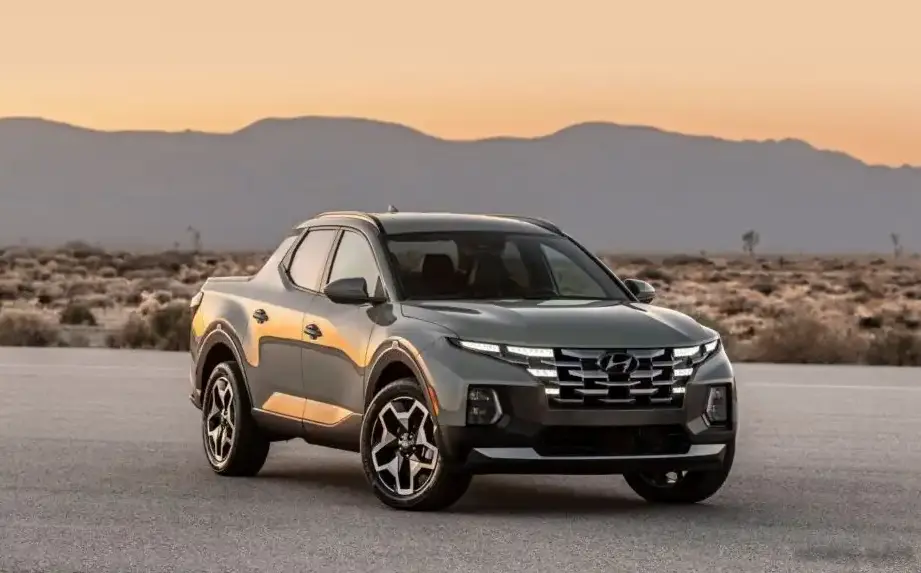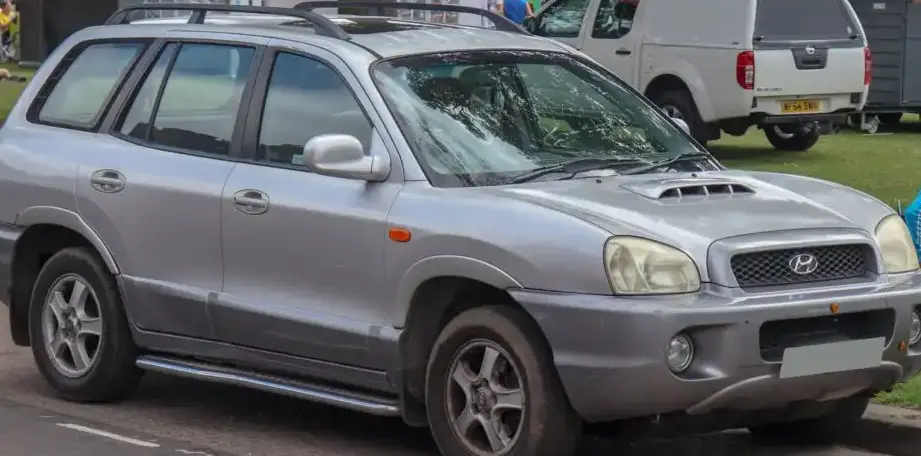
The Hyundai Santa Fe I (SM) 2.7 i V6 24V 4WD Automatic, produced from 2000 to 2006, represents Hyundai’s initial foray into the burgeoning compact SUV market. Positioned as a mid-range offering within the first-generation Santa Fe lineup (internally designated SM), this variant aimed to provide a balance of family practicality, all-weather capability through its four-wheel-drive system, and a more refined driving experience than some of its competitors. It was a key model for Hyundai as they sought to establish themselves as a credible alternative to established Japanese and American brands in the SUV segment. The Santa Fe, in general, was a significant vehicle for Hyundai, marking a move upmarket and demonstrating their increasing engineering capabilities.
Technical Specifications
| Brand | Hyundai |
| Model | Santa Fe |
| Generation | Santa Fe I (SM) |
| Type (Engine) | 2.7 i V6 24V (173 Hp) 4WD Automatic |
| Start of production | 2000 year |
| End of production | 2006 year |
| Powertrain Architecture | Internal Combustion engine |
| Body type | SUV |
| Seats | 5 |
| Doors | 5 |
| Fuel consumption (urban) | 14.9 l/100 km (15.8 US mpg, 19 UK mpg, 6.7 km/l) |
| Fuel consumption (extra urban) | 9.4 l/100 km (25 US mpg, 30.1 UK mpg, 10.6 km/l) |
| Fuel consumption (combined) | 11.4 l/100 km (20.6 US mpg, 24.8 UK mpg, 8.8 km/l) |
| Fuel Type | Petrol (Gasoline) |
| Acceleration 0 – 100 km/h | 11.6 sec |
| Acceleration 0 – 62 mph | 11.6 sec |
| Acceleration 0 – 60 mph | 11 sec |
| Maximum speed | 182 km/h (113.09 mph) |
| Weight-to-power ratio | 10.5 kg/Hp, 95.4 Hp/tonne |
| Weight-to-torque ratio | 7.3 kg/Nm, 137.8 Nm/tonne |
| Power | 173 Hp @ 6000 rpm |
| Power per litre | 65.1 Hp/l |
| Torque | 250 Nm @ 4000 rpm (184.39 lb.-ft. @ 4000 rpm) |
| Engine layout | Front, Transverse |
| Engine Model/Code | Delta / G6BA |
| Engine displacement | 2656 cm3 (162.08 cu. in.) |
| Number of cylinders | 6 |
| Engine configuration | V-engine |
| Cylinder Bore | 86.7 mm (3.41 in.) |
| Piston Stroke | 75 mm (2.95 in.) |
| Compression ratio | 10:1 |
| Number of valves per cylinder | 4 |
| Fuel injection system | Multi-port manifold injection |
| Engine aspiration | Naturally aspirated engine |
| Valvetrain | DOHC |
| Engine oil capacity | 4.5 l (4.76 US qt | 3.96 UK qt) |
| Coolant capacity | 7 l (7.4 US qt | 6.16 UK qt) |
| Kerb Weight | 1814 kg (3999.19 lbs.) |
| Max. weight | 2380 kg (5247 lbs.) |
| Max load | 566 kg (1247.82 lbs.) |
| Trunk (boot) space – minimum | 469 l (16.56 cu. ft.) |
| Trunk (boot) space – maximum | 1473 l (52.02 cu. ft.) |
| Fuel tank capacity | 65 l (17.17 US gal | 14.3 UK gal) |
| Length | 4500 mm (177.17 in.) |
| Width | 1820 mm (71.65 in.) |
| Height | 1675 mm (65.94 in.) |
| Wheelbase | 2620 mm (103.15 in.) |
| Front track | 1540 mm (60.63 in.) |
| Rear (Back) track | 1540 mm (60.63 in.) |
| Drive wheel | All wheel drive (4×4) |
| Number of gears and type of gearbox | 4 gears, automatic transmission |
| Front suspension | Wishbone |
| Rear suspension | Coil spring |
| Front brakes | Ventilated discs |
| Rear brakes | Disc |
| Assisting systems | ABS (Anti-lock braking system) |
| Steering type | Steering rack and pinion |
| Power steering | Hydraulic Steering |
| Tires size | 225/70 R16 H |
Powertrain & Engine Architecture
The heart of the Santa Fe 2.7 i 4WD is Hyundai’s Delta engine family, specifically the G6BA 2.7-liter V6. This engine is a naturally aspirated, 24-valve DOHC (Double Overhead Camshaft) unit. It utilizes a multi-port fuel injection system, delivering fuel directly into the intake ports just before the intake valves. The engine’s architecture is relatively conventional for the period, prioritizing reliability and smooth operation over outright performance. The 60-degree V-angle helps to balance the engine and reduce vibrations. The automatic transmission paired with this engine is a four-speed unit, designed for comfortable cruising and ease of use. While not offering the responsiveness of a manual transmission, it suited the target demographic of families and drivers prioritizing convenience.
Driving Characteristics
The 2.7-liter V6, producing 173 horsepower and 184 lb-ft of torque, provided adequate, but not exhilarating, performance. Acceleration from 0-60 mph took around 11 seconds, which was competitive within its class but noticeably slower than models equipped with larger engines. The four-speed automatic transmission, while smooth, had relatively wide gear ratios, which could sometimes result in the engine feeling strained during quick acceleration or when climbing hills. The all-wheel-drive system provided enhanced traction in inclement weather, making it a practical choice for drivers in regions with snow or rain. Compared to the later 2.4L four-cylinder Santa Fe, the 2.7L offered a more refined and quieter driving experience, but at the cost of slightly lower fuel economy. It also felt more capable when fully loaded with passengers and cargo.
Equipment & Trim Levels
The Santa Fe 2.7 i 4WD Automatic typically came standard with features such as air conditioning, power windows and locks, a CD player, and cloth upholstery. Safety features included ABS (Anti-lock Braking System) and dual front airbags. Optional extras included a sunroof, leather upholstery, upgraded audio systems, and alloy wheels. Trim levels were relatively simple, with the 2.7L 4WD Automatic representing a step up from the base 2.4L models, offering more standard features and a more powerful engine. The interior design was functional and straightforward, prioritizing practicality over luxury.
Chassis & Braking
The Santa Fe I utilized a front wishbone and rear coil spring suspension setup, providing a comfortable ride quality. The suspension was tuned for everyday driving, prioritizing comfort over sporty handling. Braking duties were handled by ventilated discs at the front and solid discs at the rear. The ABS system helped to maintain steering control during hard braking. The all-wheel-drive system employed a viscous coupling to distribute torque between the front and rear axles, automatically adjusting to changing road conditions. The steering was hydraulic power-assisted, providing light and easy steering feel.
Market Reception & Comparison
The Hyundai Santa Fe 2.7 i 4WD Automatic was generally well-received by critics as a competent and value-for-money SUV. It offered a spacious interior, a comfortable ride, and the added security of all-wheel drive. However, some reviewers noted that the engine lacked the refinement and power of some of its competitors, such as the Honda CR-V or Toyota RAV4. Fuel economy was also considered average for the class. Compared to the base 2.4L Santa Fe, the 2.7L offered a noticeable improvement in performance, but at a higher price point. Reliability was generally good, although some owners reported minor issues with the automatic transmission over time.
Legacy
The Hyundai Santa Fe I (SM) 2.7 i V6 4WD Automatic played a crucial role in establishing Hyundai as a serious contender in the SUV market. While not a groundbreaking vehicle, it offered a compelling combination of features, practicality, and value. The G6BA engine proved to be relatively durable, and many examples are still on the road today. However, due to its age, maintenance costs can be higher, and finding replacement parts may become increasingly challenging. In the used car market, these Santa Fes are often sought after by buyers looking for an affordable and reliable all-wheel-drive SUV, but they typically command lower prices than comparable Japanese or American models.