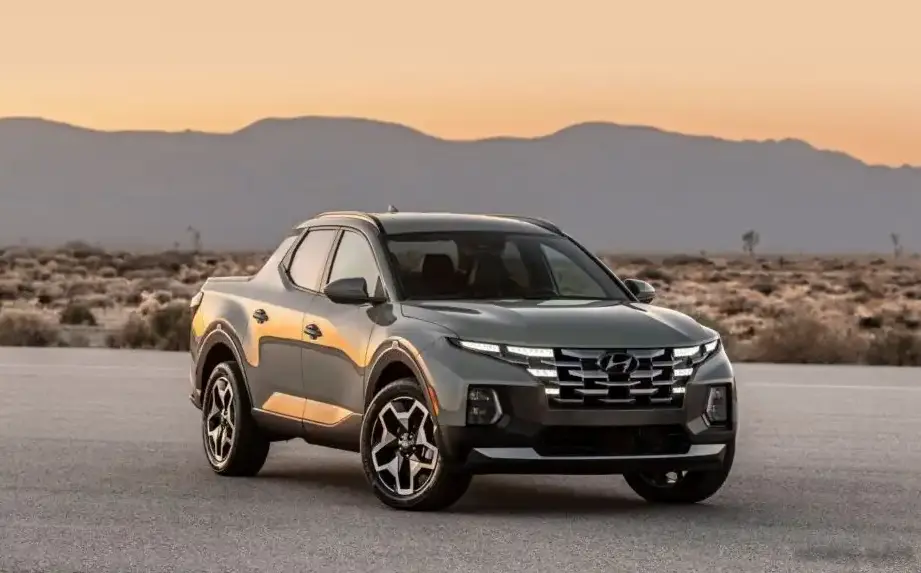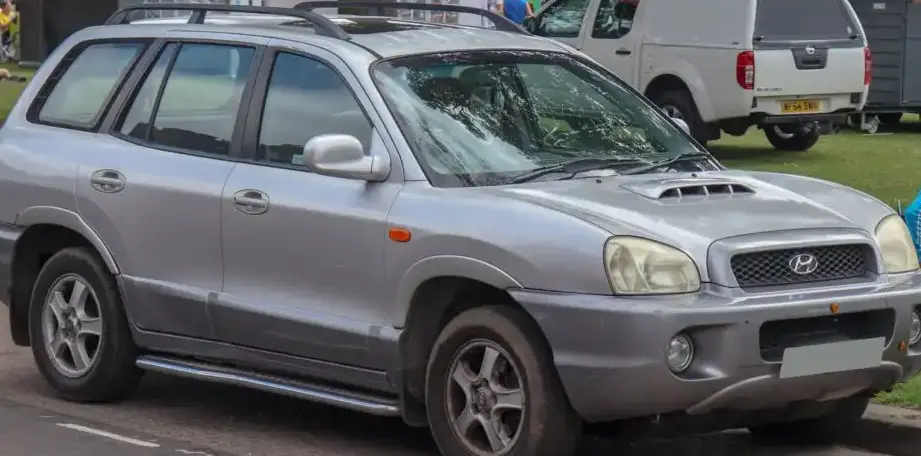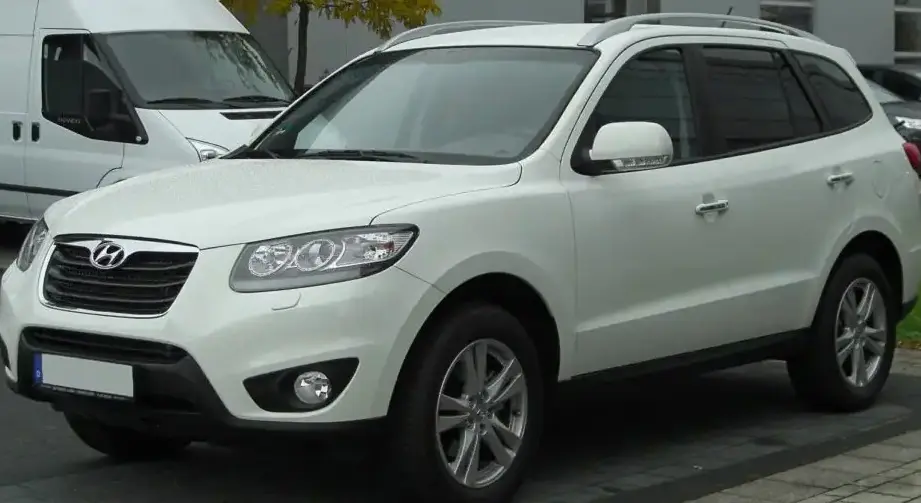
The Hyundai Santa Fe II (CM) facelift, produced from 2009 to 2012, represented a significant update to Hyundai’s popular mid-size SUV. The 2.2 CRDi variant, equipped with a 197 horsepower diesel engine and a six-speed automatic transmission coupled with all-wheel drive (4WD), was a key offering in the European and Asian markets, and increasingly found favor in North America as Hyundai expanded its presence. This particular configuration aimed to balance fuel efficiency, respectable performance, and the convenience of an automatic transmission within the Santa Fe lineup. It sat as a mid-to-upper trim level, offering more power and features than the base models but remaining below the range-topping specifications.
Technical Specifications
| Brand | Hyundai |
| Model | Santa Fe |
| Generation | Santa Fe II (CM, facelift 2009) |
| Type (Engine) | 2.2 CRDi (197 Hp) 4WD Automatic |
| Start of production | 2009 |
| End of production | 2012 |
| Powertrain Architecture | Internal Combustion engine |
| Body type | SUV |
| Seats | 5 |
| Doors | 5 |
| Fuel consumption (economy) – urban (NEDC) | 8.8 l/100 km (26.7 US mpg, 32.1 UK mpg, 11.4 km/l) |
| Fuel consumption (economy) – extra urban (NEDC) | 6.2 l/100 km (37.9 US mpg, 45.6 UK mpg, 16.1 km/l) |
| Fuel consumption (economy) – combined (NEDC) | 7.2 l/100 km (32.7 US mpg, 39.2 UK mpg, 13.9 km/l) |
| CO2 emissions (NEDC) | 194 g/km |
| Fuel Type | Diesel |
| Acceleration 0 – 100 km/h | 10.2 sec |
| Acceleration 0 – 62 mph | 10.2 sec |
| Acceleration 0 – 60 mph | 9.7 sec |
| Maximum speed | 190 km/h (118.06 mph) |
| Emission standard | Euro 5 |
| Weight-to-power ratio | 9.5 kg/Hp, 105.6 Hp/tonne |
| Weight-to-torque ratio | 4.3 kg/Nm, 233.7 Nm/tonne |
| Power | 197 Hp @ 3800 rpm |
| Power per litre | 89.6 Hp/l |
| Torque | 436 Nm @ 1800-2500 rpm (321.58 lb.-ft. @ 1800-2500 rpm) |
| Engine layout | Front, Transverse |
| Engine Model/Code | D4HB |
| Engine displacement | 2199 cm3 (134.19 cu. in.) |
| Number of cylinders | 4 |
| Engine configuration | Inline |
| Cylinder Bore | 85.4 mm (3.36 in.) |
| Piston Stroke | 96 mm (3.78 in.) |
| Compression ratio | 16:1 |
| Number of valves per cylinder | 4 |
| Fuel injection system | Diesel Commonrail |
| Engine aspiration | Turbocharger, Intercooler |
| Valvetrain | DOHC |
| Engine oil capacity | 6.7 l (7.08 US qt | 5.9 UK qt) |
| Coolant | 9 l (9.51 US qt | 7.92 UK qt) |
| Kerb Weight | 1866-1946 kg (4113.83 – 4290.2 lbs.) |
| Max. weight | 2570 kg (5665.88 lbs.) |
| Max load | 624-704 kg (1375.68 – 1552.05 lbs.) |
| Trunk (boot) space – minimum | 528 l (18.65 cu. ft.) |
| Fuel tank capacity | 75 l (19.81 US gal | 16.5 UK gal) |
| Max. roof load | 100 kg (220.46 lbs.) |
| Permitted trailer load with brakes (8%) | 2400 kg (5291.09 lbs.) |
| Permitted trailer load with brakes (12%) | 2000 kg (4409.25 lbs.) |
| Permitted trailer load without brakes | 750 kg (1653.47 lbs.) |
| Permitted towbar download | 80 kg (176.37 lbs.) |
| Length | 4660 mm (183.46 in.) |
| Width | 1890 mm (74.41 in.) |
| Height | 1760 mm (69.29 in.) |
| Wheelbase | 2700 mm (106.3 in.) |
| Front track | 1615 mm (63.58 in.) |
| Rear (Back) track | 1620 mm (63.78 in.) |
| Front overhang | 930 mm (36.61 in.) |
| Rear overhang | 1030 mm (40.55 in.) |
| Ride height (ground clearance) | 200 mm (7.87 in.) |
| Drag coefficient (Cd) | 0.38 |
| Minimum turning circle (turning diameter) | 10.9 m (35.76 ft.) |
| Approach angle | 24.6° |
| Departure angle | 21.6° |
| Ramp-over (brakeover) angle | 17.9° |
| Wading depth | 500 mm (19.69 in.) |
| Drivetrain Architecture | The Internal combustion engine (ICE) drives the front wheels permanently, and the rear wheels are driven through an electrically or mechanically operated clutch if necessary. |
| Drive wheel | All wheel drive (4×4) |
| Number of gears and type of gearbox | 6 gears, automatic transmission |
| Front suspension | Independent, type McPherson with coil spring and anti-roll bar |
| Rear suspension | Independent multi-link spring suspension with stabilizer |
| Front brakes | Ventilated discs |
| Rear brakes | Disc |
| Assisting systems | ABS (Anti-lock braking system) |
| Steering type | Steering rack and pinion |
| Power steering | Hydraulic Steering |
| Tires size | 235/65 R17; 235/60 R18 |
| Wheel rims size | 7J x 17; 7J x 18 |
Powertrain & Engine Architecture
The heart of this Santa Fe variant is the Hyundai D4HB 2.2-liter inline-four cylinder diesel engine. This engine utilizes a common-rail direct injection system, delivering fuel at extremely high pressure for optimized combustion. A variable geometry turbocharger (VGT) and intercooler work in tandem to boost power and torque while minimizing turbo lag. The D4HB engine features a double overhead camshaft (DOHC) valvetrain with four valves per cylinder, enhancing breathing and contributing to its power output. The six-speed automatic transmission, sourced from Hyundai’s own development, was designed to provide smooth shifts and efficient power delivery. It features adaptive shift logic, adjusting shift points based on driving conditions and throttle input.
Driving Characteristics
The 2.2 CRDi automatic Santa Fe offered a comfortable and capable driving experience. While not a sports SUV, the 197 horsepower and 321.58 lb-ft of torque provided adequate acceleration for everyday driving and highway cruising. The automatic transmission, while smooth, wasn’t particularly quick to downshift, meaning overtaking maneuvers required some planning. Compared to the manual transmission versions of the same engine, the automatic felt slightly less responsive. The all-wheel-drive system provided enhanced traction in inclement weather and on slippery surfaces, making it a practical choice for regions with challenging road conditions. The gear ratios were tuned for fuel efficiency and relaxed cruising, rather than outright performance.
Equipment & Trim Levels
The 2.2 CRDi 4WD Automatic trim typically included features such as air conditioning, power windows and locks, a CD/MP3 stereo system, and alloy wheels. Higher-spec versions often added leather upholstery, a sunroof, heated front seats, and a more advanced audio system. Safety features included ABS, electronic stability control (ESC), and multiple airbags. Optional extras could include a navigation system, rear parking sensors, and a tow hitch.
Chassis & Braking
The Santa Fe II utilized a McPherson strut front suspension and a multi-link rear suspension, providing a good balance between ride comfort and handling. Stabilizer bars were fitted to both axles to reduce body roll during cornering. The braking system consisted of ventilated discs on the front wheels and solid discs on the rear. ABS (Anti-lock Braking System) was standard, enhancing braking performance and stability. The suspension was tuned to prioritize comfort over sporty handling, resulting in a relatively soft ride quality.
Market Reception & Comparison
The 2.2 CRDi automatic Santa Fe was generally well-received by automotive critics. It was praised for its comfortable ride, spacious interior, and strong diesel engine. However, some reviewers noted that the automatic transmission could feel sluggish at times, and the handling wasn’t as sharp as some of its competitors. Compared to the 2.0-liter petrol versions, the 2.2 CRDi offered significantly better fuel economy and torque, making it a more practical choice for long-distance driving. Against rivals like the Kia Sorento and the Toyota RAV4, the Santa Fe offered a competitive package with a strong value proposition.
Legacy
The Hyundai Santa Fe II 2.2 CRDi automatic has proven to be a relatively reliable vehicle in the used car market. The D4HB engine, while capable of high mileage, requires regular maintenance, including timely oil changes and fuel filter replacements. The automatic transmission is generally durable, but some units have experienced issues with solenoid failures. Overall, this variant remains a popular choice for buyers seeking a spacious, comfortable, and fuel-efficient SUV with all-wheel drive. Its blend of practicality and affordability has ensured its continued presence on roads today.