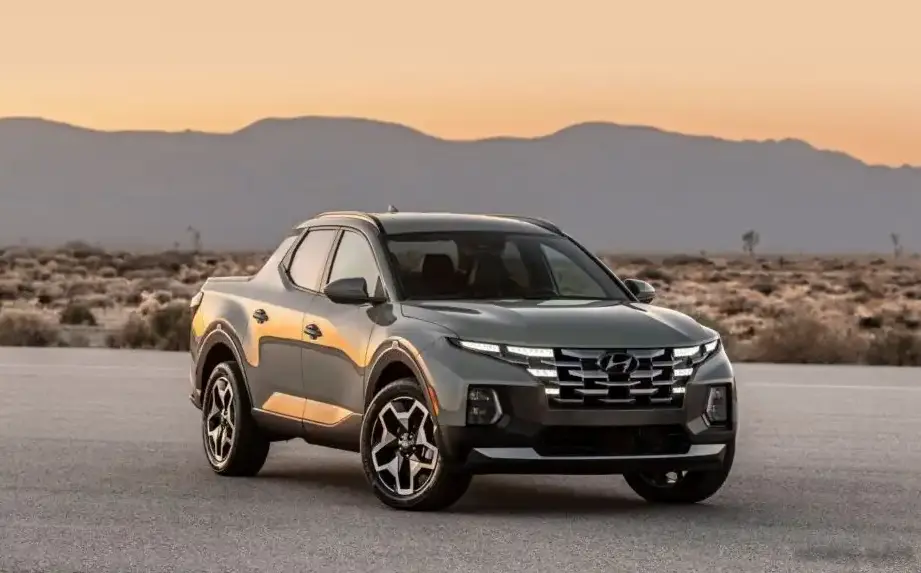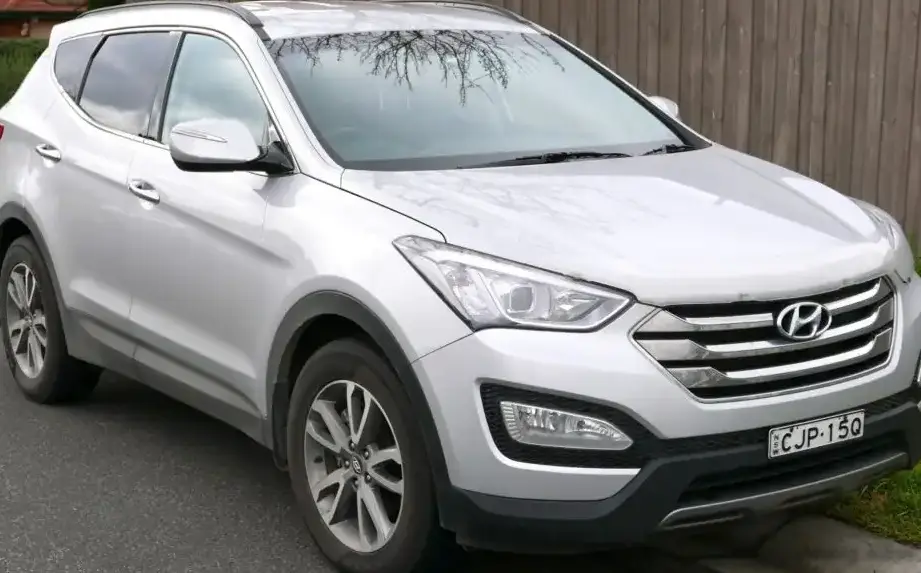
The Hyundai Santa Fe III (DM) 2.4 GDI, produced from 2013 to 2015, represented a significant step forward for Hyundai in the competitive mid-size SUV segment. Positioned as a mainstream offering within the DM generation Santa Fe lineup – which also included a longer wheelbase “Santa Fe XL” – the 2.4 GDI model aimed to balance affordability with a respectable level of performance and features. It served as the entry point to the Santa Fe range for buyers prioritizing fuel efficiency and a comfortable ride over outright power. The DM generation Santa Fe marked a shift towards a more sophisticated design language for Hyundai, and the 2.4 GDI played a key role in establishing the model’s popularity in the North American market, where three-row SUVs were in high demand.
Technical Specifications
| Brand | Hyundai |
| Model | Santa Fe |
| Generation | Santa Fe III (DM) |
| Type (Engine) | 2.4 GDI (192 Hp) |
| Start of production | 2013 |
| End of production | 2015 |
| Powertrain Architecture | Internal Combustion engine |
| Body type | SUV |
| Seats | 7 |
| Doors | 5 |
| Fuel consumption (urban) | 11.8 l/100 km (19.9 US mpg) |
| Fuel consumption (extra urban) | 6.9 l/100 km (34.1 US mpg) |
| Fuel consumption (combined) | 8.7 l/100 km (27 US mpg) |
| Fuel Type | Petrol (Gasoline) |
| Acceleration 0 – 100 km/h | 10 sec |
| Acceleration 0 – 62 mph | 10 sec |
| Acceleration 0 – 60 mph | 9.5 sec |
| Maximum speed | 190 km/h (118.06 mph) |
| Emission standard | Euro 5 |
| Weight-to-power ratio | 8.3 kg/Hp |
| Weight-to-torque ratio | 6.6 kg/Nm |
| Power | 192 Hp @ 6300 rpm |
| Torque | 242 Nm @ 4250 rpm (178.49 lb.-ft. @ 4250 rpm) |
| Engine layout | Front, Transverse |
| Engine Model/Code | Theta II / G4KJ |
| Engine displacement | 2359 cm3 (143.96 cu. in.) |
| Number of cylinders | 4 |
| Engine configuration | Inline |
| Cylinder Bore | 88 mm (3.46 in.) |
| Piston Stroke | 97 mm (3.82 in.) |
| Compression ratio | 11.3:1 |
| Number of valves per cylinder | 4 |
| Fuel injection system | Direct injection |
| Engine aspiration | Naturally aspirated engine |
| Valvetrain | DOHC |
| Engine oil capacity | 4.8 l (5.07 US qt | 4.22 UK qt) |
| Coolant | 7.1 l (7.5 US qt | 6.25 UK qt) |
| Kerb Weight | 1591 kg (3507.55 lbs.) |
| Max. weight | 2510 kg (5533.6 lbs.) |
| Max load | 919 kg (2026.05 lbs.) |
| Trunk (boot) space – minimum | 585 l (20.66 cu. ft.) |
| Trunk (boot) space – maximum | 1570 l (55.44 cu. ft.) |
| Fuel tank capacity | 64 l (16.91 US gal | 14.08 UK gal) |
| Length | 4690 mm (184.65 in.) |
| Width | 1880 mm (74.02 in.) |
| Height | 1680 mm (66.14 in.) |
| Wheelbase | 2700 mm (106.3 in.) |
| Front track | 1633 mm (64.29 in.) |
| Rear (Back) track | 1644 mm (64.72 in.) |
| Minimum turning circle | 10.9 m (35.76 ft.) |
| Drivetrain Architecture | Front wheel drive |
| Number of gears | 6 |
| Type of gearbox | Manual transmission |
| Front suspension | Independent type McPherson |
| Rear suspension | Independent coil spring |
| Front brakes | Ventilated discs |
| Rear brakes | Disc |
| Assisting systems | ABS (Anti-lock braking system) |
| Steering type | Steering rack and pinion |
| Power steering | Electric Steering |
| Tires size | 235/65 R17; 235/60 R18; 235/55 R19 |
| Wheel rims size | 7.0J x 17; 7.5J x 18; 7.5J x 19 |
INTRODUCTION
The Hyundai Santa Fe III (DM) 2.4 GDI, launched in 2013, was a crucial model for Hyundai as it aimed to solidify its position in the increasingly competitive mid-size SUV market. Built on the platform shared with the Kia Sorento, the DM Santa Fe offered a compelling combination of space, features, and value. The 2.4-liter GDI engine variant was specifically targeted at buyers seeking a balance between fuel economy and adequate performance for daily driving. It occupied the lower-mid range of the Santa Fe lineup, slotting below the more powerful 2.0T and 3.3L V6 options, and above any base-level non-GDI engines offered in some markets. The DM generation represented a significant design overhaul for the Santa Fe, moving away from the boxier styling of previous generations towards a more fluid and sculpted aesthetic.
Powertrain & Engine Architecture
At the heart of the Santa Fe 2.4 GDI lies the Hyundai Theta II engine family, specifically the G4KJ code. This 2.4-liter inline-four cylinder engine utilizes Gasoline Direct Injection (GDI) technology, which improves fuel efficiency and power output compared to traditional port fuel injection. The G4KJ features a dual continuously variable valve timing (D-CVVT) system, optimizing valve timing for improved performance across the rev range. The engine produces 192 horsepower at 6300 rpm and 178 lb-ft of torque at 4250 rpm. The 6-speed automatic transmission, while not known for being particularly sporty, was geared for fuel efficiency and smooth operation. It featured a conventional torque converter design. The engine’s architecture prioritized refinement and reliability over outright performance, making it a suitable choice for family-oriented buyers.
Driving Characteristics
The Santa Fe 2.4 GDI with the 6-speed automatic offered a comfortable and predictable driving experience. Acceleration from 0-60 mph took around 9.5 seconds, which was adequate for everyday driving but noticeably slower than the turbocharged 2.0T or V6 models. The automatic transmission generally shifted smoothly, but could sometimes feel hesitant during quick acceleration maneuvers. The gear ratios were optimized for fuel economy, resulting in a relatively relaxed driving experience at highway speeds. Compared to the manual transmission versions (available in some markets), the automatic offered greater convenience but at the expense of some driver engagement. The 2.4 GDI’s power delivery was linear and predictable, making it easy to modulate the throttle and maintain control in various driving conditions.
Equipment & Trim Levels
The 2.4 GDI Santa Fe typically came standard with a respectable array of features, including air conditioning, power windows and locks, a touchscreen infotainment system with Bluetooth connectivity, and a rearview camera. Higher trim levels added features such as leather upholstery, heated front seats, a panoramic sunroof, and a premium audio system. Interior materials were generally of good quality for the price point, and the cabin offered ample space for passengers and cargo. Optional extras included navigation, blind-spot monitoring, and rear cross-traffic alert. The interior design was functional and modern, with a focus on usability and comfort.
Chassis & Braking
The Santa Fe DM utilized a front-wheel-drive platform with independent suspension at all four corners. The front suspension employed a McPherson strut design, while the rear featured a multi-link setup. This configuration provided a comfortable ride quality, absorbing bumps and imperfections in the road effectively. The braking system consisted of ventilated discs at the front and solid discs at the rear, providing adequate stopping power for most driving situations. Anti-lock brakes (ABS) were standard, enhancing safety and control during emergency braking. The steering was electrically assisted, offering light and precise steering feel.
Market Reception & Comparison
The Hyundai Santa Fe 2.4 GDI was generally well-received by automotive critics, who praised its spacious interior, comfortable ride, and value for money. However, some reviewers noted that the 2.4-liter engine could feel underpowered when fully loaded or tackling steep hills. Compared to the 2.0T and V6 models, the 2.4 GDI offered better fuel economy but significantly less performance. Against competitors like the Honda CR-V, Toyota RAV4, and Nissan Rogue, the Santa Fe 2.4 GDI offered a compelling alternative with a longer wheelbase and available third-row seating. Its fuel economy was competitive within its class, and its reliability proved to be generally good.
Legacy
The Hyundai Santa Fe DM 2.4 GDI has proven to be a relatively reliable vehicle in the used car market. The Theta II engine, while not without its issues (some early versions experienced oil consumption problems, though these were largely addressed in later model years), has generally held up well over time. The 6-speed automatic transmission is also known for its durability. Today, these Santa Fes represent a good value for buyers seeking an affordable and practical mid-size SUV with a comfortable ride and a decent feature set. The DM generation Santa Fe helped to establish Hyundai as a major player in the SUV segment, and the 2.4 GDI variant played a key role in attracting a wide range of buyers.