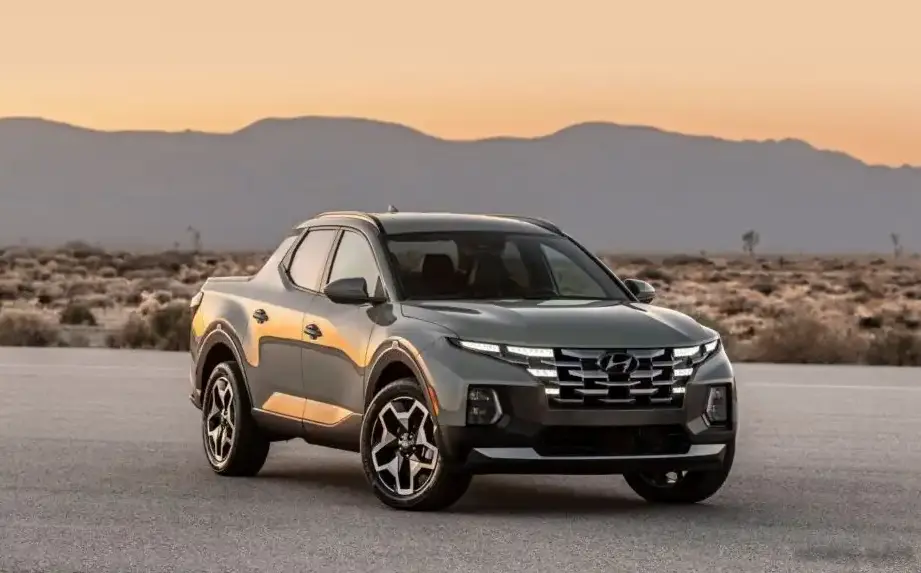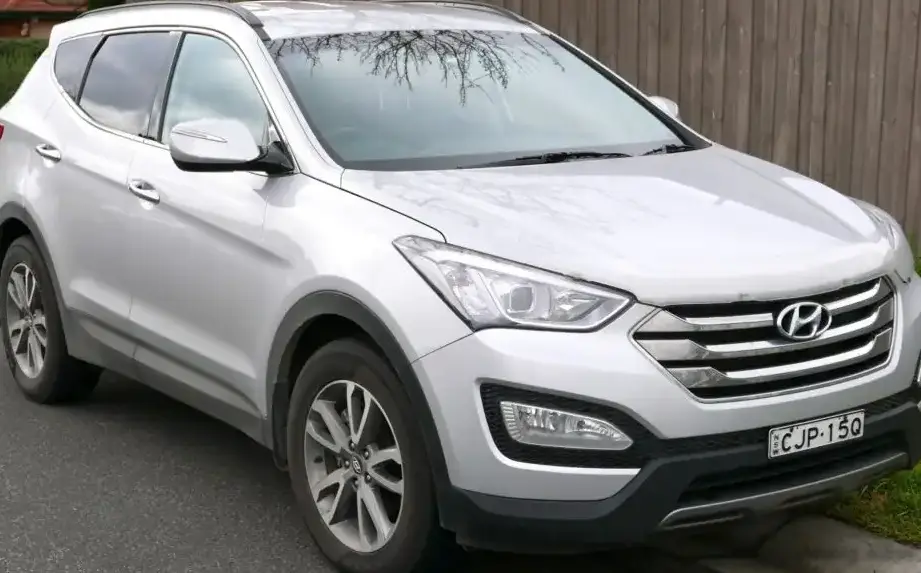
The Hyundai Santa Fe III (DM) 2.4 GDI 4WD, produced from 2013 to 2015, represented a significant step forward for Hyundai in the competitive mid-size SUV segment. Positioned as a versatile family vehicle, this variant offered a balance between fuel efficiency, available space, and all-weather capability. It was part of the DM generation Santa Fe, which introduced a more sophisticated design and a wider range of features compared to its predecessors. The 2.4 GDI 4WD trim occupied a middle ground in the Santa Fe lineup, offering a more affordable alternative to the higher-output 2.0T and 3.3L V6 models, while providing all-wheel drive for enhanced traction. This model was primarily aimed at the North American market, where SUVs with all-wheel drive are highly sought after.
Technical Specifications
| Brand | Hyundai |
| Model | Santa Fe |
| Generation | Santa Fe III (DM) |
| Type (Engine) | 2.4 GDI (192 Hp) 4WD |
| Start of production | 2013 |
| End of production | 2015 |
| Powertrain Architecture | Internal Combustion engine |
| Body type | SUV |
| Seats | 7 |
| Doors | 5 |
| Fuel consumption (urban) | 12 l/100 km (19.6 US mpg) |
| Fuel consumption (extra urban) | 7 l/100 km (33.6 US mpg) |
| Fuel consumption (combined) | 8.9 l/100 km (26.4 US mpg) |
| Fuel Type | Petrol (Gasoline) |
| Acceleration 0 – 100 km/h | 10.5 sec |
| Acceleration 0 – 62 mph | 10.5 sec |
| Acceleration 0 – 60 mph | 10 sec |
| Maximum speed | 190 km/h (118.06 mph) |
| Emission standard | Euro 5 |
| Weight-to-power ratio | 8.7 kg/Hp |
| Weight-to-torque ratio | 6.9 kg/Nm |
| Power | 192 Hp @ 6300 rpm |
| Torque | 242 Nm @ 4250 rpm (178.49 lb.-ft. @ 4250 rpm) |
| Engine layout | Front, Transverse |
| Engine Model/Code | Theta II / G4KJ |
| Engine displacement | 2359 cm3 (143.96 cu. in.) |
| Number of cylinders | 4 |
| Engine configuration | Inline |
| Cylinder Bore | 88 mm (3.46 in.) |
| Piston Stroke | 97 mm (3.82 in.) |
| Compression ratio | 11.3:1 |
| Number of valves per cylinder | 4 |
| Fuel injection system | Direct injection |
| Engine aspiration | Naturally aspirated engine |
| Valvetrain | DOHC |
| Engine oil capacity | 4.8 l (5.07 US qt | 4.22 UK qt) |
| Coolant capacity | 7.1 l (7.5 US qt | 6.25 UK qt) |
| Kerb Weight | 1662 kg (3664.08 lbs.) |
| Max. weight | 2510 kg (5533.6 lbs.) |
| Max load | 848 kg (1869.52 lbs.) |
| Trunk (boot) space – minimum | 585 l (20.66 cu. ft.) |
| Trunk (boot) space – maximum | 1570 l (55.44 cu. ft.) |
| Fuel tank capacity | 64 l (16.91 US gal | 14.08 UK gal) |
| Length | 4690 mm (184.65 in.) |
| Width | 1880 mm (74.02 in.) |
| Height | 1680 mm (66.14 in.) |
| Wheelbase | 2700 mm (106.3 in.) |
| Front track | 1633 mm (64.29 in.) |
| Rear (Back) track | 1644 mm (64.72 in.) |
| Minimum turning circle | 10.9 m (35.76 ft.) |
| Drive wheel | All wheel drive (4×4) |
| Number of gears | 6 |
| Gearbox type | Manual transmission |
| Front suspension | Independent type McPherson |
| Rear suspension | Independent coil spring |
| Front brakes | Ventilated discs |
| Rear brakes | Disc |
| Assisting systems | ABS (Anti-lock braking system) |
| Steering type | Steering rack and pinion |
| Power steering | Electric Steering |
| Tires size | 235/65 R17; 235/60 R18; 235/55 R19 |
| Wheel rims size | 7.0J x 17; 7.5J x 18; 7.5J x 19 |
Powertrain & Engine Architecture
The heart of the Santa Fe 2.4 GDI 4WD is the Hyundai Theta II engine, specifically the G4KJ code. This 2.4-liter inline-four cylinder engine utilizes Gasoline Direct Injection (GDI) technology, which improves fuel efficiency and power output compared to traditional port fuel injection. The GDI system injects fuel directly into the combustion chamber, allowing for more precise fuel control and a higher compression ratio of 11.3:1. The engine features a double overhead camshaft (DOHC) valvetrain with four valves per cylinder, optimizing airflow for enhanced performance. The 6-speed manual transmission was standard on this trim, providing drivers with direct control over gear selection. The engine produces 192 horsepower at 6300 rpm and 178.49 lb-ft of torque at 4250 rpm.
Driving Characteristics
The 2.4 GDI engine, paired with the 6-speed manual transmission, offered a reasonably responsive driving experience. While not as quick as the turbocharged 2.0T variant, it provided adequate power for everyday driving and highway cruising. The manual transmission allowed for precise control, but the gear ratios were tuned more for fuel economy than outright acceleration. Compared to the automatic transmission options available on other Santa Fe trims, the manual offered a more engaging driving experience and slightly better fuel efficiency. The all-wheel-drive system provided enhanced traction in inclement weather conditions, making it a suitable choice for regions with snow or rain. However, the 1662 kg curb weight did impact overall agility, making it feel less sporty than some of its competitors.
Equipment & Trim Levels
The 2.4 GDI 4WD trim typically included standard features such as air conditioning, power windows and locks, a basic audio system with USB connectivity, and cloth upholstery. Safety features included ABS, electronic stability control, and multiple airbags. Optional extras included a touchscreen infotainment system with navigation, a rearview camera, leather upholstery, heated front seats, and a panoramic sunroof. The interior design was functional and well-built, though it lacked the premium feel of some higher-end competitors. The 7-seat configuration provided ample space for families, with a generous cargo area when the third-row seats were folded down.
Chassis & Braking
The Santa Fe DM utilized an independent McPherson strut suspension in the front and an independent coil spring suspension in the rear. This setup provided a comfortable ride quality, absorbing bumps and irregularities in the road surface effectively. The front brakes were ventilated discs, while the rear brakes were solid discs, providing adequate stopping power for the vehicle’s weight. The electric power steering offered a light and responsive feel, making it easy to maneuver in tight spaces. The all-wheel-drive system automatically distributed torque between the front and rear wheels as needed, optimizing traction and stability.
Market Reception & Comparison
The Hyundai Santa Fe 2.4 GDI 4WD was generally well-received by critics, who praised its spacious interior, comfortable ride, and value for money. However, some reviewers noted that the 2.4-liter engine could feel underpowered when fully loaded or climbing steep hills. Compared to the 2.0T model, the 2.4 GDI offered lower performance but better fuel economy. Compared to the 3.3L V6, it provided a more affordable entry point into the Santa Fe lineup. Fuel economy figures averaged around 26.4 US mpg combined, which was competitive for its class. Reliability reports indicated that the Theta II engine was generally reliable, though some owners reported issues with oil consumption over time.
Legacy
The Hyundai Santa Fe III (DM) 2.4 GDI 4WD remains a popular choice in the used car market today. Its combination of practicality, affordability, and all-wheel-drive capability makes it an attractive option for families and individuals seeking a versatile SUV. The Theta II engine, while known for potential oil consumption issues, is generally considered durable and relatively easy to maintain. Parts availability is good, and repair costs are typically reasonable. The DM generation Santa Fe helped establish Hyundai as a major player in the mid-size SUV segment, paving the way for future generations of the popular model.