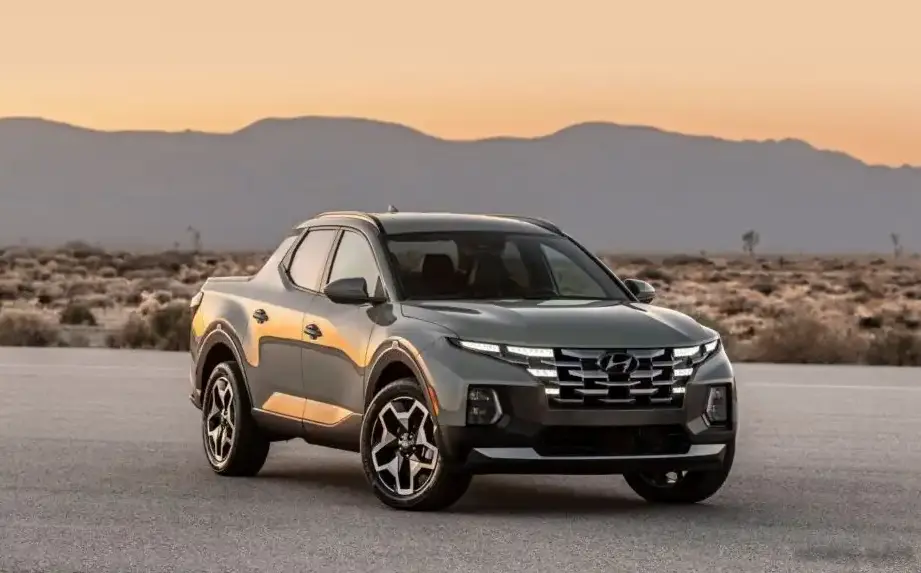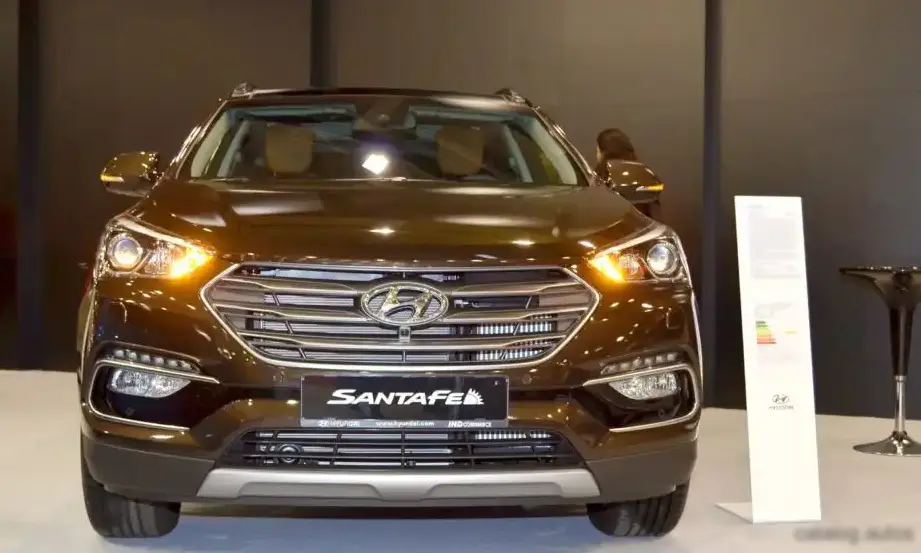
The Hyundai Santa Fe III (DM, facelift 2015) 2.0 CRDi 4WD represents a significant iteration of Hyundai’s popular mid-size SUV, produced from 2015 to 2018. This variant, equipped with a 2.0-liter turbocharged diesel engine producing 150 horsepower, and paired with a six-speed manual transmission, was positioned as a practical and efficient all-wheel-drive option within the Santa Fe lineup. It aimed to balance fuel economy with the capability of all-wheel drive, appealing to buyers seeking a versatile family vehicle. The facelift brought styling updates and refinements to the already well-received third-generation Santa Fe.
Technical Specifications
| Brand | Hyundai |
| Model | Santa Fe |
| Generation | Santa Fe III (DM, facelift 2015) |
| Type (Engine) | 2.0 CRDi (150 Hp) 4WD |
| Start of production | 2015 |
| End of production | 2018 |
| Powertrain Architecture | Internal Combustion engine |
| Body type | SUV |
| Seats | 5 |
| Doors | 5 |
| Fuel consumption (urban) | 7 l/100 km (33.6 US mpg, 40.4 UK mpg, 14.3 km/l) |
| Fuel consumption (extra urban) | 5.3 l/100 km (44.4 US mpg, 53.3 UK mpg, 18.9 km/l) |
| Fuel consumption (combined) | 6 l/100 km (39.2 US mpg, 47.1 UK mpg, 16.7 km/l) |
| CO2 emissions | 159 g/km |
| Fuel Type | Diesel |
| Acceleration 0 – 100 km/h | 11.2 sec |
| Acceleration 0 – 62 mph | 11.2 sec |
| Acceleration 0 – 60 mph | 10.6 sec |
| Maximum speed | 187 km/h (116.2 mph) |
| Emission standard | Euro 6 |
| Weight-to-power ratio | 12 kg/Hp, 83.1 Hp/tonne |
| Weight-to-torque ratio | 4.5 kg/Nm, 221.5 Nm/tonne |
| Power | 150 Hp @ 4000 rpm |
| Power per litre | 75.2 Hp/l |
| Torque | 400 Nm @ 1750-2500 rpm (295.02 lb.-ft. @ 1750-2500 rpm) |
| Engine layout | Front, Transverse |
| Engine Model/Code | R II / D4HA |
| Engine displacement | 1995 cm3 (121.74 cu. in.) |
| Number of cylinders | 4 |
| Engine configuration | Inline |
| Cylinder Bore | 84 mm (3.31 in.) |
| Piston Stroke | 90 mm (3.54 in.) |
| Compression ratio | 16:1 |
| Number of valves per cylinder | 4 |
| Fuel injection system | Diesel Commonrail |
| Engine aspiration | Turbocharger, Intercooler |
| Engine oil capacity | 6.3 l (6.66 US qt | 5.54 UK qt) |
| Coolant | 9.1 l (9.62 US qt | 8.01 UK qt) |
| Kerb Weight | 1806 kg (3981.55 lbs.) |
| Max. weight | 2510 kg (5533.6 lbs.) |
| Max load | 704 kg (1552.05 lbs.) |
| Trunk (boot) space – minimum | 585 l (20.66 cu. ft.) |
| Trunk (boot) space – maximum | 1680 l (59.33 cu. ft.) |
| Fuel tank capacity | 64 l (16.91 US gal | 14.08 UK gal) |
| Max. roof load | 100 kg (220.46 lbs.) |
| Permitted trailer load with brakes (12%) | 2500 kg (5511.56 lbs.) |
| Permitted trailer load without brakes | 750 kg (1653.47 lbs.) |
| Permitted towbar download | 100 kg (220.46 lbs.) |
| Length | 4690 mm (184.65 in.) |
| Width | 1880 mm (74.02 in.) |
| Height | 1680 mm (66.14 in.) |
| Wheelbase | 2700 mm (106.3 in.) |
| Front track | 1628-1633 mm (64.09 – 64.29 in.) |
| Rear (Back) track | 1639-1644 mm (64.53 – 64.72 in.) |
| Front overhang | 935 mm (36.81 in.) |
| Rear overhang | 1055 mm (41.54 in.) |
| Ride height (ground clearance) | 185 mm (7.28 in.) |
| Minimum turning circle (turning diameter) | 10.9 m (35.76 ft.) |
| Approach angle | 16.5° |
| Departure angle | 21.2° |
| Ramp-over (brakeover) angle | 16.6° |
| Drivetrain Architecture | The Internal combustion engine (ICE) drives the front wheels permanently, and the rear wheels are driven through an electrically or mechanically operated clutch if necessary. |
| Drive wheel | All wheel drive (4×4) |
| Number of gears and type of gearbox | 6 gears, manual transmission |
| Front suspension | Independent type McPherson |
| Rear suspension | Independent multi-link suspension |
| Front brakes | Ventilated discs |
| Rear brakes | Disc |
| Assisting systems | ABS (Anti-lock braking system) |
| Steering type | Steering rack and pinion |
| Power steering | Electric Steering |
| Tires size | 235/65 R17; 235/60 R18; 235/55 R19 |
| Wheel rims size | 7.0J x 17; 7.5J x 18; 7.5J x 19 |
INTRODUCTION
The Hyundai Santa Fe III, launched in 2012 and facelifted in 2015, represented a significant step forward for Hyundai in the competitive mid-size SUV segment. The 2.0 CRDi 4WD variant, produced between 2015 and 2018, was a key offering in many European and Asian markets. It provided a balance between fuel efficiency, reasonable performance, and the added security of all-wheel drive. This model sat in the middle of the Santa Fe range, offering a more affordable entry point than the higher-powered 2.2 CRDi models, while still providing a well-equipped and practical vehicle. The “DM” designation refers to the internal Hyundai codename for this generation.
Powertrain & Engine Architecture
At the heart of the Santa Fe 2.0 CRDi 4WD lies the Hyundai R-series diesel engine, specifically the R II / D4HA variant. This is a 1995cc, four-cylinder engine featuring a turbocharger and intercooler. The engine utilizes a common-rail direct injection system, delivering fuel at extremely high pressure for optimized combustion. The D4HA engine is known for its relatively robust construction and decent fuel economy. The engine produces 150 horsepower at 4000 rpm and a substantial 400 Nm (295 lb-ft) of torque between 1750 and 2500 rpm. This torque output is a key characteristic, providing good low-end pulling power for everyday driving and towing. The six-speed manual transmission was the standard offering for this variant, providing precise gear changes and allowing the driver to fully utilize the engine’s torque. The transmission’s gear ratios are tuned for a balance of acceleration and fuel efficiency, with a relatively tall sixth gear for highway cruising.
Driving Characteristics
The 2.0 CRDi 4WD Santa Fe offers a comfortable and composed driving experience. While not a performance-oriented SUV, the 150 hp engine and 400 Nm of torque provide adequate power for most driving situations. Acceleration from 0-60 mph takes around 10.6 seconds, which is competitive within its class. The all-wheel-drive system provides enhanced traction in slippery conditions, making it a capable vehicle for year-round use. The manual transmission allows for greater driver control, but requires more engagement than an automatic. Compared to the more powerful 2.2 CRDi models, the 2.0 CRDi feels less urgent in its acceleration, but offers better fuel economy. The suspension is tuned for comfort, absorbing bumps and imperfections in the road well. Steering is light and precise, making it easy to maneuver in urban environments.
Equipment & Trim Levels
The 2.0 CRDi 4WD Santa Fe typically came well-equipped, even in base trim levels. Standard features often included air conditioning, power windows and mirrors, a touchscreen infotainment system with Bluetooth connectivity, and alloy wheels. Higher trim levels added features such as leather upholstery, heated front seats, a panoramic sunroof, and a more advanced infotainment system with navigation. Safety features such as ABS, electronic stability control, and multiple airbags were standard across the range. Optional extras included a rear parking camera, automatic headlights, and rain-sensing wipers.
Chassis & Braking
The Santa Fe III utilizes a front independent McPherson strut suspension and a rear independent multi-link suspension. This setup provides a good balance of ride comfort and handling. The front suspension features coil springs and stabilizer bar, while the rear suspension also incorporates coil springs and a stabilizer bar. Braking duties are handled by ventilated discs at the front and solid discs at the rear. The ABS (Anti-lock Braking System) helps to maintain steering control during emergency braking. The all-wheel-drive system is typically an on-demand system, meaning it primarily drives the front wheels but automatically engages the rear wheels when traction is lost.
Market Reception & Comparison
The Hyundai Santa Fe III 2.0 CRDi 4WD was generally well-received by automotive critics. It was praised for its spacious interior, comfortable ride, and good value for money. The 2.0-liter diesel engine was considered a good compromise between performance and fuel economy. Compared to competitors such as the Kia Sorento and Nissan X-Trail, the Santa Fe offered a more refined interior and a more engaging driving experience. Fuel economy figures of around 39.2 US mpg (combined) were competitive for its class. Reliability was generally good, although some owners reported minor issues with the diesel particulate filter (DPF).
Legacy
The Hyundai Santa Fe III 2.0 CRDi 4WD has proven to be a reliable and durable vehicle. The R-series diesel engine, while not without its potential issues (such as DPF clogging), is generally considered robust when properly maintained. On the used car market, these models represent a good value proposition, offering a spacious and well-equipped SUV at an affordable price. Regular maintenance, including oil changes and DPF regeneration, is crucial for ensuring the long-term reliability of this powertrain. The Santa Fe III helped to solidify Hyundai’s reputation as a manufacturer of high-quality, reliable, and well-equipped vehicles.