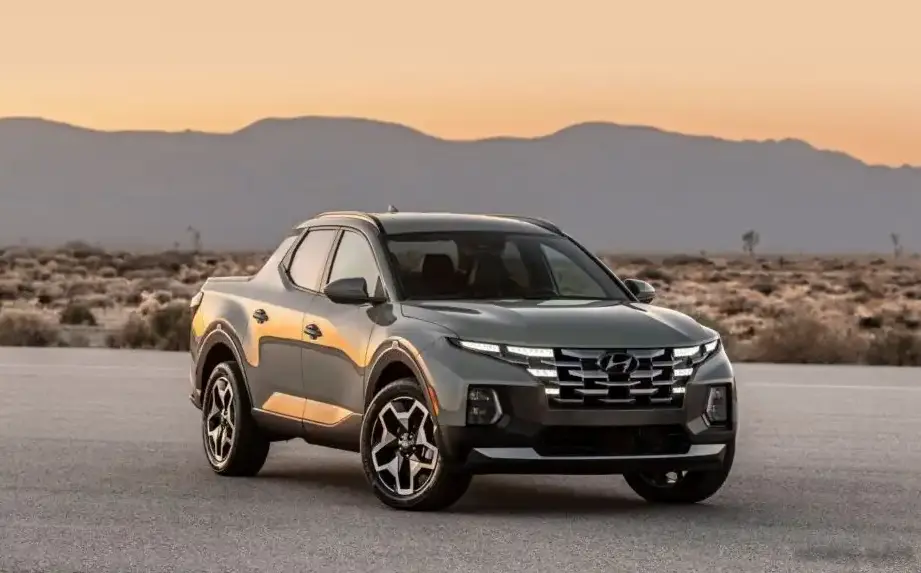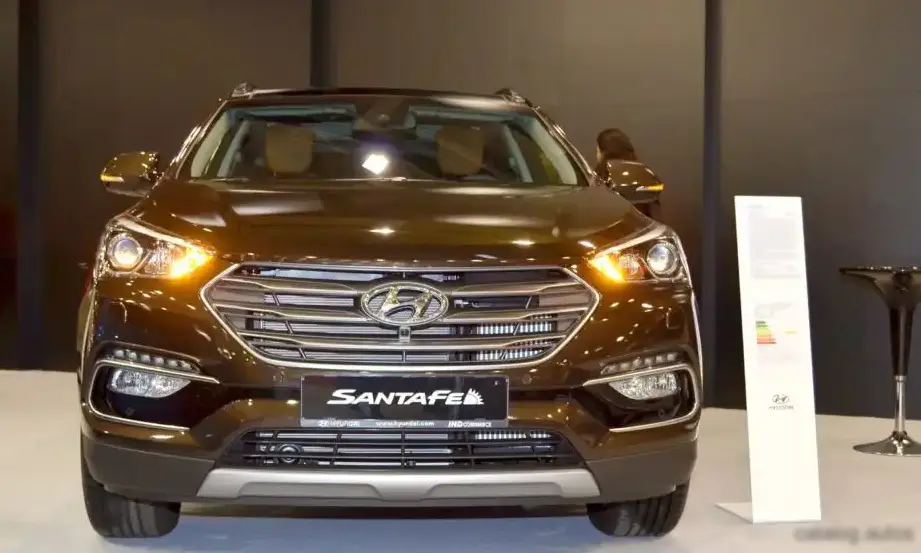
The Hyundai Santa Fe III (DM, facelift 2015) 2.2 CRDi 4WD 7-Seat represents a significant iteration of Hyundai’s popular mid-size SUV, produced from 2015 to 2018. This variant, equipped with a 2.2-liter turbocharged diesel engine producing 200 horsepower, was positioned as a premium offering within the Santa Fe lineup, catering to buyers seeking a blend of space, capability, and fuel efficiency. It built upon the foundation of the DM platform, introduced in 2012, with styling updates and enhanced features aimed at strengthening its competitive position in the global SUV market, particularly in Europe and Asia. The facelift brought revised front and rear fascias, interior refinements, and updated technology.
Technical Specifications
| Brand | Hyundai |
| Model | Santa Fe |
| Generation | Santa Fe III (DM, facelift 2015) |
| Type | 2.2 CRDi (200 Hp) 4WD 7 Seat |
| Start of production | 2015 |
| End of production | 2018 |
| Powertrain Architecture | Internal Combustion engine |
| Body type | SUV |
| Seats | 7 |
| Doors | 5 |
| Fuel consumption (urban) | 7.1 l/100 km (33.1 US mpg, 39.8 UK mpg, 14.1 km/l) |
| Fuel consumption (extra urban) | 5.3 l/100 km (44.4 US mpg, 53.3 UK mpg, 18.9 km/l) |
| Fuel consumption (combined) | 6 l/100 km (39.2 US mpg, 47.1 UK mpg, 16.7 km/l) |
| CO2 emissions | 159 g/km |
| Fuel Type | Diesel |
| Acceleration 0 – 100 km/h | 9 sec |
| Acceleration 0 – 62 mph | 9 sec |
| Acceleration 0 – 60 mph | 8.6 sec |
| Maximum speed | 203 km/h (126.14 mph) |
| Emission standard | Euro 6 |
| Weight-to-power ratio | 9.2 kg/Hp, 108.8 Hp/tonne |
| Weight-to-torque ratio | 4.2 kg/Nm, 239.3 Nm/tonne |
| Power | 200 Hp @ 3800 rpm |
| Power per litre | 91 Hp/l |
| Torque | 440 Nm @ 1750-2750 rpm (324.53 lb.-ft. @ 1750-2750 rpm) |
| Engine layout | Front, Transverse |
| Engine Model/Code | R II / D4HB |
| Engine displacement | 2199 cm3 (134.19 cu. in.) |
| Number of cylinders | 4 |
| Engine configuration | Inline |
| Cylinder Bore | 85.4 mm (3.36 in.) |
| Piston Stroke | 96 mm (3.78 in.) |
| Compression ratio | 16:1 |
| Number of valves per cylinder | 4 |
| Fuel injection system | Diesel Commonrail |
| Engine aspiration | Turbocharger, Intercooler |
| Engine oil capacity | 6.3 l (6.66 US qt | 5.54 UK qt) |
| Coolant | 9.1 l (9.62 US qt | 8.01 UK qt) |
| Kerb Weight | 1839-1977 kg (4054.3 – 4358.54 lbs.) |
| Max. weight | 2600 kg (5732.02 lbs.) |
| Max load | 623-761 kg (1373.48 – 1677.72 lbs.) |
| Trunk (boot) space – minimum | 516 l (18.22 cu. ft.) |
| Trunk (boot) space – maximum | 1615 l (57.03 cu. ft.) |
| Fuel tank capacity | 64 l (16.91 US gal | 14.08 UK gal) |
| Max. roof load | 100 kg (220.46 lbs.) |
| Permitted trailer load with brakes (12%) | 2500 kg (5511.56 lbs.) |
| Permitted trailer load without brakes | 750 kg (1653.47 lbs.) |
| Permitted towbar download | 100 kg (220.46 lbs.) |
| Length | 4690 mm (184.65 in.) |
| Width | 1880 mm (74.02 in.) |
| Height | 1680 mm (66.14 in.) |
| Wheelbase | 2700 mm (106.3 in.) |
| Front track | 1628-1633 mm (64.09 – 64.29 in.) |
| Rear (Back) track | 1639-1644 mm (64.53 – 64.72 in.) |
| Front overhang | 935 mm (36.81 in.) |
| Rear overhang | 1055 mm (41.54 in.) |
| Ride height (ground clearance) | 185 mm (7.28 in.) |
| Minimum turning circle (turning diameter) | 10.9 m (35.76 ft.) |
| Drivetrain Architecture | The Internal combustion engine (ICE) drives the front wheels permanently, and the rear wheels are driven through an electrically or mechanically operated clutch if necessary. |
| Drive wheel | All wheel drive (4×4) |
| Number of gears and type of gearbox | 6 gears, manual transmission |
| Front suspension | Independent type McPherson |
| Rear suspension | Independent multi-link suspension |
| Front brakes | Ventilated discs |
| Rear brakes | Disc |
| Assisting systems | ABS (Anti-lock braking system) |
| Steering type | Steering rack and pinion |
| Power steering | Electric Steering |
| Tires size | 235/60 R18 |
| Wheel rims size | 7.5J x 18 |
INTRODUCTION
The Hyundai Santa Fe III (DM, facelift 2015) 2.2 CRDi 4WD 7-Seat is a mid-size crossover SUV produced by Hyundai Motor Company between 2015 and 2018. This version represents a refresh of the third-generation Santa Fe, offering a more refined design, improved features, and a powerful diesel engine option. The “DM” designation refers to the internal platform code, while the facelift denotes the styling and equipment updates introduced in 2015. This particular variant, with its 2.2-liter diesel engine and all-wheel-drive system, was aimed at buyers needing a versatile, spacious, and capable vehicle for family transport and occasional off-road use. It was a key model in Hyundai’s strategy to establish itself as a major player in the competitive SUV segment.
Powertrain & Engine Architecture
At the heart of the Santa Fe III 2.2 CRDi lies the R II series diesel engine, specifically the D4HB code. This 2.2-liter inline-four cylinder engine utilizes a common-rail direct injection system, delivering fuel directly into the combustion chamber at extremely high pressure. This technology, coupled with a variable geometry turbocharger (VGT) and intercooler, allows for both strong low-end torque and impressive peak power. The engine produces 200 horsepower at 3800 rpm and a substantial 440 Nm (324.53 lb.-ft.) of torque between 1750 and 2750 rpm. The engine features a 16:1 compression ratio and 4 valves per cylinder. The 6-speed manual transmission was standard, providing a balance between fuel efficiency and driver control. The transmission’s gear ratios are tuned to maximize the engine’s torque output, providing strong acceleration in everyday driving situations.
Driving Characteristics
The 2.2 CRDi engine delivers a robust driving experience. While not a sports car, the Santa Fe offers ample power for overtaking and highway cruising. The 9-second 0-60 mph acceleration time is respectable for a vehicle of this size and weight. The manual transmission allows for precise gear selection, and the engine’s strong low-end torque means that frequent downshifting isn’t necessary. Compared to the base 2.0-liter petrol engine, the 2.2 CRDi provides significantly more power and torque, resulting in a more confident and relaxed driving experience, especially when fully loaded or towing. The all-wheel-drive system enhances traction and stability, particularly in adverse weather conditions. However, the added weight of the AWD system and diesel engine does slightly impact handling agility compared to front-wheel-drive variants.
Equipment & Trim Levels
The 2.2 CRDi 4WD 7-Seat trim typically came well-equipped, reflecting its position as a premium offering. Standard features often included automatic climate control, a touchscreen infotainment system with navigation, Bluetooth connectivity, rear parking sensors, and alloy wheels. Higher trim levels added features such as leather upholstery, a panoramic sunroof, heated and ventilated front seats, and advanced safety systems like lane departure warning and automatic emergency braking. The interior design focused on practicality and comfort, with a spacious cabin and ample storage compartments. The seven-seat configuration provided flexibility for families, although the third-row seats were best suited for children or shorter adults.
Chassis & Braking
The Santa Fe III utilizes a McPherson strut front suspension and a multi-link rear suspension, providing a comfortable and controlled ride. The suspension is tuned to prioritize comfort over sporty handling, absorbing bumps and imperfections in the road effectively. The 2.2 CRDi models typically featured ventilated disc brakes at the front and solid disc brakes at the rear. Anti-lock Braking System (ABS) was standard, enhancing braking performance and stability. The steering is electrically assisted, providing a light and responsive feel. The all-wheel-drive system employs a multi-plate clutch to distribute torque between the front and rear axles as needed, optimizing traction in various driving conditions.
Market Reception & Comparison
The Hyundai Santa Fe III 2.2 CRDi 4WD 7-Seat was generally well-received by automotive critics. It was praised for its spacious interior, comfortable ride, and powerful diesel engine. Fuel economy was also a strong point, with combined fuel consumption figures around 39.2 US mpg. Compared to competitors like the Kia Sorento and Nissan X-Trail, the Santa Fe offered a compelling combination of value, features, and performance. However, some critics noted that the interior materials weren’t quite as premium as those found in some European rivals. The diesel engine, while powerful, was sometimes criticized for being slightly noisy compared to petrol alternatives.
Legacy
The Hyundai Santa Fe III 2.2 CRDi 4WD 7-Seat has proven to be a reliable and durable vehicle in the used car market. The R II diesel engine, while requiring regular maintenance, is generally known for its longevity. Common issues include diesel particulate filter (DPF) clogging, particularly on vehicles used primarily for short trips, and potential problems with the turbocharger. However, with proper servicing and maintenance, these engines can easily exceed 150,000 miles. Today, these Santa Fes represent a good value proposition for buyers seeking a spacious, capable, and fuel-efficient SUV, offering a blend of practicality and affordability.