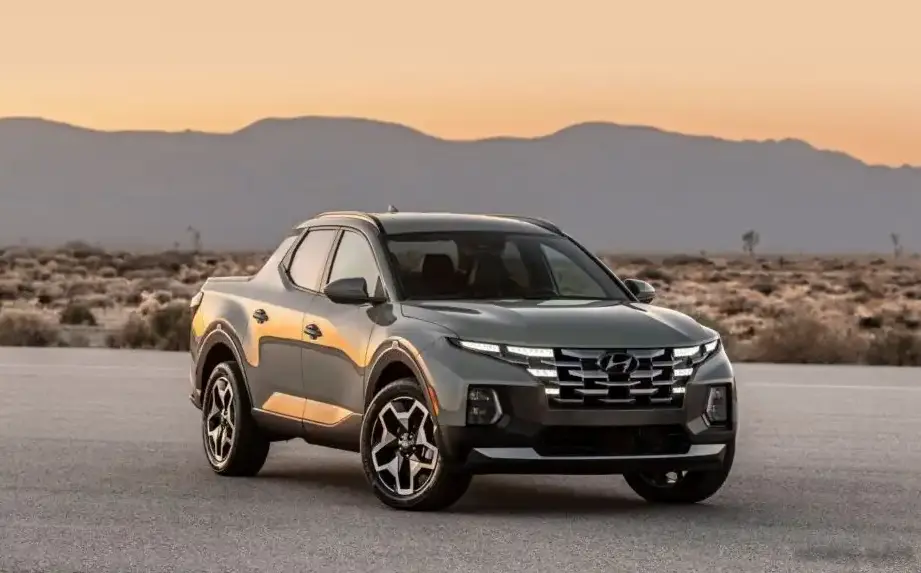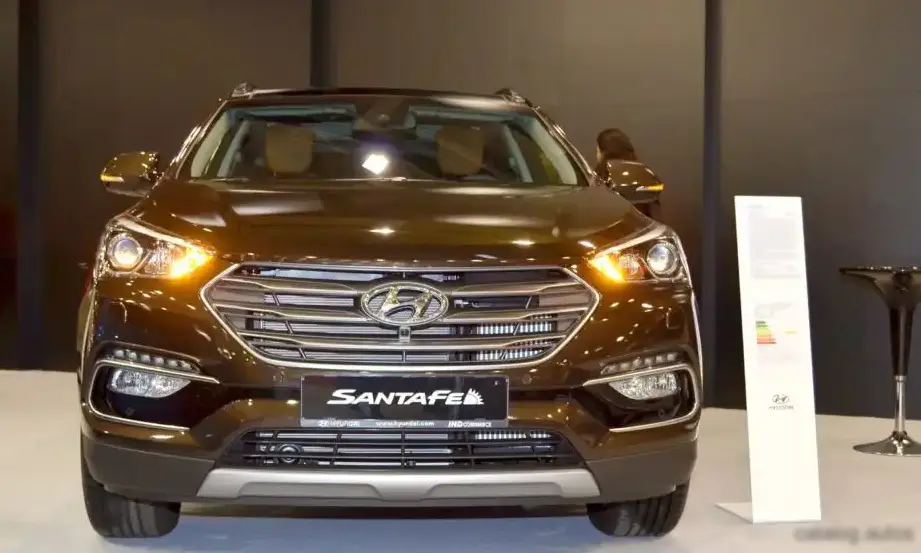
The Hyundai Santa Fe Sport 2.0 Turbo GDI AWD Automatic, produced from 2017 to 2018, represents a mid-cycle refresh of the third-generation (DM) Santa Fe. This variant occupied the upper-mid-range position within the Santa Fe lineup, offering a balance of performance, features, and all-weather capability. It was designed to appeal to families seeking a versatile SUV with a more engaging driving experience than the base models. The “Sport” designation indicated a focus on a slightly more dynamic driving feel compared to the standard Santa Fe, while the 2.0 Turbo GDI engine and all-wheel drive system provided enhanced power and traction.
Technical Specifications
| Brand | Hyundai |
| Model | Santa Fe |
| Generation | Santa Fe III (DM, facelift 2015) |
| Type (Engine) | Sport 2.0 Turbo GDI (240 Hp) AWD Automatic |
| Start of production | 2017 |
| End of production | 2018 |
| Powertrain Architecture | Internal Combustion engine |
| Body type | SUV |
| Seats | 5-7 |
| Doors | 5 |
| Fuel consumption (economy) – urban (NEDC) | 12.3 l/100 km (19.1 US mpg, 23 UK mpg, 8.1 km/l) |
| Fuel consumption (economy) – extra urban (NEDC) | 9 l/100 km (26.1 US mpg, 31.4 UK mpg, 11.1 km/l) |
| Fuel consumption (economy) – combined (NEDC) | 10.6 l/100 km (22.2 US mpg, 26.6 UK mpg, 9.4 km/l) |
| Fuel Type | Petrol (Gasoline) |
| Weight-to-power ratio | 7.4 kg/Hp, 135.7 Hp/tonne |
| Weight-to-torque ratio | 5 kg/Nm, 199.7 Nm/tonne |
| Power | 240 Hp @ 6000 rpm |
| Power per litre | 120.1 Hp/l |
| Torque | 353 Nm @ 1450-3500 rpm (260.36 lb.-ft. @ 1450-3500 rpm) |
| Engine layout | Front, Transverse |
| Engine Model/Code | Theta II / G4KH |
| Engine displacement | 1998 cm3 (121.93 cu. in.) |
| Number of cylinders | 4 |
| Engine configuration | Inline |
| Cylinder Bore | 86 mm (3.39 in.) |
| Piston Stroke | 86 mm (3.39 in.) |
| Compression ratio | 10:1 |
| Number of valves per cylinder | 4 |
| Fuel injection system | Direct injection |
| Engine aspiration | Turbocharger, Intercooler |
| Valvetrain | DOHC |
| Engine oil capacity | 4.8 l (5.07 US qt | 4.22 UK qt) |
| Coolant | 9.7 l (10.25 US qt | 8.53 UK qt) |
| Kerb Weight | 1768 kg (3897.77 lbs.) |
| Max. weight | 2340 kg (5158.82 lbs.) |
| Max load | 572 kg (1261.04 lbs.) |
| Trunk (boot) space – maximum | 1680 l (59.33 cu. ft.) |
| Fuel tank capacity | 66 l (17.44 US gal | 14.52 UK gal) |
| Permitted trailer load with brakes (12%) | 1588 kg (3500.94 lbs.) |
| Permitted trailer load without brakes | 748 kg (1649.06 lbs.) |
| Length | 4699 mm (185 in.) |
| Width | 1880 mm (74.02 in.) |
| Height | 1689 mm (66.5 in.) |
| Wheelbase | 2700 mm (106.3 in.) |
| Front track | 1628 mm (64.09 in.) |
| Rear (Back) track | 1639 mm (64.53 in.) |
| Minimum turning circle (turning diameter) | 10.9 m (35.76 ft.) |
| Drivetrain Architecture | All wheel drive (4×4). Internal Combustion engine. The Internal combustion engine (ICE) drives permanently the four wheels of the vehicle. |
| Number of gears and type of gearbox | 6 gears, automatic transmission |
| Front suspension | Independent type McPherson |
| Rear suspension | Independent multi-link suspension |
| Front brakes | Ventilated discs |
| Rear brakes | Disc |
| Assisting systems | ABS (Anti-lock braking system) |
| Steering type | Steering rack and pinion |
| Power steering | Electric Steering |
| Tires size | 235/60 R18 |
| Wheel rims size | 7.5J x 18 |
Powertrain & Engine Architecture
The heart of the Santa Fe Sport 2.0 Turbo GDI AWD is the Hyundai Theta II engine, specifically the G4KH code. This 1.998-liter, inline-four cylinder engine utilizes direct fuel injection (GDI) and a twin-scroll turbocharger to deliver 240 horsepower at 6000 rpm and 260 lb-ft of torque between 1450 and 3500 rpm. The direct injection system allows for precise fuel delivery, enhancing both power and fuel efficiency. The twin-scroll turbocharger minimizes turbo lag, providing a more responsive driving experience. The engine features a double overhead camshaft (DOHC) valvetrain with four valves per cylinder, optimizing airflow for increased performance. The engine is paired with a six-speed automatic transmission, designed to handle the engine’s torque output and provide smooth gear changes. This transmission was a conventional torque-converter automatic, prioritizing comfort and ease of use over outright sportiness.
Driving Characteristics
The 2.0 Turbo GDI engine provides brisk acceleration for a mid-size SUV. While not a sports car, the Santa Fe Sport offers noticeably more power than the base 2.4-liter engine option. The automatic transmission is well-tuned for everyday driving, offering smooth shifts and adequate responsiveness. The all-wheel-drive system provides enhanced traction in various weather conditions, making it a capable vehicle for year-round use. Compared to the manual transmission versions (available in other Santa Fe trims), the automatic prioritizes convenience over driver engagement. The gear ratios are optimized for fuel economy and comfortable cruising, rather than aggressive acceleration. The weight of the vehicle, around 3900 lbs, is noticeable, but the engine’s torque helps to overcome this, providing decent passing power.
Equipment & Trim Levels
The Santa Fe Sport 2.0 Turbo GDI AWD Automatic typically came well-equipped with standard features such as automatic headlights, a rearview camera, a touchscreen infotainment system with Apple CarPlay and Android Auto compatibility, and a suite of safety features including automatic emergency braking, lane departure warning, and blind-spot monitoring. Interior upholstery was typically cloth or leather, depending on optional packages. Available options included a panoramic sunroof, heated and ventilated front seats, a premium sound system, and navigation. The “Sport” trim level often included unique exterior styling cues, such as a different grille design and alloy wheel options.
Chassis & Braking
The Santa Fe Sport utilizes a front independent McPherson strut suspension and a rear independent multi-link suspension. This setup provides a comfortable ride quality while maintaining reasonable handling characteristics. The suspension was tuned to balance comfort and control, making it suitable for both city driving and highway cruising. Braking duties are handled by ventilated discs at the front and solid discs at the rear. The anti-lock braking system (ABS) is standard, along with electronic brake-force distribution (EBD) and brake assist. The steering is an electric power-assisted rack-and-pinion system, providing light and precise steering feel.
Market Reception & Comparison
The Santa Fe Sport 2.0 Turbo GDI AWD Automatic was generally well-received by automotive critics. It was praised for its spacious interior, comfortable ride, and strong engine performance. Fuel economy was considered average for its class, with combined ratings around 22 mpg. Compared to other trims in the Santa Fe lineup, the 2.0 Turbo GDI offered a significant performance upgrade over the base 2.4-liter engine, but at a higher price point. Reliability was generally good, although some owners reported minor issues with the infotainment system and occasional turbocharger concerns. Compared to competitors like the Honda CR-V and Toyota RAV4, the Santa Fe Sport offered a more powerful engine option, but its overall refinement and fuel economy were slightly behind.
Legacy
The Hyundai Santa Fe Sport 2.0 Turbo GDI AWD Automatic has proven to be a relatively reliable vehicle in the used car market. The Theta II engine, while not without its potential issues (such as occasional oil consumption), has generally been durable when properly maintained. The six-speed automatic transmission is also known for its reliability. Today, these vehicles can be found at reasonable prices, offering a good value for buyers seeking a spacious, well-equipped, and capable SUV. Regular maintenance, including oil changes and timely servicing of the turbocharger, is crucial to ensure the long-term reliability of this powertrain.