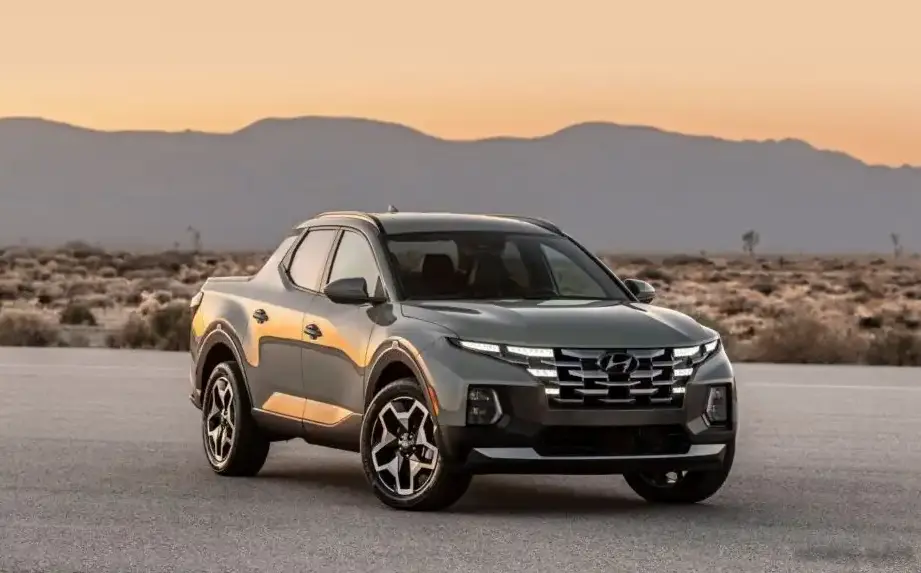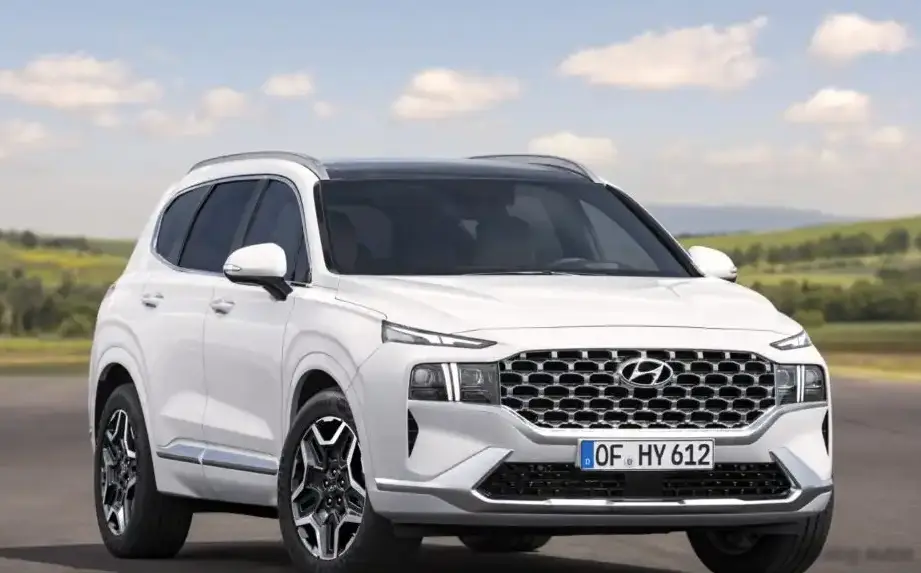
The Hyundai Santa Fe IV (TM) facelift, specifically the 2.2 CRDi variant with a 7-speed Dual Clutch Transmission (DCT) and seven-seat configuration, was produced from November 2020 to February 2022. This model represents a mid-cycle refresh of the fourth-generation Santa Fe (TM), introduced in 2018, and aimed to enhance the vehicle’s appeal with updated styling, improved technology, and refined powertrain options. Positioned as a mid-to-upper trim level within the Santa Fe lineup, this 2.2 CRDi DCT offered a balance of performance, fuel efficiency, and practicality for families seeking a spacious and well-equipped SUV. It primarily targeted the European and Asian markets, where diesel engines remained popular due to their fuel economy and torque characteristics.
Technical Specifications
| Brand | Hyundai |
| Model | Santa Fe |
| Generation | Santa Fe IV (TM, facelift 2020) |
| Type (Engine) | 2.2 CRDi (202 Hp) DCT 7 Seat |
| Start of production | November, 2020 |
| End of production | February, 2022 |
| Powertrain Architecture | Internal Combustion engine |
| Body type | SUV |
| Seats | 7 |
| Doors | 5 |
| Combined fuel consumption (WLTP) | 6.3 l/100 km (37.3 US mpg, 44.8 UK mpg, 15.9 km/l) |
| CO2 emissions (WLTP) | 166 g/km |
| Fuel consumption (urban) | 6.5 l/100 km (36.2 US mpg, 43.5 UK mpg, 15.4 km/l) |
| Fuel consumption (extra urban) | 5.1 l/100 km (46.1 US mpg, 55.4 UK mpg, 19.6 km/l) |
| Fuel consumption (combined) | 5.6 l/100 km (42 US mpg, 50.4 UK mpg, 17.9 km/l) |
| CO2 emissions (NEDC) | 148 g/km |
| Fuel Type | Diesel |
| Acceleration 0 – 100 km/h | 9 sec |
| Acceleration 0 – 62 mph | 9 sec |
| Acceleration 0 – 60 mph | 8.6 sec |
| Maximum speed | 205 km/h (127.38 mph) |
| Emission standard | Euro 6d |
| Weight-to-power ratio | 8.8 kg/Hp, 114.1 Hp/tonne |
| Weight-to-torque ratio | 4 kg/Nm, 248.6 Nm/tonne |
| Power | 202 Hp @ 3800 rpm |
| Torque | 440 Nm @ 1750-2750 rpm (324.53 lb.-ft. @ 1750-2750 rpm) |
| Engine layout | Front, Transverse |
| Engine Model/Code | Smartstream / D4HE |
| Engine displacement | 2151 cm3 (131.26 cu. in.) |
| Number of cylinders | 4 |
| Engine configuration | Inline |
| Cylinder Bore | 83 mm (3.27 in.) |
| Piston Stroke | 99.4 mm (3.91 in.) |
| Number of valves per cylinder | 4 |
| Fuel injection system | Diesel Commonrail |
| Engine aspiration | Turbocharger, Intercooler |
| Engine oil capacity | 5.6 l (5.92 US qt | 4.93 UK qt) |
| Coolant capacity | 8.4 l (8.88 US qt | 7.39 UK qt) |
| Kerb Weight | 1770-1919 kg (3902.18 – 4230.67 lbs.) |
| Max. weight | 2550 kg (5621.79 lbs.) |
| Max load | 631-780 kg (1391.12 – 1719.61 lbs.) |
| Trunk (boot) space – minimum | 571-782 l (20.16 – 27.62 cu. ft.) |
| Trunk (boot) space – maximum | 1649 l (58.23 cu. ft.) |
| Fuel tank capacity | 67 l (17.7 US gal | 14.74 UK gal) |
| Max. roof load | 100 kg (220.46 lbs.) |
| Permitted trailer load (braked) | 2500 kg (5511.56 lbs.) |
| Permitted trailer load (unbraked) | 750 kg (1653.47 lbs.) |
| Permitted towbar download | 100 kg (220.46 lbs.) |
| Length | 4785 mm (188.39 in.) |
| Width | 1900 mm (74.8 in.) |
| Height | 1685 mm (66.34 in.) |
| Wheelbase | 2765 mm (108.86 in.) |
| Front track | 1637-1646 mm (64.45 – 64.8 in.) |
| Rear track | 1647-1656 mm (64.84 – 65.2 in.) |
| Ride height (ground clearance) | 176 mm (6.93 in.) |
| Drivetrain | Front wheel drive |
| Number of gears | 8 |
| Gearbox type | Automatic transmission DCT |
| Front brakes | Ventilated discs |
| Rear brakes | Disc |
| Tire size | 235/55 R19; 255/45 R20 |
| Wheel rims size | 7.5J x 19; 8.5J x 20 |
Powertrain & Engine Architecture
The heart of this Santa Fe variant is the Smartstream D4HE 2.2-liter four-cylinder diesel engine. This engine utilizes a cast iron block and aluminum cylinder head, incorporating a turbocharger with an intercooler to boost power and efficiency. The engine employs a common-rail direct injection system, delivering fuel at extremely high pressures for optimized combustion. The D4HE engine is known for its relatively quiet operation compared to older diesel designs, thanks to features like improved fuel injector technology and optimized engine mounting. The 7-speed Dual Clutch Transmission (DCT) provides quick and smooth gear changes, contributing to both performance and fuel economy. Unlike traditional automatic transmissions, a DCT uses two separate clutches for odd and even gears, allowing for pre-selection of the next gear and minimizing power interruption during shifts.
Driving Characteristics
The 202 hp and 440 Nm (324.53 lb-ft) of torque delivered by the 2.2 CRDi engine provide ample power for everyday driving and highway cruising. Acceleration from 0 to 60 mph takes approximately 8.6 seconds, and the engine feels responsive throughout the rev range. The DCT transmission contributes to a more engaging driving experience than a traditional automatic, with quick and precise shifts. While not a sports SUV, the Santa Fe 2.2 CRDi offers a comfortable and confident ride, with well-tuned suspension that absorbs bumps effectively. Compared to the base 1.6L gasoline engine, the 2.2 CRDi provides significantly more torque, making it better suited for towing and carrying a full load of passengers. Compared to higher-output diesel variants (if offered in some markets), this version offers a good balance between performance and fuel efficiency.
Equipment & Trim Levels
The 2.2 CRDi DCT 7-seat trim typically included a generous array of standard features. These commonly included automatic climate control, a touchscreen infotainment system with Apple CarPlay and Android Auto compatibility, a rearview camera, parking sensors, and a suite of safety features such as lane keeping assist, forward collision avoidance assist, and adaptive cruise control. Interior upholstery was typically cloth or leather, depending on optional packages. Available options included a panoramic sunroof, premium sound system, heated and ventilated front seats, and a power liftgate. The overall interior design focused on providing a comfortable and spacious environment for passengers.
Chassis & Braking
The Santa Fe IV utilizes a front-wheel-drive platform with independent suspension at all four corners. The front suspension consists of MacPherson struts, while the rear features a multi-link setup. This configuration provides a good balance of ride comfort and handling. Braking duties are handled by ventilated discs at the front and solid discs at the rear. Anti-lock Braking System (ABS) and Electronic Stability Control (ESC) are standard features, enhancing safety and control. The steering is electrically assisted, providing a light and responsive feel.
Market Reception & Comparison
The Hyundai Santa Fe IV facelift, including the 2.2 CRDi DCT variant, was generally well-received by automotive critics. Reviewers praised its spacious interior, comfortable ride, and comprehensive list of standard features. The diesel engine was noted for its fuel efficiency and strong torque output. Compared to competitors like the Kia Sorento, Nissan X-Trail, and Toyota RAV4, the Santa Fe offered a compelling value proposition with its combination of features, performance, and price. Fuel economy figures of around 6.3 l/100 km (37.3 US mpg) were competitive within its class. Reliability reports generally indicated good dependability, although some owners reported minor issues with the infotainment system.
Legacy
The Hyundai Santa Fe IV 2.2 CRDi DCT has proven to be a relatively reliable powertrain combination. The Smartstream engine, while complex, has demonstrated good durability when properly maintained. The DCT transmission, while requiring occasional servicing, has generally held up well over time. In the used car market, these models are often sought after for their spaciousness, fuel efficiency, and well-equipped interiors. Regular maintenance, including oil changes and timely servicing of the DCT, is crucial to ensure long-term reliability. The Santa Fe IV continues to be a popular choice for families seeking a practical and comfortable SUV.