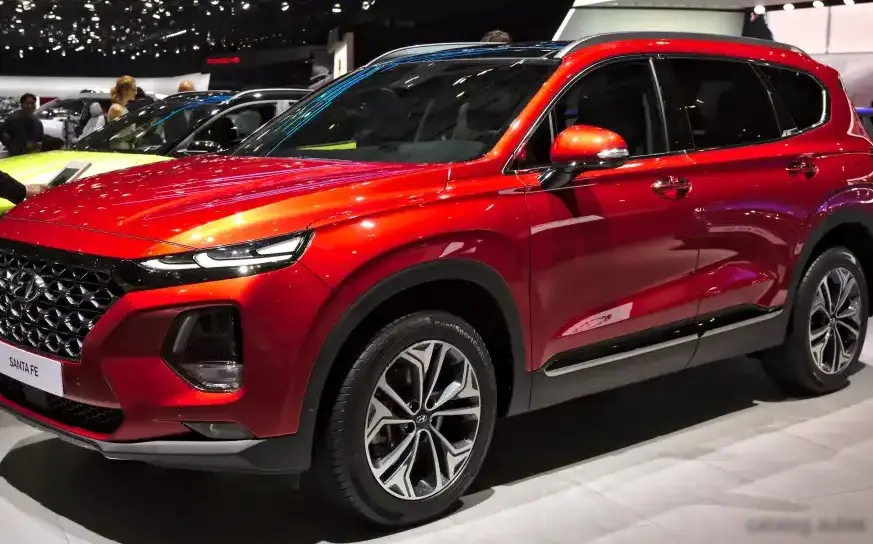
The Hyundai Santa Fe TM, produced from 2018 to 2020, represented the fourth generation of Hyundai’s popular mid-size SUV. Within the TM range, the 2.0 CRDi variant with 150 horsepower was a significant offering, particularly in European and Asian markets. This model aimed to balance fuel efficiency with practicality, serving as a core trim level within the broader Santa Fe lineup. It was positioned as a more economical alternative to the higher-powered diesel options and gasoline engines available, targeting buyers prioritizing value and everyday usability. The Santa Fe TM was built on the platform shared with the Kia Sorento, offering a spacious interior and a focus on family-oriented features.
Technical Specifications
| Brand | Hyundai |
| Model | Santa Fe |
| Generation | Santa Fe IV (TM) |
| Type (Engine) | R 2.0 CRDi (150 Hp) |
| Start of production | 2018 year |
| End of production | 2020 year |
| Powertrain Architecture | Internal Combustion engine |
| Body type | SUV |
| Seats | 5 |
| Doors | 5 |
| Fuel Type | Diesel |
| Emission standard | Euro 6 |
| Power | 150 Hp @ 4000 rpm |
| Power per litre | 75.2 Hp/l |
| Torque | 397 Nm @ 1750 rpm / 292.81 lb.-ft. @ 1750 rpm |
| Engine layout | Front, Transverse |
| Engine Model/Code | R II / D4HA |
| Engine displacement | 1995 cm3 / 121.74 cu. in. |
| Number of cylinders | 4 |
| Engine configuration | Inline |
| Cylinder Bore | 84 mm / 3.31 in. |
| Piston Stroke | 90 mm / 3.54 in. |
| Compression ratio | 10.6:1 |
| Number of valves per cylinder | 4 |
| Fuel injection system | Diesel Commonrail |
| Engine aspiration | Turbocharger, Intercooler |
| Valvetrain | DOHC |
| Engine oil capacity | 6.5 l / 6.87 US qt | 5.72 UK qt |
| Coolant | 8.8 l / 9.3 US qt | 7.74 UK qt |
| Trunk (boot) space – minimum | 625 l / 22.07 cu. ft. |
| Length | 4770 mm / 187.8 in. |
| Width | 1890 mm / 74.41 in. |
| Height | 1680 mm / 66.14 in. |
| Wheelbase | 2765 mm / 108.86 in. |
| Front overhang | 940 mm / 37.01 in. |
| Rear overhang | 1065 mm / 41.93 in. |
| Ride height (ground clearance) | 185 mm / 7.28 in. |
| Drivetrain Architecture | The Internal combustion engine (ICE) drives the front wheels of the vehicle. |
| Drive wheel | Front wheel drive |
| Number of gears and type of gearbox | 6 gears, manual transmission |
| Front brakes | Ventilated discs |
| Rear brakes | Disc |
| Assisting systems | ABS (Anti-lock braking system) |
| Steering type | Steering rack and pinion |
| Power steering | Electric Steering |
| Tires size | 235/65 R17; 235/60 R18; 235/55 R19 |
| Wheel rims size | 17; 18; 19 |
Powertrain & Engine Architecture
The heart of the Santa Fe 2.0 CRDi (150 hp) is the Hyundai R II series diesel engine, specifically the D4HA code. This is a four-cylinder, inline engine utilizing a second-generation common-rail direct injection system. This system, developed in-house by Hyundai, allowed for precise fuel delivery and optimized combustion, contributing to both power output and fuel efficiency. The engine features a turbocharger with an intercooler, enhancing power and torque across the rev range. The DOHC (Double Overhead Camshaft) valvetrain, with four valves per cylinder, further improves breathing and engine performance. The 1995cc displacement provides a good balance between responsiveness and economy. The engine’s design incorporates features to reduce noise, vibration, and harshness (NVH), a key focus for Hyundai during this period.
Driving Characteristics
The 150 horsepower output, coupled with 397 Nm (292.81 lb-ft) of torque, provided adequate performance for everyday driving. While not a sports SUV, the 2.0 CRDi offered sufficient power for highway cruising and overtaking maneuvers. The six-speed manual transmission allowed for driver control and contributed to fuel efficiency. Compared to the higher-output 2.2 CRDi variants, the 2.0 CRDi felt less urgent in acceleration, but the difference was often negligible in typical driving scenarios. The gear ratios were tuned for fuel economy, meaning the engine needed to be revved slightly to access peak power. The front-wheel-drive configuration contributed to lower weight and improved fuel consumption, but it lacked the all-weather capability of the available all-wheel-drive options.
Equipment & Trim Levels
The 2.0 CRDi 150 hp trim typically came with a respectable level of standard equipment. This included air conditioning, power windows and mirrors, a touchscreen infotainment system with Bluetooth connectivity, and basic safety features like ABS and multiple airbags. Higher trim levels offered upgrades such as leather upholstery, a panoramic sunroof, heated seats, and advanced driver-assistance systems (ADAS) like lane departure warning and automatic emergency braking. Interior materials were generally durable and well-assembled, reflecting Hyundai’s increasing focus on quality. Dashboard configurations were relatively straightforward and user-friendly, prioritizing functionality over flashy design.
Chassis & Braking
The Santa Fe TM utilized a MacPherson strut front suspension and a multi-link rear suspension. This setup provided a comfortable ride quality, absorbing bumps and irregularities in the road surface effectively. The front brakes were ventilated discs, offering good stopping power, while the rear brakes were solid discs. The electric power steering provided a light and responsive feel, making it easy to maneuver in urban environments. Stabilizer bars were fitted to both the front and rear axles to reduce body roll during cornering. The ride height of 185mm (7.28 inches) provided adequate ground clearance for most road conditions.
Market Reception & Comparison
The Hyundai Santa Fe 2.0 CRDi (150 hp) was generally well-received by automotive critics as a practical and fuel-efficient family SUV. It was praised for its spacious interior, comfortable ride, and competitive pricing. However, some reviewers noted that the engine could feel strained when fully loaded or driving uphill. Compared to the 2.2 CRDi models, the 2.0 CRDi offered better fuel economy, but at the expense of some performance. Against competitors like the Kia Sorento, Nissan X-Trail, and Volkswagen Tiguan, the Santa Fe offered a compelling value proposition, often undercutting its rivals in price while providing a similar level of features and practicality.
Legacy
The Hyundai Santa Fe TM 2.0 CRDi (150 hp) has proven to be a relatively reliable vehicle in the used car market. The R II diesel engine, while not without its potential issues (like diesel particulate filter clogging with infrequent long journeys), is generally robust and long-lasting when properly maintained. Common maintenance items include regular oil changes, filter replacements, and inspection of the turbocharger and fuel injection system. Today, these models represent a cost-effective option for buyers seeking a spacious and practical SUV with good fuel economy. The availability of parts and relatively straightforward mechanical design contribute to its continued appeal in the used car market.