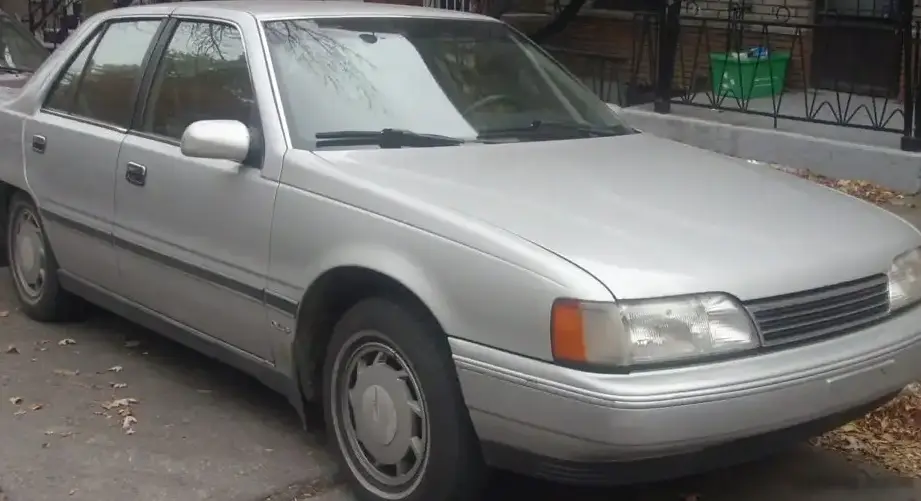
The Hyundai Sonata II (Y2), produced between 1988 and 1991, marked a significant advancement for the South Korean automaker as it sought to establish a foothold in the competitive mid-size sedan market. This generation, based on the Y2 platform, represented a move towards a more refined and technologically equipped vehicle compared to its predecessors. The 1.8-liter (95 hp) variant, equipped with a catalytic converter and automatic transmission, was strategically positioned as a comfortable and economical option within the Sonata II lineup, appealing to buyers who valued ease of use and affordability. It was a key component of Hyundai’s broader strategy to gain acceptance in export markets, offering a value-driven alternative to established Japanese and American brands.
Technical Specifications
| Brand | Hyundai |
| Model | Sonata |
| Generation | Sonata II (Y2) |
| Type (Engine) | 1.8 (95 Hp) CAT Automatic |
| Start of production | 1988 |
| End of production | 1991 |
| Powertrain Architecture | Internal Combustion engine |
| Body type | Sedan |
| Seats | 5 |
| Doors | 4 |
| Fuel consumption (urban) | 12.4 l/100 km (19 US mpg, 22.8 UK mpg, 8.1 km/l) |
| Fuel consumption (extra urban) | 6.3 l/100 km (37.3 US mpg, 44.8 UK mpg, 15.9 km/l) |
| Fuel consumption (combined) | 8.7 l/100 km (27 US mpg, 32.5 UK mpg, 11.5 km/l) |
| Fuel Type | Petrol (Gasoline) |
| Acceleration 0 – 100 km/h | 13 sec |
| Acceleration 0 – 62 mph | 13 sec |
| Acceleration 0 – 60 mph | 12.4 sec |
| Maximum speed | 160 km/h (99.42 mph) |
| Weight-to-power ratio | 12.9 kg/Hp, 77.6 Hp/tonne |
| Weight-to-torque ratio | 8.6 kg/Nm, 116.7 Nm/tonne |
| Power | 95 Hp @ 5250 rpm |
| Power per litre | 52.9 Hp/l |
| Torque | 143 Nm @ 4000 rpm (105.47 lb.-ft. @ 4000 rpm) |
| Engine layout | Front, Transverse |
| Engine displacement | 1796 cm3 (109.6 cu. in.) |
| Number of cylinders | 4 |
| Engine configuration | Inline |
| Cylinder Bore | 80.6 mm (3.17 in.) |
| Piston Stroke | 88 mm (3.46 in.) |
| Compression ratio | 8.9:1 |
| Number of valves per cylinder | 2 |
| Fuel injection system | Multi-port manifold injection |
| Engine aspiration | Naturally aspirated engine |
| Valvetrain | OHC |
| Kerb Weight | 1225 kg (2700.66 lbs.) |
| Trunk (boot) space – minimum | 473 l (16.7 cu. ft.) |
| Fuel tank capacity | 60 l (15.85 US gal | 13.2 UK gal) |
| Length | 4680 mm (184.25 in.) |
| Width | 1750 mm (68.9 in.) |
| Height | 1410 mm (55.51 in.) |
| Wheelbase | 2650 mm (104.33 in.) |
| Front track | 1455 mm (57.28 in.) |
| Rear (Back) track | 1444 mm (56.85 in.) |
| Drivetrain Architecture | The Internal combustion engine (ICE) drives the front wheels of the vehicle. |
| Drive wheel | Front wheel drive |
| Number of gears and type of gearbox | 4 gears, automatic transmission |
| Front suspension | Independent, type McPherson with coil spring and anti-roll bar |
| Rear suspension | Coil spring |
| Front brakes | Ventilated discs |
| Rear brakes | Disc |
| Assisting systems | ABS (Anti-lock braking system) |
| Steering type | Steering rack and pinion |
| Power steering | Hydraulic Steering |
| Tires size | 185/70 R14 |
| Wheel rims size | 5.5J x 14 |
Powertrain & Engine Architecture
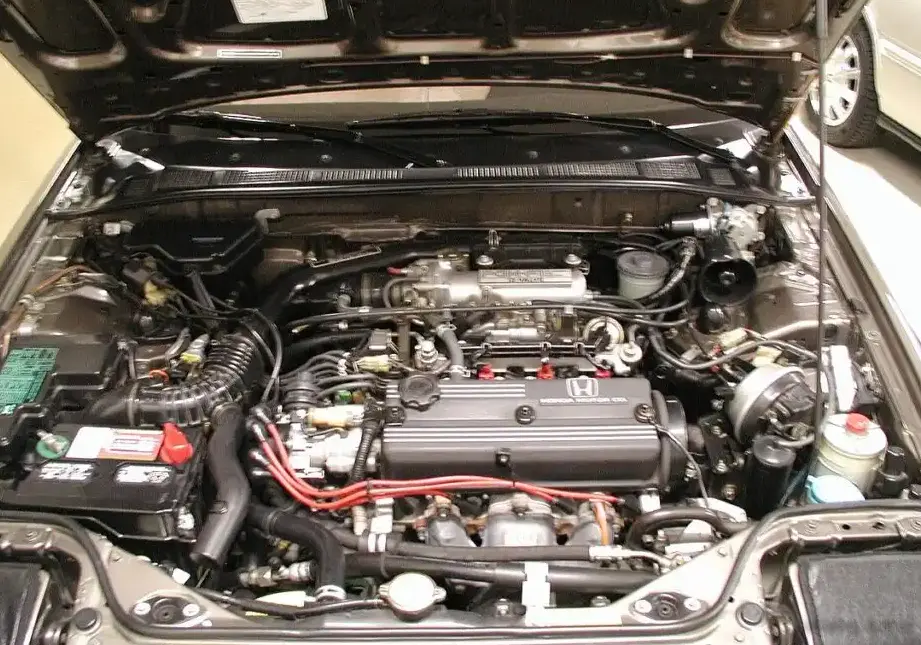
The Sonata II 1.8’s engine was a Mitsubishi-sourced 4G63 inline-four cylinder, displacing 1796 cc. This engine, identified by various codes depending on the specific market, featured a single overhead camshaft (SOHC) valvetrain with two valves per cylinder. The multi-port fuel injection system, a relatively advanced feature for the late 1980s, contributed to improved fuel efficiency and smoother engine operation compared to older carbureted designs. The inclusion of a catalytic converter, denoted by the “CAT” designation, was essential for meeting increasingly strict emissions standards. The engine generated 95 horsepower at 5250 rpm and 143 Nm (105.47 lb-ft) of torque at 4000 rpm. It was paired with a four-speed automatic transmission, prioritizing comfortable cruising over outright performance. This automatic transmission was a conventional hydraulic unit, lacking the electronic controls that would become commonplace in later years.
Driving Characteristics
The 1.8-liter automatic Sonata II delivered a relaxed and comfortable driving experience. Acceleration was sufficient for typical daily driving, achieving a 0-60 mph time of approximately 12.4 seconds. However, it was demonstrably slower than versions equipped with the manual transmission or the larger 2.0-liter engine. The automatic transmission’s gear ratios were tuned for fuel economy and smooth shifting, rather than aggressive acceleration. The engine felt somewhat strained under hard acceleration, and overtaking required careful consideration. The steering was light and responsive, making it easy to maneuver in urban settings, but lacked the tactile feedback preferred by more enthusiastic drivers. The overall driving experience emphasized comfort and convenience over sporty handling.
Equipment & Trim Levels
The 1.8-liter automatic Sonata II generally included a reasonable array of standard features. These typically included power steering, a basic audio system, cloth upholstery, and manual windows and door locks. Air conditioning was frequently offered as an optional upgrade. The interior trim was functional and durable, though not particularly luxurious. Higher trim levels, usually reserved for the 2.0-liter models, offered features such as power windows, upgraded audio systems, and more comfortable seating materials. The 1.8L automatic trim was positioned as the entry-level offering, appealing to buyers seeking a practical and affordable mid-size sedan.
Chassis & Braking
The Sonata II employed a front-wheel-drive layout with an independent McPherson strut suspension at the front and a coil spring suspension in the rear. An anti-roll bar was incorporated into the front suspension to minimize body roll during cornering. The braking system consisted of ventilated discs at the front and solid discs at the rear. An anti-lock braking system (ABS) was available, but not standard across all trim levels. The suspension was tuned for ride comfort, providing a relatively smooth experience over varied road surfaces. The chassis was robust and well-constructed, contributing to the vehicle’s overall durability.
Market Reception & Comparison
The Sonata II 1.8 automatic received a mixed reception from automotive critics. While its affordability, comfortable ride, and improved build quality compared to earlier Hyundai models were praised, the engine’s limited power and the automatic transmission’s somewhat sluggish performance were common criticisms. Compared to the 2.0-liter versions, the 1.8 offered significantly reduced performance but improved fuel economy. When benchmarked against Japanese competitors like the Toyota Camry and Honda Accord, the Sonata II offered a lower price point but lacked the established reputation for reliability and refinement. The 1.8L automatic was often viewed as a sensible choice for budget-conscious buyers prioritizing practicality and fuel efficiency.
Legacy
The Hyundai Sonata II 1.8 automatic, while not a performance benchmark, played a vital role in establishing Hyundai as a credible competitor in the global automotive landscape. The powertrain, while not revolutionary, proved to be reasonably reliable with consistent maintenance. Today, these vehicles are relatively scarce and are increasingly sought after by collectors and enthusiasts interested in early Hyundai models. The 4G63 engine, in particular, is well-regarded for its durability and potential for modification. While sourcing parts can present challenges, the Sonata II 1.8 remains a testament to Hyundai’s early ambitions and its efforts to build a reputation for quality and value.