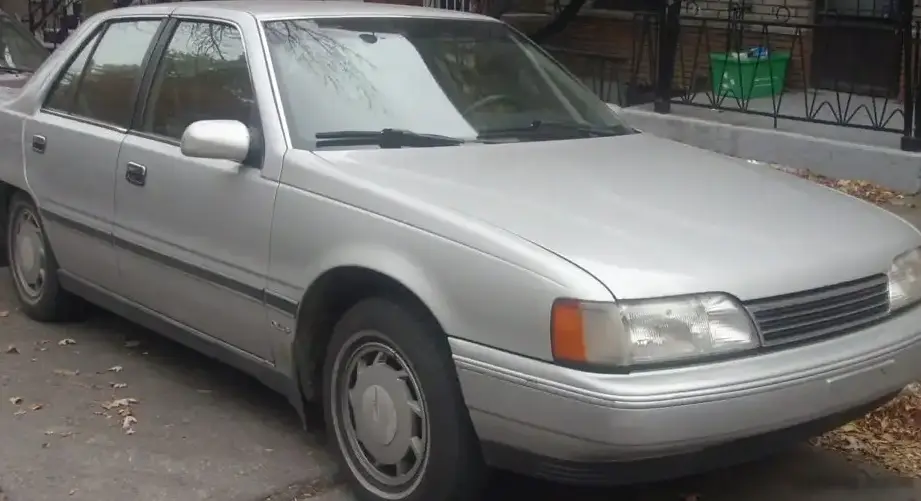
The Hyundai Sonata II (Y2), produced between 1989 and 1991, represented a significant step forward for the South Korean automaker in its ambition to establish a presence in the global mid-size sedan market. Positioned as a more refined and spacious alternative to smaller domestic offerings, the Y2 Sonata aimed to compete with established Japanese and American brands. This generation, built upon a stretched version of the first Sonata’s platform, offered a more modern design and a wider range of features. The 2.4-liter, 114 horsepower variant occupied a middle ground in the Sonata II lineup, offering a balance between performance and affordability, and was a key model for attracting buyers seeking a comfortable and reliable family car.
Technical Specifications
| Brand | Hyundai |
| Model | Sonata |
| Generation | Sonata II (Y2) |
| Type (Engine) | 2.4 (114 Hp) |
| Start of production | 1989 |
| End of production | 1991 |
| Powertrain Architecture | Internal Combustion engine |
| Body type | Sedan |
| Seats | 5 |
| Doors | 4 |
| Fuel consumption (combined) | 9.4 l/100 km (25 US mpg, 30.1 UK mpg, 10.6 km/l) |
| Fuel Type | Petrol (Gasoline) |
| Maximum speed | 190 km/h (118.06 mph) |
| Weight-to-power ratio | 11 kg/Hp, 91.2 Hp/tonne |
| Weight-to-torque ratio | 6.6 kg/Nm, 151.2 Nm/tonne |
| Power | 114 Hp @ 4500 rpm |
| Power per litre | 48.5 Hp/l |
| Torque | 189 Nm @ 3500 rpm (139.4 lb.-ft. @ 3500 rpm) |
| Engine layout | Front, Transverse |
| Engine displacement | 2351 cm3 (143.47 cu. in.) |
| Number of cylinders | 4 |
| Engine configuration | Inline |
| Cylinder Bore | 86.5 mm (3.41 in.) |
| Piston Stroke | 100 mm (3.94 in.) |
| Compression ratio | 8.6:1 |
| Number of valves per cylinder | 2 |
| Fuel injection system | Multi-port manifold injection |
| Engine aspiration | Naturally aspirated engine |
| Valvetrain | DOHC |
| Kerb Weight | 1250 kg (2755.78 lbs.) |
| Max. weight | 1740 kg (3836.04 lbs.) |
| Max load | 490 kg (1080.27 lbs.) |
| Trunk (boot) space – minimum | 473 l (16.7 cu. ft.) |
| Fuel tank capacity | 60 l (15.85 US gal | 13.2 UK gal) |
| Length | 4680 mm (184.25 in.) |
| Width | 1750 mm (68.9 in.) |
| Height | 1410 mm (55.51 in.) |
| Wheelbase | 2650 mm (104.33 in.) |
| Front track | 1461 mm (57.52 in.) |
| Rear (Back) track | 1440 mm (56.69 in.) |
| Drivetrain Architecture | The Internal combustion engine (ICE) drives the front wheels of the vehicle. |
| Drive wheel | Front wheel drive |
| Number of gears and type of gearbox | 5 gears, manual transmission |
| Front suspension | Independent, type McPherson with coil spring and anti-roll bar |
| Rear suspension | Coil spring |
| Front brakes | Ventilated discs |
| Rear brakes | Drum |
| Assisting systems | ABS (Anti-lock braking system) |
| Steering type | Steering rack and pinion |
| Power steering | Hydraulic Steering |
| Tires size | 185/70 R14 |
| Wheel rims size | 14 |
Powertrain & Engine Architecture
The heart of the Sonata II 2.4 was the Mitsubishi-sourced 4G63 inline-four cylinder engine. Displacing 2.4 liters (2351 cc), this engine featured a dual overhead camshaft (DOHC) valvetrain with two valves per cylinder. Multi-port fuel injection was employed, contributing to improved fuel efficiency and smoother power delivery compared to earlier carbureted designs. The engine produced 114 horsepower at 4500 rpm and 189 Nm (139.4 lb-ft) of torque at 3500 rpm. The 8.6:1 compression ratio was a compromise between performance and the quality of fuel available in many markets. The engine was transversely mounted, driving the front wheels. The standard transmission for this variant was a five-speed manual, although a four-speed automatic transmission was also offered, impacting performance slightly.
Driving Characteristics
The 2.4-liter engine, paired with the five-speed manual transmission, provided adequate performance for everyday driving. Acceleration was respectable, though not particularly brisk, with a 0-60 mph time estimated around 11-12 seconds. The manual gearbox offered precise shifts, and the engine was relatively willing to rev. The automatic transmission, while offering convenience, noticeably dulled acceleration and increased fuel consumption. The front-wheel-drive configuration provided predictable handling, but the suspension, while comfortable, wasn’t particularly sporty. The weight distribution, typical of front-wheel-drive cars, could lead to understeer when pushed hard in corners. The 2.4L offered a more refined driving experience than the base 1.6L engine, but lacked the punch of the larger, more expensive engines available in other Sonata II trims.
Equipment & Trim Levels
The Sonata II 2.4 typically came with a reasonable level of standard equipment. This included power steering, a basic audio system, cloth upholstery, and manual windows and locks. Air conditioning was often an optional extra. Higher trim levels offered features such as power windows and locks, upgraded audio systems, and a sunroof. Interior appointments were generally functional and durable, reflecting the car’s focus on practicality and value. The dashboard layout was straightforward and easy to use, with clearly marked controls. The 2.4 trim often served as a base for adding optional packages, allowing buyers to customize their vehicle to their specific needs and budget.
Chassis & Braking
The Sonata II utilized a McPherson strut front suspension with coil springs and an anti-roll bar, providing a comfortable ride and reasonable handling. The rear suspension employed a simple coil spring setup. Braking duties were handled by ventilated discs at the front and drum brakes at the rear. An anti-lock braking system (ABS) was available as an option, enhancing safety. The steering was rack and pinion, providing precise and responsive control. The car rode on 14-inch wheels with 185/70 R14 tires. The chassis was designed for durability and comfort, prioritizing ride quality over outright sporting performance.
Market Reception & Comparison
The Sonata II 2.4 was generally well-received by critics as a solid and reliable family sedan. It offered a good balance of features, space, and affordability. Compared to the base 1.6-liter engine, the 2.4 provided noticeably more power and refinement. However, it wasn’t as sporty or powerful as the larger engine options available in the Sonata II range. Fuel economy was reasonable for the time, averaging around 25 mpg in combined driving. Reliability was a strong point, with the Mitsubishi engine proving to be durable and relatively easy to maintain. The Sonata II 2.4 competed directly with other mid-size sedans such as the Toyota Camry, Honda Accord, and Ford Tempo.
Legacy
The Hyundai Sonata II 2.4, while not a groundbreaking vehicle, played a crucial role in establishing Hyundai as a credible player in the global automotive market. The 4G63 engine proved to be remarkably durable, and many examples are still on the road today. The 2.4-liter variant, with its balance of performance and affordability, remains a popular choice among enthusiasts and collectors seeking a classic Korean sedan. Parts availability is generally good, and maintenance costs are relatively low. The Sonata II 2.4 represents a significant milestone in Hyundai’s history, demonstrating the company’s commitment to building quality and reliable vehicles.