Technical Specifications
| Brand | Hyundai |
| Model | Sonata |
| Generation | Sonata V (NF, facelift 2008) |
| Type (Engine) | GLS 2.4 (177 Hp) Automatic |
| Start of production | 2008 |
| End of production | 2009 |
| Powertrain Architecture | Internal Combustion engine |
| Body type | Sedan |
| Seats | 5 |
| Doors | 4 |
| Fuel consumption (combined) | 9.4 l/100 km (25 US mpg, 30.1 UK mpg, 10.6 km/l) |
| Fuel Type | Petrol (Gasoline) |
| Weight-to-power ratio | 8.5 kg/Hp, 117.3 Hp/tonne |
| Weight-to-torque ratio | 6.6 kg/Nm, 151.1 Nm/tonne |
| Power | 177 Hp @ 6200 rpm |
| Power per litre | 75 Hp/l |
| Torque | 228 Nm @ 4000 rpm (168.16 lb.-ft. @ 4000 rpm) |
| Engine layout | Front, Transverse |
| Engine Model/Code | Theta II / G4KE |
| Engine displacement | 2359 cm3 (143.96 cu. in.) |
| Number of cylinders | 4 |
| Engine configuration | Inline |
| Cylinder Bore | 88 mm (3.46 in.) |
| Piston Stroke | 97 mm (3.82 in.) |
| Number of valves per cylinder | 4 |
| Fuel injection system | Multi-port manifold injection |
| Engine aspiration | Naturally aspirated engine |
| Valvetrain | DOHC, CVVT |
| Engine oil capacity | 4.3 l (4.54 US qt | 3.78 UK qt) |
| Coolant | 6.6 l (6.97 US qt | 5.81 UK qt) |
| Kerb Weight | 1509 kg (3326.78 lbs.) |
| Max. weight | 1951 kg (4301.22 lbs.) |
| Max load | 442 kg (974.44 lbs.) |
| Trunk (boot) space – minimum | 523 l (18.47 cu. ft.) |
| Fuel tank capacity | 67 l (17.7 US gal | 14.74 UK gal) |
| Length | 4798 mm (188.9 in.) |
| Width | 1832 mm (72.13 in.) |
| Height | 1473 mm (57.99 in.) |
| Wheelbase | 2730 mm (107.48 in.) |
| Front track | 1575 mm (62.01 in.) |
| Rear (Back) track | 1560 mm (61.42 in.) |
| Drag coefficient (Cd) | 0.32 |
| Minimum turning circle (turning diameter) | 12 m (39.37 ft.) |
| Drivetrain Architecture | The Internal combustion engine (ICE) drives the front wheels of the vehicle. |
| Drive wheel | Front wheel drive |
| Number of gears and type of gearbox | 5 gears, automatic transmission |
| Front suspension | Independent, type McPherson with coil spring and anti-roll bar |
| Rear suspension | Independent multi-link suspension |
| Front brakes | Ventilated discs |
| Rear brakes | Disc |
| Assisting systems | ABS (Anti-lock braking system) |
| Steering type | Steering rack and pinion |
| Tires size | 215/60 R16 |
| Wheel rims size | 16 |
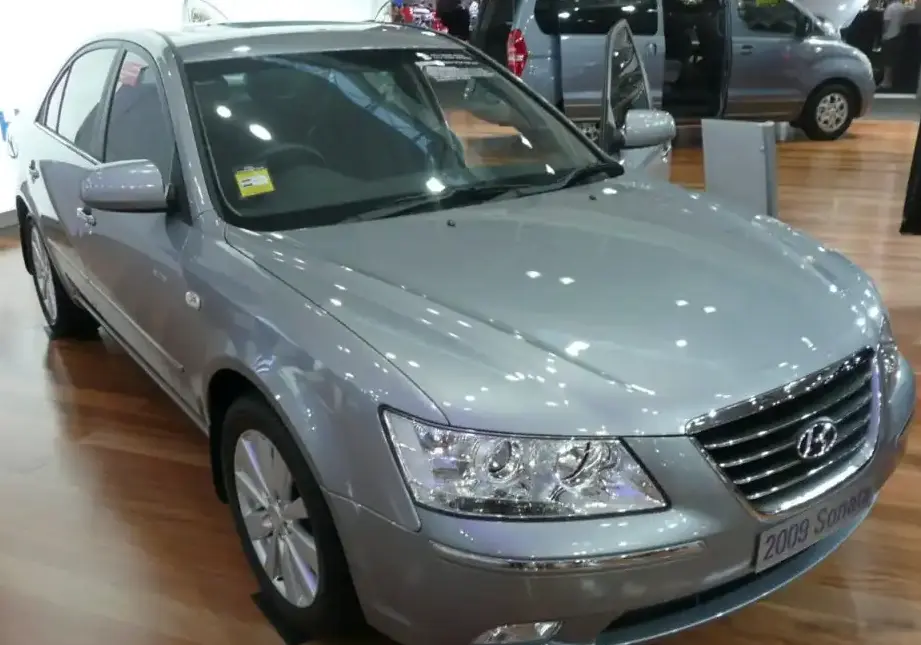
The Hyundai Sonata V (NF facelift) GLS 2.4 Automatic, produced between 2008 and 2009, was a pivotal model for Hyundai in its quest to establish a strong foothold in the highly competitive mid-size sedan segment. The “NF” designation signifies the fifth generation of the Sonata. The 2008 facelift brought with it a series of cosmetic enhancements, including a redesigned grille, updated headlights and taillights, and subtle interior refinements. This specific variant, equipped with the 2.4-liter Theta II engine and a 5-speed automatic transmission, was engineered to deliver a comfortable, reliable, and reasonably efficient driving experience, appealing to families and daily commuters. It occupied a sweet spot in the lineup, offering a balance of features and affordability, positioned above the base GLS 2.0L and below the more powerful Limited trim.
Powertrain & Engine Architecture
The GLS 2.4’s engine was the Hyundai Theta II, identified by the code G4KE. This 2.4-liter inline-four cylinder engine featured a robust cast iron engine block and a lightweight aluminum cylinder head. It employed multi-port fuel injection (MPI) to deliver fuel to the cylinders, and a double overhead camshaft (DOHC) valvetrain. Crucially, it incorporated continuously variable valve timing (CVVT) on both the intake and exhaust camshafts. This CVVT system dynamically adjusted valve timing based on engine speed and load, optimizing both performance and fuel efficiency. The engine generated 177 horsepower at 6200 rpm and 228 Nm (168.16 lb-ft) of torque at 4000 rpm. The 5-speed automatic transmission was a conventional torque converter design, prioritizing smooth shifts over ultimate efficiency. The transmission’s tuning emphasized comfort and fuel economy, rather than aggressive performance.
Driving Characteristics
Behind the wheel, the Sonata GLS 2.4 Automatic provided a comfortable and predictable driving experience. Acceleration was adequate for typical daily driving scenarios, though it wasn’t particularly quick. The 5-speed automatic transmission, while smooth in operation, lacked the responsiveness found in some competing models. The gear ratios were geared towards maximizing fuel economy, resulting in the engine operating at lower revolutions during cruising speeds. Compared to the base 2.0L engine, the 2.4L offered a noticeable improvement in power, making highway merging and overtaking maneuvers less strenuous. However, it didn’t possess the robust power delivery of the optional V6 engine available in higher trim levels. The steering was light and easy to use, making it well-suited for navigating city streets, but it lacked the tactile feedback preferred by more enthusiastic drivers. The overall driving experience was geared towards comfort and practicality.
Equipment & Trim Levels
The GLS trim level of the Sonata V offered a commendable array of standard features. These typically included air conditioning, power windows and door locks, a CD player with MP3 playback capability, and cloth upholstery. Safety features were also prioritized, with dual front airbags, side airbags, and an Anti-lock Braking System (ABS) included as standard equipment. A range of optional extras were available for the GLS 2.4 Automatic, such as a power sunroof, an upgraded audio system, and stylish alloy wheels. The interior design was functional and user-friendly, with a focus on ergonomics. The dashboard layout was clean and intuitive, and the seats provided sufficient support for longer journeys.
Chassis & Braking
The Sonata GLS 2.4 Automatic employed a front-wheel-drive configuration, coupled with an independent McPherson strut suspension system at the front and an independent multi-link suspension at the rear. This suspension setup was designed to deliver a comfortable ride quality, effectively absorbing bumps and road imperfections. The front suspension incorporated a coil spring and an anti-roll bar to minimize body roll during cornering maneuvers. Braking performance was provided by ventilated discs at the front and solid discs at the rear. The inclusion of ABS (Anti-lock Braking System) as standard equipment enhanced braking performance and stability, particularly in emergency stopping situations. The chassis was engineered to prioritize ride comfort and noise isolation over sporty handling characteristics.
Market Reception & Comparison
The Hyundai Sonata V (NF facelift) GLS 2.4 Automatic generally received positive reviews from automotive critics. It was consistently praised for its spacious interior, comfortable ride quality, and competitive pricing. However, some reviewers pointed out that the engine lacked the refinement and power of certain competitors, and the automatic transmission could occasionally feel hesitant. When compared to established mid-size sedans like the Toyota Camry and Honda Accord, the Sonata offered a comparable level of features at a more attractive price point. Fuel economy was competitive, averaging around 25 mpg in combined driving conditions. Reliability was also a strong suit, with the Theta II engine demonstrating a generally durable and dependable nature.
Legacy
The Hyundai Sonata V (NF facelift) GLS 2.4 Automatic has proven to be a reliable and affordable option in the used car market. The Theta II engine, while having experienced some issues with oil consumption in certain early iterations, generally demonstrates good longevity with proper maintenance. The 5-speed automatic transmission is also known for its durability. Today, these Sonatas can be found at very reasonable prices, making them an attractive choice for budget-conscious buyers. The NF Sonata played a crucial role in reshaping perceptions of the Hyundai brand, proving that the company was capable of producing vehicles that could compete effectively with established players in the automotive industry. Its success laid the groundwork for Hyundai’s continued growth and expansion in subsequent years.