
Technical Specifications
| Brand | Hyundai |
| Model | Staria |
| Generation | Staria |
| Type | 2.2 CRDi VGT (177 Hp) AWD Automatic 8 Seat |
| Start of production | August, 2021 |
| End of production | October, 2024 |
| Powertrain Architecture | Internal Combustion engine |
| Body type | Minivan |
| Seats | 8 |
| Doors | 5 |
| Fuel consumption (urban) | 10.4 l/100 km (22.6 US mpg, 27.2 UK mpg, 9.6 km/l) |
| Fuel consumption (extra urban) | 7 l/100 km (33.6 US mpg, 40.4 UK mpg, 14.3 km/l) |
| Fuel consumption (combined) | 8.2 l/100 km (28.7 US mpg, 34.4 UK mpg, 12.2 km/l) |
| CO2 emissions | 218 g/km |
| Fuel Type | Diesel |
| Emission standard | Euro 5 |
| Weight-to-power ratio | 12.7 kg/Hp, 78.5 Hp/tonne |
| Weight-to-torque ratio | 5.2 kg/Nm, 190.7 Nm/tonne |
| Power | 177 Hp @ 3800 rpm |
| Power per litre | 80.5 Hp/l |
| Torque | 430 Nm @ 1500-2500 rpm (317.15 lb.-ft. @ 1500-2500 rpm) |
| Engine layout | Front, Transverse |
| Engine Model/Code | D4HB |
| Engine displacement | 2199 cm3 (134.19 cu. in.) |
| Number of cylinders | 4 |
| Engine configuration | Inline |
| Cylinder Bore | 85.4 mm (3.36 in.) |
| Piston Stroke | 96 mm (3.78 in.) |
| Compression ratio | 16:1 |
| Number of valves per cylinder | 4 |
| Fuel injection system | Diesel Commonrail |
| Engine aspiration | Turbocharger, Intercooler |
| Engine oil capacity | 5.6 l (5.92 US qt | 4.93 UK qt) |
| Coolant capacity | 9.96 l (10.52 US qt | 8.76 UK qt) |
| Kerb Weight | 2255-2325 kg (4971.42 – 5125.75 lbs.) |
| Max. weight | 3040 kg (6702.05 lbs.) |
| Max load | 715-785 kg (1576.31 – 1730.63 lbs.) |
| Trunk (boot) space – minimum | 831 l (29.35 cu. ft.) |
| Trunk (boot) space – maximum | 1303 l (46.02 cu. ft.) |
| Fuel tank capacity | 75 l (19.81 US gal | 16.5 UK gal) |
| Permitted trailer load with brakes (12%) | 2500 kg (5511.56 lbs.) |
| Permitted trailer load without brakes | 750 kg (1653.47 lbs.) |
| Permitted towbar download | 100 kg (220.46 lbs.) |
| Length | 5253 mm (206.81 in.) |
| Width | 1997 mm (78.62 in.) |
| Height | 1990 mm (78.35 in.) |
| Wheelbase | 3273 mm (128.86 in.) |
| Front track | 1721 mm (67.76 in.) |
| Rear (Back) track | 1732 mm (68.19 in.) |
| Ride height (ground clearance) | 186 mm (7.32 in.) |
| Minimum turning circle (turning diameter) | 11.9 m (39.04 ft.) |
| Approach angle | 17.6° |
| Departure angle | 19.3° |
| Ramp-over (brakeover) angle | 14.9° |
| Drivetrain Architecture | The Internal combustion engine (ICE) drives the front wheels permanently, and the rear wheels are driven through an electrically or mechanically operated clutch if necessary. |
| Drive wheel | All wheel drive (4×4) |
| Number of gears and type of gearbox | 8 gears, automatic transmission |
| Front suspension | Independent type McPherson |
| Rear suspension | Independent multi-link suspension |
| Front brakes | Ventilated discs, 345×30 mm |
| Rear brakes | Ventilated discs, 325×20 mm |
| Assisting systems | ABS (Anti-lock braking system) |
| Steering type | Steering rack and pinion |
| Power steering | Electric Steering |
| Tires size | 235/55 R18 104H |
| Wheel rims size | 7.0J x 18 |
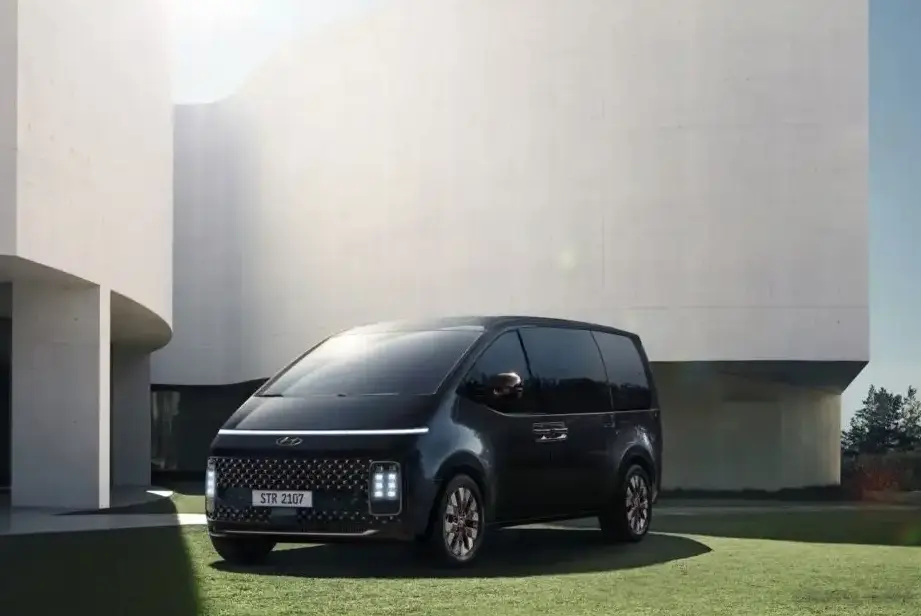
The Hyundai Staria, launched in 2021, marked a departure from traditional minivan designs, embracing a more futuristic and spacious aesthetic. The 2.2 CRDi VGT AWD Automatic 8 Seat variant, powered by the D4HB engine, was a key model in the range. It was designed to appeal to buyers seeking a versatile vehicle for both family transport and commercial applications. The Staria replaced the older Hyundai H-1 (also known as the iMax in some markets), offering a significant upgrade in terms of technology, safety, and overall refinement. This model specifically targeted customers who needed the added security and capability of all-wheel drive, particularly in regions with inclement weather or challenging road conditions.
Powertrain & Engine Architecture
At the heart of the Staria 2.2 CRDi VGT AWD is the D4HB engine, a 2.2-liter inline-four cylinder diesel engine. This engine utilizes a variable geometry turbocharger (VGT) and a common-rail direct injection system to deliver a balance of power and fuel efficiency. The D4HB produces 177 horsepower at 3800 rpm and a substantial 430 Nm (317.15 lb.-ft.) of torque between 1500 and 2500 rpm. The engine features a 16:1 compression ratio and four valves per cylinder. The eight-speed automatic transmission, sourced from Hyundai’s own development, is designed to provide smooth and efficient gear changes. This transmission is crucial for managing the engine’s torque output and optimizing fuel economy. The AWD system operates by sending power to the front wheels under normal driving conditions, and automatically engaging the rear wheels when slip is detected, enhancing traction and stability.
Driving Characteristics
The Staria 2.2 CRDi VGT AWD Automatic offers a comfortable and composed driving experience. While not a performance-oriented vehicle, the engine’s ample torque provides sufficient power for everyday driving and even for carrying a full load of passengers and cargo. The eight-speed automatic transmission contributes to relaxed cruising, keeping engine speeds low at highway speeds. Compared to potential manual transmission versions (not widely available in many markets), the automatic prioritizes convenience over outright driver engagement. The AWD system provides enhanced grip and stability, particularly on slippery surfaces, making it a confident vehicle in adverse weather conditions. The gear ratios are tuned for fuel efficiency and smooth acceleration, rather than rapid sprints.
Equipment & Trim Levels
The Staria 2.2 CRDi VGT AWD Automatic 8 Seat typically came well-equipped, reflecting its position as a premium trim level. Standard features often included automatic climate control, a touchscreen infotainment system with Apple CarPlay and Android Auto compatibility, a rearview camera, and a suite of advanced driver-assistance systems (ADAS) such as lane-keeping assist, forward collision avoidance assist, and adaptive cruise control. Interior upholstery was typically a combination of cloth and leatherette, with options for full leather available. Optional extras could include a panoramic sunroof, premium sound system, and additional safety features. The interior design prioritized spaciousness and comfort, with ample legroom and headroom for all passengers.
Chassis & Braking
The Staria utilizes an independent McPherson strut suspension at the front and an independent multi-link suspension at the rear, providing a comfortable ride quality and good handling characteristics. The chassis is designed to accommodate the vehicle’s weight and provide stability, especially when fully loaded. Braking duties are handled by ventilated disc brakes on all four wheels, providing ample stopping power. The inclusion of ABS (Anti-lock Braking System) is standard, enhancing safety during emergency braking situations. The Staria’s suspension tuning is geared towards comfort and ride quality, rather than sporty handling.
Market Reception & Comparison
The Hyundai Staria was generally well-received by critics for its innovative design, spacious interior, and comprehensive feature set. The 2.2 CRDi VGT AWD Automatic variant was praised for its smooth powertrain and all-weather capability. Compared to other minivans in its class, such as the Kia Carnival, the Staria offered a more distinctive and futuristic design. Fuel economy was considered competitive for a vehicle of its size and weight, averaging around 8.2 l/100 km (28.7 US mpg). Reliability reports have been generally positive, with the D4HB engine proving to be a robust and dependable unit. However, some reviewers noted that the Staria’s styling might not appeal to all tastes.
Legacy
The Hyundai Staria represents a significant step forward in minivan design and functionality. The 2.2 CRDi VGT AWD Automatic 8 Seat variant, with its capable powertrain and all-wheel-drive system, has proven to be a popular choice for families and businesses seeking a versatile and reliable vehicle. On the used car market, these models hold their value reasonably well, reflecting their build quality and feature content. The D4HB engine is known for its longevity, provided it receives regular maintenance. The Staria’s innovative design and spacious interior have set a new benchmark for the minivan segment, and it continues to be a compelling option for buyers seeking a practical and stylish people-mover.
