
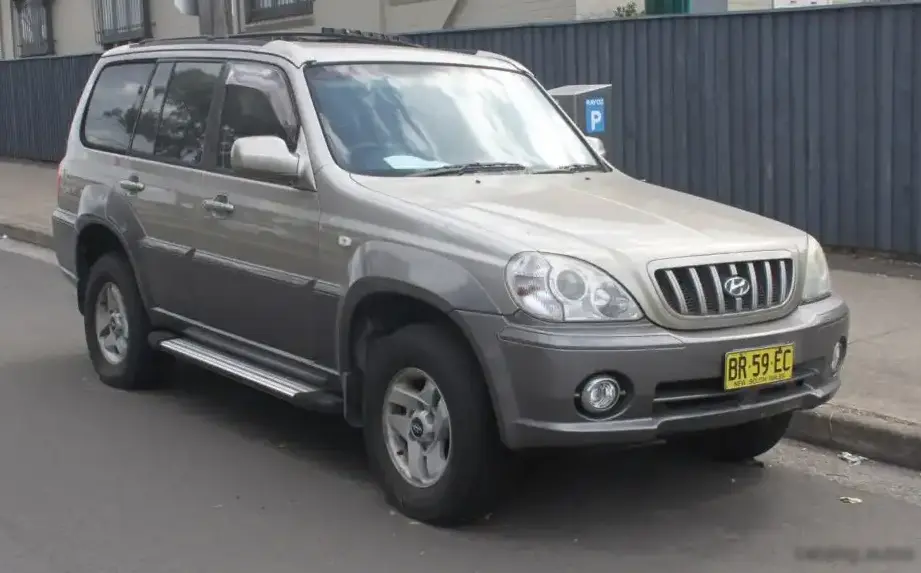
The Hyundai Terracan, produced from 2001 to 2006, was Hyundai’s initial foray into the mid-size SUV segment, primarily aimed at markets outside of North America. Positioned as a robust, body-on-frame vehicle, it sought to compete with established players like the Toyota Prado and Mitsubishi Pajero. The 3.5 i V6 24V variant, equipped with the Sigma / G6CU engine producing 195 horsepower, represented the top-tier engine option for the Terracan. This model year range corresponds to the first and only generation of the Terracan, designed to offer a blend of off-road capability and family-oriented practicality.
Technical Specifications
| Brand | Hyundai |
| Model | Terracan |
| Generation | Terracan |
| Type (Engine) | 3.5 i V6 24V (195 Hp) |
| Start of production | 2001 year |
| End of production | 2006 year |
| Powertrain Architecture | Internal Combustion engine |
| Body type | SUV |
| Seats | 5 |
| Doors | 5 |
| Fuel consumption (urban) | 18.8 l/100 km (12.5 US mpg, 15 UK mpg, 5.3 km/l) |
| Fuel consumption (extra urban) | 11 l/100 km (21.4 US mpg, 25.7 UK mpg, 9.1 km/l) |
| Fuel consumption (combined) | 13.9 l/100 km (16.9 US mpg, 20.3 UK mpg, 7.2 km/l) |
| Fuel Type | Petrol (Gasoline) |
| Acceleration 0 – 100 km/h | 9.5 sec |
| Acceleration 0 – 62 mph | 9.5 sec |
| Acceleration 0 – 60 mph | 9 sec |
| Maximum speed | 185 km/h (114.95 mph) |
| Weight-to-power ratio | 10.2 kg/Hp, 98 Hp/tonne |
| Weight-to-torque ratio | 6.8 kg/Nm, 147.7 Nm/tonne |
| Power | 195 Hp @ 5500 rpm |
| Power per litre | 55.8 Hp/l |
| Torque | 294 Nm @ 3000 rpm (216.84 lb.-ft. @ 3000 rpm) |
| Engine layout | Front, Longitudinal |
| Engine Model/Code | Sigma / G6CU |
| Engine displacement | 3497 cm3 (213.4 cu. in.) |
| Number of cylinders | 6 |
| Engine configuration | V-engine |
| Cylinder Bore | 93 mm (3.66 in.) |
| Piston Stroke | 85.8 mm (3.38 in.) |
| Compression ratio | 10:1 |
| Number of valves per cylinder | 4 |
| Fuel injection system | Multi-port manifold injection |
| Engine aspiration | Naturally aspirated engine |
| Valvetrain | DOHC |
| Engine oil capacity | 4.3 l (4.54 US qt | 3.78 UK qt) |
| Coolant capacity | 11 l (11.62 US qt | 9.68 UK qt) |
| Kerb Weight | 1990 kg (4387.2 lbs.) |
| Trunk (boot) space – minimum | 1170 l (41.32 cu. ft.) |
| Trunk (boot) space – maximum | 1955 l (69.04 cu. ft.) |
| Fuel tank capacity | 75 l (19.81 US gal | 16.5 UK gal) |
| Length | 4710 mm (185.43 in.) |
| Width | 1860 mm (73.23 in.) |
| Height | 1790 mm (70.47 in.) |
| Wheelbase | 2750 mm (108.27 in.) |
| Front track | 1500 mm (59.06 in.) |
| Rear (Back) track | 1500 mm (59.06 in.) |
| Drive wheel | All wheel drive (4×4) |
| Number of gears and type of gearbox | 5 gears, manual transmission |
| Front suspension | Double wishbone |
| Rear suspension | Coil spring |
| Front brakes | Ventilated discs |
| Rear brakes | Disc |
| Assisting systems | ABS (Anti-lock braking system) |
| Steering type | Steering rack and pinion |
| Power steering | Hydraulic Steering |
| Tires size | 235/75 R15 |
INTRODUCTION
The Hyundai Terracan 3.5 i V6 24V, produced between 2001 and 2006, was the flagship model of Hyundai’s first dedicated SUV offering. Built on a traditional body-on-frame chassis, it was designed to provide a durable and capable vehicle for both on-road comfort and off-road excursions. The Terracan was primarily marketed in regions like Europe, Asia, and Australia, where demand for rugged SUVs remained strong. It wasn’t officially sold in the United States. The 3.5L V6 engine was the premium engine choice, offering a significant power upgrade over the available diesel options.
Powertrain & Engine Architecture
At the heart of the Terracan 3.5 i V6 lies the Hyundai Sigma engine, specifically the G6CU variant. This 3.5-liter, naturally aspirated V6 engine utilizes a 60-degree V-angle configuration. It features a dual overhead camshaft (DOHC) valvetrain with four valves per cylinder, contributing to its 24-valve designation. Fuel delivery is managed by a multi-port fuel injection system, providing precise fuel metering for optimal combustion. The engine produces 195 horsepower at 5500 rpm and 294 Nm (216.84 lb-ft) of torque at 3000 rpm. The engine’s longitudinal mounting allowed for a rear-wheel-drive bias, with the all-wheel-drive system engaging as needed. The 5-speed manual transmission was the standard gearbox for this variant, offering direct control over the engine’s power. While an automatic transmission was available in some markets, the manual was favored by enthusiasts for its responsiveness.
Driving Characteristics
The Terracan 3.5 i V6, with its 195 hp and 294 Nm of torque, offered a noticeable performance advantage over the diesel-powered versions. Acceleration from 0 to 60 mph was achieved in around 9 seconds, making it reasonably quick for a vehicle of its size and weight. The manual transmission allowed drivers to fully exploit the engine’s powerband, providing good acceleration in most driving situations. The all-wheel-drive system enhanced traction, particularly on loose surfaces, making it a capable off-roader. However, the Terracan’s body-on-frame construction resulted in a less refined ride compared to more modern, unibody SUVs. Body roll was noticeable in corners, and the steering lacked the precision of more contemporary vehicles. The 5-speed manual transmission’s gear ratios were well-suited for both highway cruising and off-road crawling, providing a balance between fuel efficiency and low-end torque.
Equipment & Trim Levels
The Terracan 3.5 i V6 typically came with a fairly comprehensive list of standard features, though specific equipment levels varied depending on the market. Common features included air conditioning, power windows and locks, and a basic audio system. Higher trim levels added features like leather upholstery, alloy wheels, a sunroof, and upgraded audio systems. Interior appointments were generally functional and durable, prioritizing practicality over luxury. The dashboard layout was straightforward and easy to use, with clearly labeled controls. Optional extras included a rear differential lock for enhanced off-road capability and a tow package for hauling trailers or boats.
Chassis & Braking
The Terracan’s chassis was a traditional body-on-frame design, providing a robust and durable platform. The front suspension utilized a double wishbone setup, while the rear suspension employed coil springs. This configuration offered a reasonable balance between ride comfort and off-road capability. Braking duties were handled by ventilated discs at the front and solid discs at the rear. An anti-lock braking system (ABS) was standard, enhancing safety by preventing wheel lockup during hard braking. The steering system was a rack-and-pinion setup with hydraulic power assistance, providing reasonable steering feel and responsiveness. The standard tire size was 235/75 R15, offering a good compromise between on-road comfort and off-road traction.
Market Reception & Comparison
The Hyundai Terracan 3.5 i V6 was generally well-received by automotive critics, who praised its robust construction, capable engine, and competitive price point. However, it was often criticized for its less refined ride quality and somewhat dated interior compared to more modern SUVs. Compared to the diesel-powered Terracan variants, the 3.5 i V6 offered significantly more power and a smoother driving experience, but at the cost of increased fuel consumption. Against competitors like the Toyota Prado and Mitsubishi Pajero, the Terracan offered a more affordable alternative, but lacked the brand recognition and established reputation of its rivals. Fuel economy was a notable drawback, averaging around 16.9 US mpg in combined driving.
Legacy
The Hyundai Terracan, while not a massive sales success, played a crucial role in establishing Hyundai as a credible player in the SUV market. The 3.5 i V6 variant, with its potent engine and capable all-wheel-drive system, remains a popular choice among enthusiasts seeking a rugged and reliable SUV. The Sigma engine, while not known for being particularly high-tech, proved to be durable and relatively easy to maintain. Today, well-maintained Terracans can be found on the used car market, offering a relatively affordable and capable off-road vehicle. However, potential buyers should be aware of the vehicle’s age and potential maintenance requirements, including checking for rust and ensuring the all-wheel-drive system is functioning correctly.
