
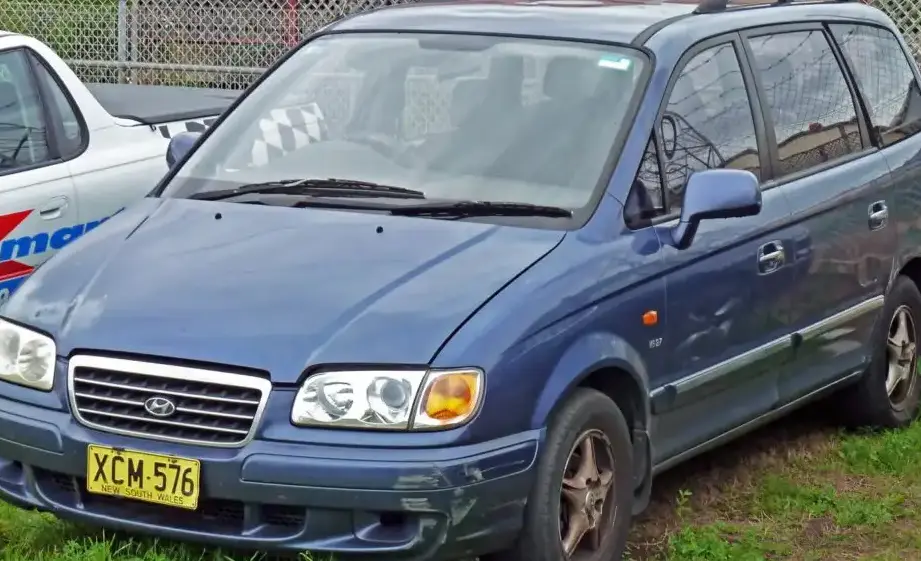
The Hyundai Trajet, introduced in 2001 and produced through 2006, represented Hyundai’s entry into the increasingly popular minivan segment. Specifically, the 2.0 CRDi variant, producing 113 horsepower, was positioned as a fuel-efficient and practical option within the Trajet lineup. Falling between the base gasoline engine and potentially higher-trim diesel options (depending on regional availability), the 2.0 CRDi aimed to balance affordability with the benefits of diesel torque and economy. The Trajet (FO) chassis code designates this first generation model, sharing platform elements with other Hyundai offerings of the period.
Technical Specifications
| Brand | Hyundai |
| Model | Trajet |
| Generation | Trajet (FO) |
| Type (Engine) | 2.0 CRDi (113 Hp) |
| Start of production | 2001 |
| End of production | 2006 |
| Powertrain Architecture | Internal Combustion engine |
| Body type | Minivan |
| Seats | 7 |
| Doors | 5 |
| Fuel consumption (urban) | 9.3 l/100 km (25.3 US mpg) |
| Fuel consumption (extra urban) | 6 l/100 km (39.2 US mpg) |
| Fuel consumption (combined) | 7.2 l/100 km (32.7 US mpg) |
| Fuel Type | Diesel |
| Acceleration 0 – 100 km/h | 14.2 sec |
| Acceleration 0 – 62 mph | 14.2 sec |
| Acceleration 0 – 60 mph | 13.5 sec |
| Maximum speed | 170 km/h (105.63 mph) |
| Weight-to-power ratio | 16.6 kg/Hp |
| Weight-to-torque ratio | 8 kg/Nm |
| Power | 113 Hp @ 4000 rpm |
| Torque | 235 Nm @ 1800 rpm (173.33 lb.-ft. @ 1800 rpm) |
| Engine layout | Front, Transverse |
| Engine Model/Code | D / D4EA |
| Engine displacement | 1991 cm3 (121.5 cu. in.) |
| Number of cylinders | 4 |
| Engine configuration | Inline |
| Cylinder Bore | 83 mm (3.27 in.) |
| Piston Stroke | 92 mm (3.62 in.) |
| Compression ratio | 17.7:1 |
| Number of valves per cylinder | 4 |
| Fuel injection system | Diesel Commonrail |
| Engine aspiration | Turbocharger, Intercooler |
| Valvetrain | OHC |
| Engine oil capacity | 5.9 l (6.23 US qt | 5.19 UK qt) |
| Kerb Weight | 1881 kg (4146.9 lbs.) |
| Max. weight | 2510 kg (5533.6 lbs.) |
| Max load | 629 kg (1386.71 lbs.) |
| Trunk (boot) space – minimum | 304 l (10.74 cu. ft.) |
| Trunk (boot) space – maximum | 2716 l (95.91 cu. ft.) |
| Fuel tank capacity | 65 l (17.17 US gal | 14.3 UK gal) |
| Length | 4695 mm (184.84 in.) |
| Width | 1840 mm (72.44 in.) |
| Height | 1710 mm (67.32 in.) |
| Wheelbase | 2830 mm (111.42 in.) |
| Front track | 1565 mm (61.61 in.) |
| Rear (Back) track | 1565 mm (61.61 in.) |
| Drivetrain Architecture | Front wheel drive |
| Number of gears | 5 |
| Gearbox type | Manual transmission |
| Front suspension | Wishbone |
| Rear suspension | Coil spring |
| Front brakes | Ventilated discs |
| Rear brakes | Ventilated discs |
| Assisting systems | ABS (Anti-lock braking system) |
| Steering type | Steering rack and pinion |
| Power steering | Hydraulic Steering |
| Tires size | 215/65 R15 |
Powertrain & Engine Architecture
The heart of the Trajet 2.0 CRDi is the Hyundai D4EA engine, a 1.991-liter inline-four cylinder diesel. This engine utilizes a second-generation common rail direct injection system, providing improved fuel atomization and more precise control over the combustion process. The D4EA is a turbocharged engine, employing a variable geometry turbocharger (VGT) and an intercooler to boost power and efficiency. The engine features an overhead camshaft (OHC) valvetrain with four valves per cylinder. The 113 horsepower output at 4000 rpm, coupled with 235 Nm (173 lb-ft) of torque available from just 1800 rpm, provided adequate, though not exceptional, performance for a minivan of this size. The five-speed manual transmission was the standard offering for this variant, chosen for its balance of cost and fuel efficiency. The engine code ‘D’ is sometimes used interchangeably with D4EA.
Driving Characteristics
The 2.0 CRDi Trajet, equipped with the five-speed manual transmission, offered a reasonably refined driving experience for its class. Acceleration was adequate for everyday driving, with the 0-60 mph sprint taking around 13.5 seconds. The readily available torque from the diesel engine made it feel more responsive than the gasoline-powered versions, particularly when fully loaded with passengers and cargo. However, it wasn’t a particularly quick vehicle. The gear ratios were tuned for fuel economy rather than outright performance. Compared to potential higher-output diesel variants (if offered in certain markets), the 113 hp version felt noticeably less powerful, especially when climbing hills or overtaking. The manual transmission allowed for greater driver control, but the shift quality wasn’t always the smoothest.
Equipment & Trim Levels
The 2.0 CRDi Trajet typically came with a moderate level of standard equipment. Features generally included air conditioning, power windows, power door locks, and a basic audio system. Interior upholstery was typically cloth, with a relatively simple dashboard layout. Optional extras could include alloy wheels, a sunroof, upgraded audio systems, and rear parking sensors. Trim levels varied by market, but the 2.0 CRDi often represented a mid-range offering, providing a step up from the base models in terms of features and refinement.
Chassis & Braking
The Trajet utilized a front-wheel-drive layout with independent wishbone suspension at the front and a coil spring setup at the rear. The suspension was tuned for comfort rather than sporty handling. Braking duties were handled by ventilated disc brakes on all four wheels, along with an Anti-lock Braking System (ABS) as standard equipment. The Trajet’s chassis was designed to prioritize interior space and ride comfort, rather than dynamic performance. Stabilizer bars were included, but were relatively modest in size, reflecting the vehicle’s intended use as a family hauler.
Market Reception & Comparison
The Hyundai Trajet 2.0 CRDi was generally well-received as a practical and affordable minivan. Critics praised its spacious interior, comfortable ride, and fuel-efficient diesel engine. However, it was often criticized for its somewhat bland styling and lack of refinement compared to established competitors from Japanese and European manufacturers. Compared to the gasoline-powered Trajet, the 2.0 CRDi offered significantly better fuel economy and more torque, making it a more appealing option for drivers who covered long distances or frequently carried heavy loads. Reliability was generally considered good, although some owners reported issues with the diesel particulate filter (DPF) and common rail injection system.
Legacy
The Hyundai Trajet, while not a runaway success, played an important role in establishing Hyundai as a credible player in the minivan segment. The 2.0 CRDi powertrain, while not without its quirks, proved to be relatively durable and reliable when properly maintained. Today, used Trajets are relatively affordable and can represent a good value for budget-conscious buyers seeking a spacious and practical vehicle. However, potential buyers should be aware of the potential for issues with the DPF and common rail system, and ensure that the vehicle has been regularly serviced. The Trajet paved the way for Hyundai’s later, more successful minivan offerings, such as the Entourage and the current Palisade.
