
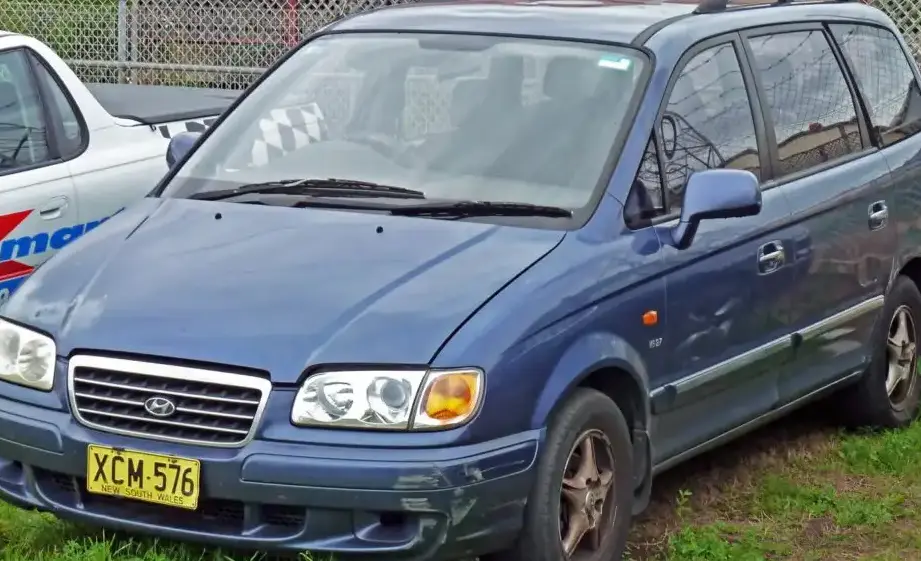
The Hyundai Trajet, introduced in 2000 and produced through 2004, represented Hyundai’s entry into the increasingly popular minivan segment. Specifically, the 2.0 i 16V (136 hp) Automatic variant, designated the FO series, was positioned as a mid-range offering within the Trajet lineup, aiming to balance affordability with convenience. Built on the Hyundai’s ‘FO’ platform, the Trajet was primarily marketed towards families seeking a spacious and practical vehicle. While not a major sales success in the highly competitive North American market, it found a more receptive audience in Asia and Europe, where smaller minivans were more common. This particular configuration, combining a 2.0-liter inline-four engine with a four-speed automatic transmission, was a key component of the Trajet’s appeal to buyers prioritizing ease of driving over outright performance.
Technical Specifications
| Brand | Hyundai |
| Model | Trajet |
| Generation | Trajet (FO) |
| Type (Engine) | 2.0 i 16V (136 Hp) Automatic |
| Start of production | 2000 year |
| End of production | 2004 year |
| Powertrain Architecture | Internal Combustion engine |
| Body type | Minivan |
| Seats | 7 |
| Doors | 5 |
| Fuel consumption (economy) – urban | 14.1 l/100 km (16.7 US mpg, 20 UK mpg, 7.1 km/l) |
| Fuel consumption (economy) – extra urban | 8 l/100 km (29.4 US mpg, 35.3 UK mpg, 12.5 km/l) |
| Fuel consumption (economy) – combined | 10.3 l/100 km (22.8 US mpg, 27.4 UK mpg, 9.7 km/l) |
| Fuel Type | Petrol (Gasoline) |
| Acceleration 0 – 100 km/h | 14.7 sec |
| Acceleration 0 – 62 mph | 14.7 sec |
| Acceleration 0 – 60 mph | 14 sec |
| Maximum speed | 172 km/h (106.88 mph) |
| Weight-to-power ratio | 13.3 kg/Hp, 75.1 Hp/tonne |
| Weight-to-torque ratio | 9.9 kg/Nm, 101 Nm/tonne |
| Power | 136 Hp @ 5800 rpm |
| Power per litre | 68.1 Hp/l |
| Torque | 183 Nm @ 4600 rpm (134.97 lb.-ft. @ 4600 rpm) |
| Engine layout | Front, Transverse |
| Engine Model/Code | Sirius II / G4JP |
| Engine displacement | 1997 cm3 (121.86 cu. in.) |
| Number of cylinders | 4 |
| Engine configuration | Inline |
| Cylinder Bore | 85 mm (3.35 in.) |
| Piston Stroke | 88 mm (3.46 in.) |
| Compression ratio | 10:1 |
| Number of valves per cylinder | 4 |
| Fuel injection system | Multi-port manifold injection |
| Engine aspiration | Naturally aspirated engine |
| Valvetrain | DOHC |
| Engine oil capacity | 4.3 l (4.54 US qt | 3.78 UK qt) |
| Coolant | 7.8 l (8.24 US qt | 6.86 UK qt) |
| Kerb Weight | 1812 kg (3994.78 lbs.) |
| Max. weight | 2400 kg (5291.09 lbs.) |
| Max load | 588 kg (1296.32 lbs.) |
| Trunk (boot) space – minimum | 304 l (10.74 cu. ft.) |
| Trunk (boot) space – maximum | 2716 l (95.91 cu. ft.) |
| Fuel tank capacity | 65 l (17.17 US gal | 14.3 UK gal) |
| Length | 4895 mm (192.72 in.) |
| Width | 1840 mm (72.44 in.) |
| Height | 1710 mm (67.32 in.) |
| Wheelbase | 2830 mm (111.42 in.) |
| Front track | 1565 mm (61.61 in.) |
| Rear (Back) track | 1565 mm (61.61 in.) |
| Drivetrain Architecture | The Internal combustion engine (ICE) drives the front wheels of the vehicle. |
| Drive wheel | Front wheel drive |
| Number of gears and type of gearbox | 4 gears, automatic transmission |
| Front suspension | Wishbone |
| Rear suspension | Coil spring |
| Front brakes | Ventilated discs |
| Rear brakes | Ventilated discs |
| Assisting systems | ABS (Anti-lock braking system) |
| Steering type | Steering rack and pinion |
| Power steering | Hydraulic Steering |
| Tires size | 215/65 R15 |
| Wheel rims size | 15 |
Powertrain & Engine Architecture
The heart of the Trajet 2.0 i Automatic is the Hyundai Sirius II engine, internally designated G4JP. This 1.997-liter inline-four cylinder engine utilizes a dual overhead camshaft (DOHC) valvetrain with four valves per cylinder, contributing to its relatively efficient breathing. Fuel delivery is managed by a multi-point fuel injection system, a common setup for engines of this era. The engine produces 136 horsepower at 5800 rpm and 183 Nm (135 lb-ft) of torque at 4600 rpm. The four-speed automatic transmission, while providing convenience, was a somewhat dated design by the early 2000s. It featured conventional hydraulic control and lacked the sophistication of newer electronically controlled transmissions. The transmission’s gear ratios were tuned for fuel economy and smooth cruising rather than spirited acceleration.
Driving Characteristics
The 2.0-liter engine and four-speed automatic combination in the Trajet delivered adequate, but not exhilarating, performance. Acceleration from 0 to 60 mph took approximately 14 seconds, making it slower than many competitors. The automatic transmission’s shift points were generally smooth, but could feel hesitant during quick overtaking maneuvers. The relatively tall gear ratios prioritized fuel efficiency, but at the expense of responsiveness. Compared to the available manual transmission, the automatic version noticeably reduced performance. The Trajet’s weight of around 3995 lbs also contributed to its less-than-sporty driving experience. However, for everyday driving and family transportation, the powertrain proved to be reasonably capable.
Equipment & Trim Levels
The 2.0 i Automatic trim level of the Trajet typically included features such as air conditioning, power windows and locks, and a basic audio system. Higher trim levels added options like alloy wheels, a sunroof, and upgraded interior upholstery. The interior generally featured durable, if somewhat basic, plastics. Seating was configured for seven passengers, with a 2-3-2 arrangement. The second-row seats could be folded or removed to create more cargo space. Safety features included ABS brakes, but airbags were limited to the front occupants in many markets.
Chassis & Braking
The Trajet utilized a front-wheel-drive layout with a MacPherson strut front suspension and a coil spring rear suspension. The suspension was tuned for comfort rather than handling precision. Braking duties were handled by ventilated disc brakes on all four wheels, providing adequate stopping power for the vehicle’s weight class. The steering was a rack-and-pinion system with hydraulic power assistance, offering reasonable feel and responsiveness. Tire size was typically 215/65 R15.
Market Reception & Comparison
The Trajet 2.0 i Automatic received mixed reviews from automotive critics. While praised for its spacious interior and affordability, it was often criticized for its lackluster performance and somewhat dated design. Compared to rivals like the Honda Odyssey and Toyota Sienna, the Trajet lacked the refinement and driving dynamics of those established players. However, it offered a more affordable alternative, particularly in markets where smaller minivans were preferred. Fuel economy was average for its class, and reliability was generally considered to be acceptable, though not exceptional.
Legacy
The Hyundai Trajet, while not a runaway success, played a role in establishing Hyundai as a viable competitor in the minivan segment. The 2.0-liter engine and four-speed automatic transmission proved to be reasonably durable, and many examples remain on the road today. However, finding parts can be increasingly challenging as the vehicle ages. On the used car market, the Trajet 2.0 i Automatic is typically valued as an affordable and practical family vehicle, but its age and mileage often limit its appeal to budget-conscious buyers. Its legacy lies in demonstrating Hyundai’s ambition to expand its product range and compete with established automakers in a wider variety of segments.
