
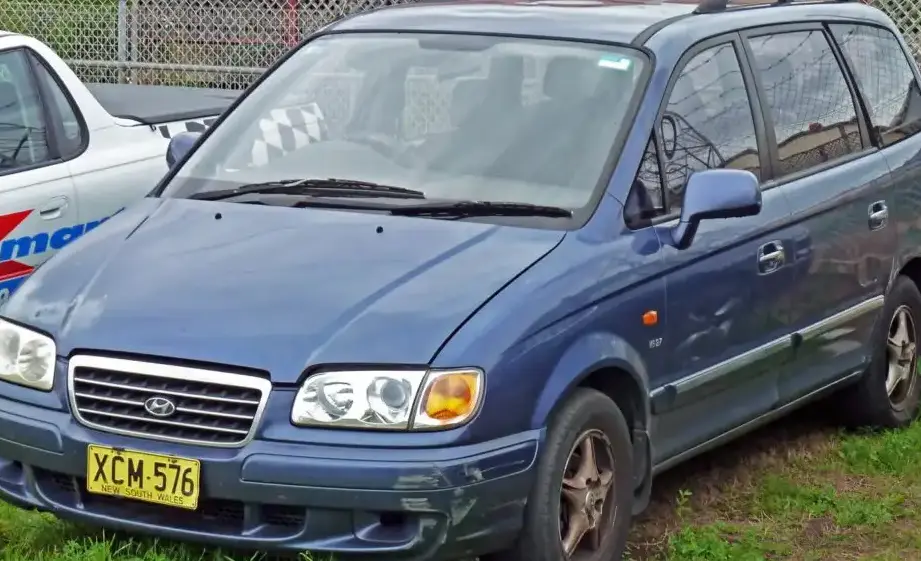
The Hyundai Trajet, manufactured between 2004 and 2008, marked Hyundai’s initial foray into the burgeoning minivan market. Positioned as an economical, seven-passenger vehicle, the Trajet aimed to deliver practicality and ample space at a competitive price. The 2.0 i 16V variant, equipped with the Beta II engine producing 140 horsepower, represented a mid-range offering within the Trajet lineup, positioned between the base engine and potentially higher trim levels depending on regional market specifications. It was primarily targeted towards families in need of an affordable and versatile vehicle for everyday transportation.
Technical Specifications
| Brand | Hyundai |
| Model | Trajet |
| Generation | Trajet (FO) |
| Type (Engine) | 2.0 i 16V (140 Hp) |
| Start of Production | 2004 |
| End of Production | 2008 |
| Powertrain Architecture | Internal Combustion Engine |
| Body Type | Minivan |
| Seats | 7 |
| Doors | 5 |
| Fuel Type | Petrol (Gasoline) |
| Power | 140 Hp |
| Engine Model/Code | Beta II / G4GC |
| Engine Aspiration | Naturally Aspirated |
| Engine Oil Capacity | 4.1 l (4.33 US qt | 3.61 UK qt) |
| Coolant Capacity | 6 l (6.34 US qt | 5.28 UK qt) |
| Drivetrain | Front Wheel Drive |
| Number of Gears | 5 |
| Gearbox Type | Manual Transmission |
Powertrain & Engine Architecture
At the core of the 2.0 i 16V Trajet lies the Hyundai Beta II engine, specifically designated as the G4GC. This 1999 cc (2.0 liter) inline-four cylinder engine employs a dual overhead camshaft (DOHC) configuration with four valves per cylinder, hence the 16V designation. The Beta II engine was a notable advancement for Hyundai, integrating multi-point fuel injection to enhance both efficiency and power delivery. While not a particularly sophisticated engine by the standards of the time, it was recognized for its inherent simplicity and durability. The engine’s design prioritized dependability over peak performance. The standard transmission paired with this engine was a 5-speed manual, providing a direct mechanical link between the engine and the front wheels. The transmission itself was a conventional design, emphasizing smooth gear changes and longevity rather than sporty gear ratios.
Driving Characteristics
The 140 horsepower and approximately 136 lb-ft of torque generated by the 2.0L engine delivered adequate, though not particularly spirited, performance for the Trajet. Acceleration was best described as relaxed, especially when the vehicle was fully occupied with passengers and cargo. The 5-speed manual transmission allowed drivers to maintain the engine within its optimal power range, but frequent downshifts were often required for overtaking or ascending inclines. The gear ratios were calibrated for fuel economy and everyday usability, rather than aggressive driving. In comparison to a hypothetical higher-output engine option (which wasn’t commonly available on the Trajet), this variant prioritized fuel efficiency and reduced operating costs. The front-wheel-drive layout provided predictable handling characteristics, but lacked the all-weather capability of an all-wheel-drive system. The Trajet’s suspension was tuned for ride comfort, effectively absorbing bumps and road irregularities, albeit at the expense of precise handling.
Equipment & Trim Levels
The 2.0 i 16V Trajet typically included a reasonable array of standard features, aiming to provide good value for the money. These commonly encompassed air conditioning, power windows and door locks, and a basic audio system. Interior upholstery was generally cloth, designed for durability and practicality. The dashboard layout was straightforward and functional, prioritizing ease of operation over elaborate aesthetics. Optional extras varied depending on the specific market, but could include alloy wheels, a sunroof, upgraded audio systems, and rear parking sensors. Higher trim levels, when offered, might have incorporated features such as leather upholstery, automatic climate control, and more advanced audio systems. The specific trim level also influenced cosmetic enhancements, such as body-colored bumpers and door handles.
Chassis & Braking
The Trajet’s chassis utilized a conventional body-on-frame construction, prioritizing cost-effectiveness and robustness. The front suspension employed MacPherson struts, while the rear suspension featured a torsion beam setup. This configuration provided a comfortable ride but didn’t offer particularly sporty handling. Braking was accomplished through disc brakes on the front wheels and drum brakes on the rear wheels – a common configuration for vehicles in this price bracket at the time. An Anti-lock Braking System (ABS) was often included as standard equipment, enhancing safety. Stabilizer bars were fitted to both the front and rear axles to minimize body roll during cornering, although their effectiveness was limited by the vehicle’s overall weight and suspension design.
Market Reception & Comparison
The Hyundai Trajet was generally well-received as an affordable and practical minivan option. Reviewers commended its spacious interior, comfortable ride quality, and competitive pricing. However, it often faced criticism for its relatively unremarkable styling, modest performance, and somewhat basic interior materials. When compared to established competitors like the Honda Odyssey or Toyota Sienna, the Trajet lacked the refinement and dynamic driving experience of those vehicles. Nevertheless, it offered a significant price advantage. Fuel economy was considered average for its class, and reliability was generally good, though not exceptional. The 2.0 i 16V manual transmission combination struck a favorable balance between fuel efficiency and usability, making it a popular choice among budget-conscious families.
Legacy
The Hyundai Trajet, while not a revolutionary vehicle, played a crucial role in establishing Hyundai as a viable contender in the minivan segment. The Beta II engine, though eventually superseded by more advanced designs, proved to be a relatively durable and dependable powerplant. In today’s used car market, the Trajet represents an exceptionally affordable option for those seeking a spacious and practical vehicle. However, prospective buyers should be mindful of the vehicle’s age and potential maintenance requirements. The 2.0 i 16V manual transmission variant is generally considered a sound choice due to its simplicity and reliability. Parts availability is typically good, and the vehicle’s relatively straightforward design facilitates repairs. While it may not boast the features or refinement of more contemporary minivans, the Trajet remains a feasible option for individuals seeking a budget-friendly and functional family vehicle.
