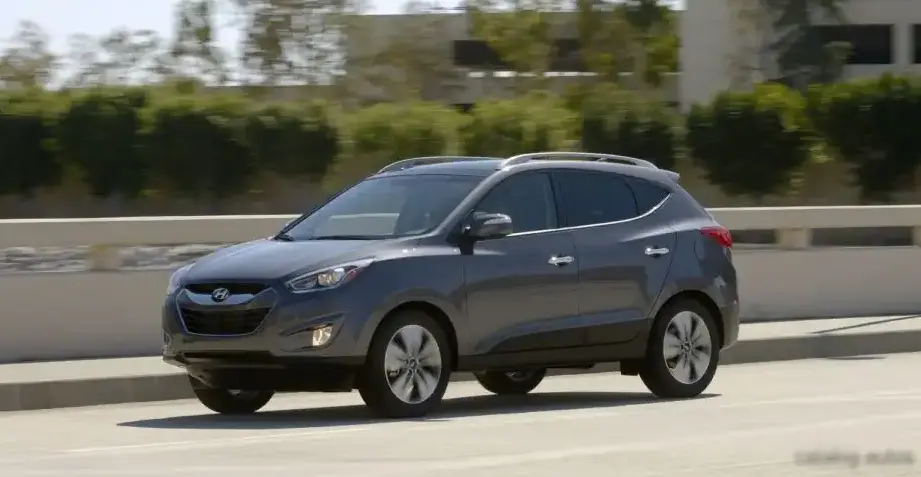
The Hyundai Tucson II (facelift, produced from September 2013 to 2015) 2.0 GDI (164 Hp) AWD Shiftronic represents a significant iteration of Hyundai’s popular compact SUV. This variant, positioned as a mid-range offering within the Tucson II lineup, aimed to provide a balance of performance, fuel efficiency, and all-weather capability for the North American and European markets. It built upon the foundation of the first-generation Tucson, offering a more refined driving experience and updated styling. The facelift brought revised front and rear fascias, interior enhancements, and the introduction of Hyundai’s GDI (Gasoline Direct Injection) engine technology.
Technical Specifications
| Brand | Hyundai |
| Model | Tucson |
| Generation | Tucson II (facelift 2013) |
| Type (Engine) | 2.0 GDI (164 Hp) AWD SHIFTRONIC |
| Start of production | September, 2013 |
| End of production | 2015 |
| Powertrain Architecture | Internal Combustion engine |
| Body type | SUV |
| Seats | 5 |
| Doors | 5 |
| Fuel consumption (economy) – urban (EPA) | 11.2 l/100 km (21 US mpg, 25.2 UK mpg, 8.9 km/l) |
| Fuel consumption (economy) – extra urban (EPA) | 9.4 l/100 km (25 US mpg, 30.1 UK mpg, 10.6 km/l) |
| Fuel consumption (economy) – combined (EPA) | 10.2 l/100 km (23.1 US mpg, 27.7 UK mpg, 9.8 km/l) |
| Fuel Type | Petrol (Gasoline) |
| Emission standard | ULEV |
| Weight-to-power ratio | 9.3 kg/Hp, 107.2 Hp/tonne |
| Weight-to-torque ratio | 7.5 kg/Nm, 134 Nm/tonne |
| Power | 164 Hp @ 6200 rpm |
| Power per litre | 82 Hp/l |
| Torque | 205 Nm @ 4000 rpm (151.2 lb.-ft. @ 4000 rpm) |
| Engine layout | Front, Transverse |
| Engine Model/Code | Nu / G4NC |
| Engine displacement | 1999 cm3 (121.99 cu. in.) |
| Number of cylinders | 4 |
| Engine configuration | Inline |
| Cylinder Bore | 81 mm (3.19 in.) |
| Piston Stroke | 97 mm (3.82 in.) |
| Compression ratio | 11.5:1 |
| Number of valves per cylinder | 4 |
| Fuel injection system | Direct injection |
| Engine aspiration | Naturally aspirated engine |
| Valvetrain | DOHC, D-CVVT |
| Engine oil capacity | 4 l (4.23 US qt | 3.52 UK qt) |
| Coolant | 6.7 l (7.08 US qt | 5.9 UK qt) |
| Kerb Weight | 1530 kg (3373.07 lbs.) |
| Max. weight | 2090 kg (4607.66 lbs.) |
| Max load | 560 kg (1234.59 lbs.) |
| Trunk (boot) space – minimum | 728 l (25.71 cu. ft.) |
| Trunk (boot) space – maximum | 1580 l (55.8 cu. ft.) |
| Fuel tank capacity | 58 l (15.32 US gal | 12.76 UK gal) |
| Permitted trailer load with brakes (12%) | 907 kg (1999.59 lbs.) |
| Permitted trailer load without brakes | 454 kg (1000.9 lbs.) |
| Length | 4400 mm (173.23 in.) |
| Width | 1820 mm (71.65 in.) |
| Height | 1655 mm (65.16 in.) |
| Wheelbase | 2640 mm (103.94 in.) |
| Front track | 1585 mm (62.4 in.) |
| Rear (Back) track | 1586 mm (62.44 in.) |
| Ride height (ground clearance) | 170 mm (6.69 in.) |
| Drag coefficient (Cd) | 0.37 |
| Minimum turning circle (turning diameter) | 10.6 m (34.78 ft.) |
| Drivetrain Architecture | The Internal combustion engine (ICE) drives the front wheels permanently, and the rear wheels are driven through an electrically or mechanically operated clutch if necessary. |
| Drive wheel | All wheel drive (4×4) |
| Number of gears and type of gearbox | 6 gears, automatic transmission Shiftronic |
| Front suspension | Independent, type McPherson with coil spring and anti-roll bar |
| Rear suspension | Independent multi-link spring suspension with stabilizer |
| Front brakes | Ventilated discs |
| Rear brakes | Disc |
| Assisting systems | ABS (Anti-lock braking system) |
| Steering type | Steering rack and pinion |
| Power steering | Electric Steering |
| Tires size | 225/60 R17 |
| Wheel rims size | 6.5J x 17 |
INTRODUCTION
The 2013-2015 Hyundai Tucson II 2.0 GDI AWD Shiftronic is a five-passenger compact SUV that served as a key model in Hyundai’s expanding lineup. The “II” designation indicates the second generation of the Tucson, which debuted in 2010 and received a significant facelift in 2013. This facelift included styling updates, interior refinements, and the introduction of the Nu series 2.0-liter GDI engine. The Shiftronic automatic transmission, a six-speed unit, was paired with Hyundai’s all-wheel-drive system, providing enhanced traction and stability in various driving conditions. This particular configuration aimed to appeal to buyers seeking a practical, well-equipped, and capable SUV for daily commuting and family adventures.
Powertrain & Engine Architecture
At the heart of the Tucson 2.0 GDI AWD Shiftronic lies the Hyundai Nu engine family, specifically the G4NC 2.0-liter inline-four cylinder. This engine utilizes Gasoline Direct Injection (GDI) technology, where fuel is injected directly into the combustion chamber, resulting in improved fuel efficiency and increased power output compared to traditional port fuel injection systems. The G4NC engine produces 164 horsepower at 6200 rpm and 205 Nm (151.2 lb-ft) of torque at 4000 rpm. It features a double overhead camshaft (DOHC) valvetrain with Hyundai’s Dual Continuously Variable Valve Timing (D-CVVT) system, optimizing valve timing for improved performance and efficiency across the engine’s operating range. The engine’s block is constructed from aluminum, contributing to weight reduction. The Shiftronic six-speed automatic transmission offers smooth and responsive shifting. While not a dual-clutch transmission, it provides a good balance of efficiency and drivability. The AWD system is an on-demand system, primarily driving the front wheels but automatically engaging the rear wheels when wheel slip is detected, enhancing stability and traction.
Driving Characteristics
The 2.0 GDI engine paired with the six-speed automatic transmission delivers adequate performance for everyday driving. Acceleration is reasonably brisk, though not particularly sporty. The Shiftronic transmission offers a manual shift mode, allowing drivers to exert some control over gear selection, but it’s not as engaging as a dedicated manual transmission. Compared to the more powerful Tucson variants (like those with larger engines), the 2.0 GDI feels less eager to accelerate, especially when fully loaded. However, it provides a smoother and more refined driving experience than the base engine options. The AWD system provides confident handling in inclement weather, offering improved grip on slippery surfaces. The steering is light and precise, making it easy to maneuver in urban environments. Overall, the driving experience is comfortable and predictable, prioritizing practicality and ease of use over outright performance.
Equipment & Trim Levels
The 2.0 GDI AWD Shiftronic trim typically included a generous array of standard features. These commonly included air conditioning, power windows and locks, a touchscreen infotainment system with Bluetooth connectivity, a rearview camera, and alloy wheels. Higher trim levels added features such as leather upholstery, a panoramic sunroof, heated front seats, and a premium audio system. Safety features such as ABS, electronic stability control, and multiple airbags were standard across all trims. The interior design was functional and modern, with a focus on ergonomics and user-friendliness. The available color schemes were generally conservative, appealing to a broad range of buyers.
Chassis & Braking
The Tucson II utilizes a front independent McPherson strut suspension and a rear independent multi-link suspension. This setup provides a comfortable ride quality and good handling characteristics. Stabilizer bars are fitted to both the front and rear axles to reduce body roll during cornering. The braking system consists of ventilated disc brakes at the front and solid disc brakes at the rear. ABS (Anti-lock Braking System) is standard, enhancing braking performance and stability. The steering system is a rack-and-pinion type with electric power steering, providing light and precise steering feel.
Market Reception & Comparison
The Hyundai Tucson II 2.0 GDI AWD Shiftronic was generally well-received by automotive critics. It was praised for its comfortable ride, spacious interior, and generous features list. The GDI engine was noted for its improved fuel efficiency compared to older engine designs. However, some critics found the engine to be somewhat underpowered, particularly when compared to competitors. Compared to other trims in the Tucson lineup, the 2.0 GDI AWD Shiftronic offered a good balance of performance and fuel economy. It was more affordable than the V6-powered models but provided more power and refinement than the base engine options. Fuel economy figures averaged around 23.1 US mpg combined, which was competitive for its class.
Legacy
The Hyundai Tucson II 2.0 GDI AWD Shiftronic has proven to be a relatively reliable vehicle in the used car market. The Nu engine family, while not without its issues (some early models experienced oil consumption problems), has generally proven durable with proper maintenance. The Shiftronic transmission is also known for its reliability. Today, these Tucsons represent a good value for buyers seeking an affordable and capable compact SUV. Common maintenance items include regular oil changes, timing belt replacement (depending on mileage), and inspection of the AWD system. The Tucson II helped solidify Hyundai’s reputation for building well-equipped, reliable, and affordable vehicles, paving the way for the continued success of the Tucson nameplate.