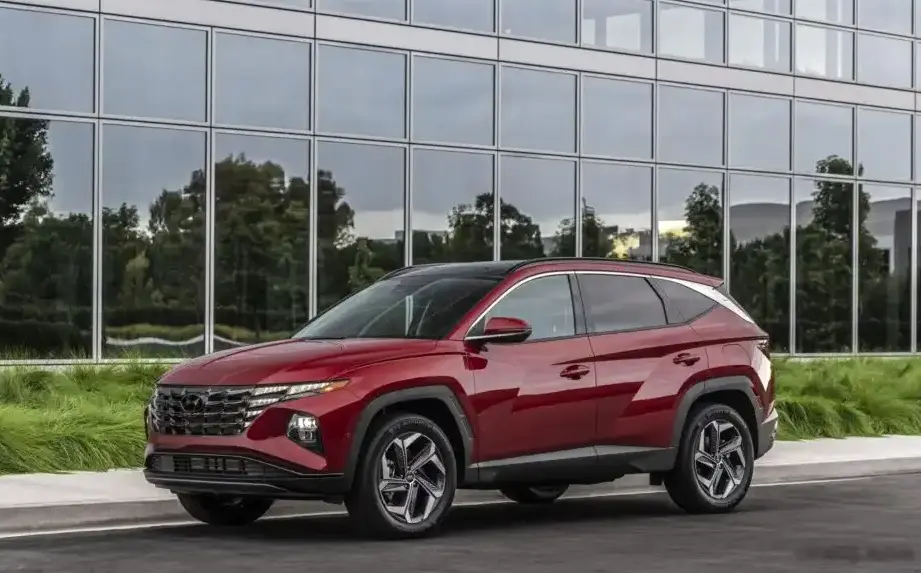
The Hyundai Tucson IV 1.6 CRDi (116 hp) was a diesel-powered variant of the fourth-generation Hyundai Tucson (codenamed NX4), produced from December 2020 to February 2022. Positioned as an entry-level to mid-range offering within the Tucson IV lineup, it aimed to provide fuel efficiency and reasonable performance for everyday driving. This model was primarily marketed in Europe and other regions where diesel engines remained popular, offering a balance between running costs and practicality within the compact SUV segment. It represented Hyundai’s continued effort to offer a diverse range of powertrain options to cater to varying customer needs and preferences.
Technical Specifications
| Brand | Hyundai |
| Model | Tucson |
| Generation | Tucson IV |
| Type (Engine) | 1.6 CRDi (116 Hp) |
| Start of production | December, 2020 |
| End of production | February, 2022 |
| Powertrain Architecture | Internal Combustion engine |
| Body type | SUV |
| Seats | 5 |
| Doors | 5 |
| CO2 emissions (WLTP) | 146 g/km |
| Fuel consumption (urban) | 5.6 l/100 km (42 US mpg, 50.4 UK mpg, 17.9 km/l) |
| Fuel consumption (extra urban) | 4.4 l/100 km (53.5 US mpg, 64.2 UK mpg, 22.7 km/l) |
| Fuel consumption (combined) | 4.8 l/100 km (49 US mpg, 58.9 UK mpg, 20.8 km/l) |
| CO2 emissions (NEDC) | 127 g/km |
| Fuel Type | Diesel |
| Acceleration 0 – 100 km/h | 12.1 sec |
| Acceleration 0 – 62 mph | 12.1 sec |
| Acceleration 0 – 60 mph | 11.5 sec |
| Maximum speed | 175 km/h (108.74 mph) |
| Emission standard | Euro 6d |
| Weight-to-power ratio | 12.7 kg/Hp, 78.5 Hp/tonne |
| Weight-to-torque ratio | 5.3 kg/Nm, 189.6 Nm/tonne |
| Power | 116 Hp @ 4000 rpm |
| Power per litre | 72.6 Hp/l |
| Torque | 280 Nm @ 1500-2750 rpm (206.52 lb.-ft. @ 1500-2750 rpm) |
| Engine layout | Front, Transverse |
| Engine Model/Code | D4FE |
| Engine displacement | 1598 cm3 (97.52 cu. in.) |
| Number of cylinders | 4 |
| Engine configuration | Inline |
| Cylinder Bore | 76.99 mm (3.03 in.) |
| Piston Stroke | 85.8 mm (3.38 in.) |
| Compression ratio | 15.9:1 |
| Number of valves per cylinder | 4 |
| Fuel injection system | Diesel Commonrail |
| Engine aspiration | Twin-Turbo, Intercooler |
| Engine oil capacity | 4.4 l (4.65 US qt | 3.87 UK qt) |
| Coolant capacity | 7.2 l (7.61 US qt | 6.34 UK qt) |
| Kerb Weight | 1477-1628 kg (3256.23 – 3589.13 lbs.) |
| Max. weight | 2105 kg (4640.73 lbs.) |
| Max load | 477-628 kg (1051.6 – 1384.5 lbs.) |
| Trunk (boot) space – minimum | 598 l (21.12 cu. ft.) |
| Trunk (boot) space – maximum | 1777 l (62.75 cu. ft.) |
| Fuel tank capacity | 54 l (14.27 US gal | 11.88 UK gal) |
| Max. roof load | 100 kg (220.46 lbs.) |
| Permitted trailer load with brakes (12%) | 1650 kg (3637.63 lbs.) |
| Permitted trailer load without brakes | 750 kg (1653.47 lbs.) |
| Permitted towbar download | 100 kg (220.46 lbs.) |
| Length | 4500 mm (177.17 in.) |
| Width | 1865 mm (73.43 in.) |
| Width including mirrors | 2130 mm (83.86 in.) |
| Height | 1651-1653 mm (65 – 65.08 in.) |
| Wheelbase | 2680 mm (105.51 in.) |
| Front track | 1615-1630 mm (63.58 – 64.17 in.) |
| Rear (Back) track | 1622-1637 mm (63.86 – 64.45 in.) |
| Front overhang | 895 mm (35.24 in.) |
| Rear overhang | 925 mm (36.42 in.) |
| Ride height (ground clearance) | 170 mm (6.69 in.) |
| Drag coefficient (Cd) | 0.315 |
| Minimum turning circle | 10.92 m (35.83 ft.) |
| Approach angle | 17.4° |
| Departure angle | 25.7° |
| Ramp-over angle | 16.7° |
| Drivetrain Architecture | Front wheel drive |
| Number of gears | 6 |
| Type of gearbox | Manual transmission |
| Front suspension | Independent, type McPherson with coil spring and anti-roll bar |
| Rear suspension | Independent multi-link spring suspension with stabilizer |
| Front brakes | Ventilated discs, 291 mm |
| Rear brakes | Disc, 302 mm |
| Assisting systems | ABS (Anti-lock braking system) |
| Steering type | Steering rack and pinion |
| Power steering | Electric Steering |
| Tires size | 215/65 R17; 235/55 R18 |
| Wheel rims size | 7.0J x 17; 7.5J x 18 |
INTRODUCTION
The Hyundai Tucson IV 1.6 CRDi (116 hp) was introduced in December 2020 as part of the fourth-generation Tucson (NX4) lineup. This variant utilized a 1.6-liter turbocharged diesel engine, producing 116 horsepower. It was designed to appeal to buyers seeking a fuel-efficient and practical SUV for daily commuting and family use. The Tucson IV represented a significant step forward in design and technology for Hyundai, and the 1.6 CRDi model offered a more accessible entry point into the range, particularly in European markets where diesel remained a popular choice. It sat below the more powerful diesel options and the gasoline-powered variants in terms of performance and price.
Powertrain & Engine Architecture
The heart of the Tucson IV 1.6 CRDi is the D4FE engine, a 1.6-liter inline-four cylinder diesel engine. This engine features a twin-turbocharger setup with an intercooler, designed to improve both power and efficiency. The engine employs a common-rail direct fuel injection system, delivering fuel directly into the combustion chamber at high pressure for optimized combustion. The engine’s architecture includes four valves per cylinder and a compression ratio of 15.9:1. The 116 hp output is achieved at 4000 rpm, while peak torque of 280 Nm (206.52 lb.-ft.) is available between 1500 and 2750 rpm. This broad torque band contributes to good drivability in everyday situations. The engine is transversely mounted in the front of the vehicle. The 6-speed manual transmission was standard on this variant, providing a balance between fuel economy and driver control.
Driving Characteristics
The 1.6 CRDi with the manual transmission offered a comfortable and economical driving experience. While not particularly sporty, the engine provided sufficient power for typical driving scenarios, including highway cruising and city commuting. The broad torque band meant that drivers didn’t need to frequently downshift to maintain speed. Acceleration from 0 to 100 km/h (0-62 mph) took approximately 12.1 seconds, which is typical for a vehicle in this class with this power output. Compared to the higher-output diesel variants (like the 2.0 CRDi), the 1.6 CRDi felt less responsive, especially during overtaking maneuvers. However, the manual transmission allowed for greater driver engagement and control compared to an automatic. The gear ratios were tuned for fuel efficiency, prioritizing lower engine speeds at highway speeds.
Equipment & Trim Levels
The Tucson IV 1.6 CRDi typically came with a respectable level of standard equipment. This included features such as air conditioning, a touchscreen infotainment system with Apple CarPlay and Android Auto compatibility, Bluetooth connectivity, and a suite of safety features like ABS, ESC (Electronic Stability Control), and multiple airbags. Interior upholstery was typically cloth, with options for leather upgrades available at an additional cost. Trim levels varied by market, but generally, the 1.6 CRDi was offered in base or mid-range trims. Optional extras included features like a panoramic sunroof, heated seats, a premium sound system, and advanced driver-assistance systems (ADAS) such as lane keeping assist and adaptive cruise control.
Chassis & Braking
The Tucson IV 1.6 CRDi utilized an independent suspension system on both the front and rear axles. The front suspension employed a McPherson strut design with a coil spring and anti-roll bar, while the rear suspension featured a multi-link setup with a stabilizer bar. This configuration provided a good balance between ride comfort and handling. Braking duties were handled by ventilated discs on the front wheels and solid discs on the rear. The ABS (Anti-lock Braking System) was standard, enhancing braking performance and stability. The steering system was an electric power-assisted rack and pinion setup, offering light and precise steering feel.
Market Reception & Comparison
The Hyundai Tucson IV 1.6 CRDi was generally well-received by automotive critics as a practical and fuel-efficient option within the compact SUV segment. It was praised for its comfortable ride, spacious interior, and comprehensive standard equipment. However, some reviewers noted that the 116 hp engine could feel underpowered, particularly when fully loaded or driving uphill. Compared to the more powerful diesel variants, the 1.6 CRDi offered better fuel economy but sacrificed some performance. Against competitors like the Nissan Qashqai, Kia Sportage, and Volkswagen Tiguan, the Tucson IV 1.6 CRDi offered a competitive package in terms of price, features, and warranty.
Legacy
The Hyundai Tucson IV 1.6 CRDi, while a relatively short-lived variant, has established a reputation for reliability and fuel efficiency in the used car market. The D4FE engine, when properly maintained, is known to be a durable unit. Common maintenance items include regular oil changes, filter replacements, and inspection of the turbocharger system. The availability of parts is generally good, and repair costs are reasonable. As a used car, the 1.6 CRDi represents a good value proposition for buyers seeking a practical and economical SUV. Its fuel efficiency and comfortable ride continue to make it an appealing option for those prioritizing everyday usability over outright performance.