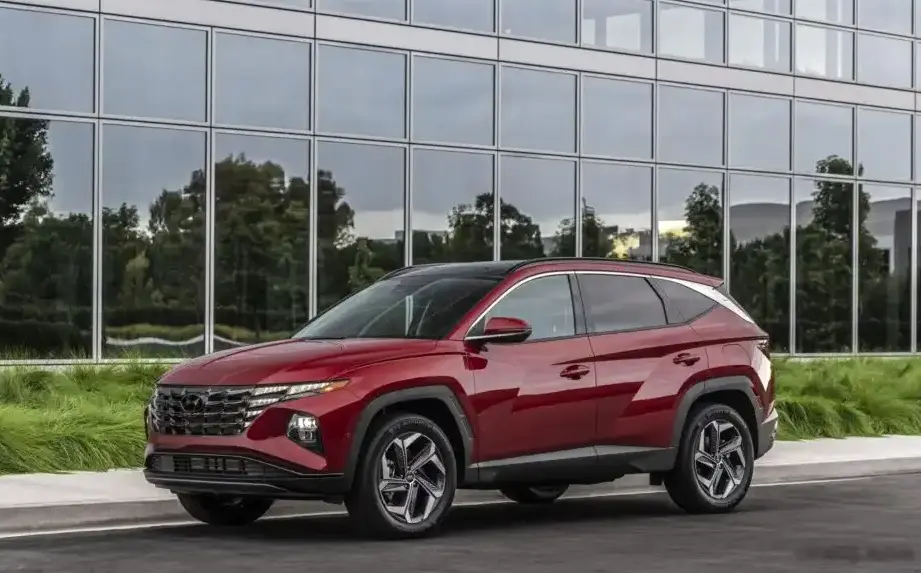
The Hyundai Tucson IV 1.6 CRDi (136 Hp) Mild Hybrid 4WD DCT represents a significant offering in the fourth generation of Hyundai’s popular Tucson SUV, produced from December 2020 through October 2023. This variant aimed to balance fuel efficiency with all-weather capability, slotting into the mid-range of the Tucson IV lineup. It combined a diesel engine with mild hybrid technology and a dual-clutch transmission, offering a compelling package for European and other markets where diesel remains a popular choice. The Tucson IV, built on the N3 platform, represented a substantial leap forward in design and technology compared to its predecessor.
Technical Specifications
| Brand | Hyundai |
| Model | Tucson |
| Generation | Tucson IV |
| Type (Engine) | 1.6 CRDi (136 Hp) Mild Hybrid 4WD DCT |
| Start of production | December, 2020 |
| End of production | October, 2023 |
| Powertrain Architecture | MHEV (Mild Hybrid Electric Vehicle) |
| Body type | SUV |
| Seats | 5 |
| Doors | 5 |
| CO2 emissions (WLTP) | 158 g/km |
| Fuel consumption (urban) | 4.7 l/100 km (50 US mpg, 60.1 UK mpg, 21.3 km/l) |
| Fuel consumption (extra urban) | 4.7 l/100 km (50 US mpg, 60.1 UK mpg, 21.3 km/l) |
| Fuel consumption (combined) | 4.7 l/100 km (50 US mpg, 60.1 UK mpg, 21.3 km/l) |
| CO2 emissions (NEDC) | 124 g/km |
| Fuel Type | Diesel |
| Acceleration 0 – 100 km/h | 11.6 sec |
| Acceleration 0 – 62 mph | 11.6 sec |
| Acceleration 0 – 60 mph | 11 sec |
| Maximum speed | 180 km/h (111.85 mph) |
| Emission standard | Euro 6d |
| Weight-to-power ratio | 11.7 kg/Hp |
| Weight-to-torque ratio | 5 kg/Nm |
| Gross battery capacity | 0.44 kWh |
| Power | 136 Hp @ 4000 rpm |
| Torque | 320 Nm @ 2000-2250 rpm (236.02 lb.-ft.) |
| Engine layout | Front, Transverse |
| Engine Model/Code | D4FE |
| Engine displacement | 1598 cm3 (97.52 cu. in.) |
| Number of cylinders | 4 |
| Engine configuration | Inline |
| Cylinder Bore | 76.99 mm (3.03 in.) |
| Piston Stroke | 85.8 mm (3.38 in.) |
| Compression ratio | 15.9:1 |
| Number of valves per cylinder | 4 |
| Fuel injection system | Diesel Commonrail |
| Engine aspiration | Twin-Turbo, Intercooler |
| Engine oil capacity | 4.4 l (4.65 US qt | 3.87 UK qt) |
| Coolant capacity | 7.2 l (7.61 US qt | 6.34 UK qt) |
| Kerb Weight | 1590-1729 kg (3505.35 – 3811.79 lbs.) |
| Max. weight | 2200 kg (4850.17 lbs.) |
| Max load | 471-610 kg (1038.38 – 1344.82 lbs.) |
| Trunk (boot) space – minimum | 546 l (19.28 cu. ft.) |
| Trunk (boot) space – maximum | 1725 l (60.92 cu. ft.) |
| Fuel tank capacity | 54 l (14.27 US gal | 11.88 UK gal) |
| Max. roof load | 100 kg (220.46 lbs.) |
| Permitted trailer load (braked) | 1650 kg (3637.63 lbs.) |
| Permitted trailer load (unbraked) | 750 kg (1653.47 lbs.) |
| Permitted towbar download | 100 kg (220.46 lbs.) |
| Length | 4500 mm (177.17 in.) |
| Width | 1865 mm (73.43 in.) |
| Width (with mirrors) | 2130 mm (83.86 in.) |
| Height | 1651-1653 mm (65 – 65.08 in.) |
| Wheelbase | 2680 mm (105.51 in.) |
| Front track | 1615-1630 mm (63.58 – 64.17 in.) |
| Rear track | 1622-1637 mm (63.86 – 64.45 in.) |
| Front overhang | 895 mm (35.24 in.) |
| Rear overhang | 925 mm (36.42 in.) |
| Ride height (ground clearance) | 170 mm (6.69 in.) |
| Drag coefficient (Cd) | 0.315 |
| Minimum turning circle | 10.92 m (35.83 ft.) |
| Approach angle | 17.4° |
| Departure angle | 25.7° |
| Ramp-over angle | 16.7° |
| Drivetrain Architecture | ICE and electric motor drive front wheels, rear wheels engaged via clutch |
| Drive wheel | All wheel drive (4×4) |
| Number of gears | 7 |
| Gearbox type | Automatic transmission DCT |
| Front suspension | Independent, McPherson with coil spring and anti-roll bar |
| Rear suspension | Independent multi-link with stabilizer |
| Front brakes | Ventilated discs, 291 mm |
| Rear brakes | Discs, 302 mm |
| Steering type | Steering rack and pinion |
| Power steering | Electric |
| Tire size | 215/65 R17; 235/55 R18; 235/50 R19 |
| Wheel rims size | 7.0J x 17; 7.5J x 18; 7.5J x 19 |
INTRODUCTION
The Hyundai Tucson IV 1.6 CRDi (136 Hp) Mild Hybrid 4WD DCT, launched in December 2020, was a key variant within the fourth-generation Tucson (NX4) range. Positioned as a practical and efficient option, it catered to buyers seeking the benefits of a diesel engine – good fuel economy and strong torque – combined with the added security of all-wheel drive and the mild hybrid assistance for reduced emissions. This model was primarily aimed at the European market, where diesel-powered SUVs remained popular, and also found traction in other regions with similar preferences. The Tucson IV represented a significant redesign, moving away from the more conservative styling of previous generations with a bolder, more angular design language.
Powertrain & Engine Architecture
At the heart of this Tucson variant lies the Hyundai-Kia D4FE 1.6-liter four-cylinder diesel engine. This engine utilizes a common-rail direct injection system, delivering fuel at extremely high pressure for optimized combustion. The D4FE is a turbocharged engine, and this specific version employs a twin-turbo setup to minimize turbo lag and provide a broader torque curve. The mild hybrid system consists of a 48V electric motor and a small battery pack (0.44 kWh). This system provides assistance during acceleration and allows for engine shut-off during coasting and braking, improving fuel efficiency. The engine produces 136 horsepower at 4000 rpm and 320 Nm (236 lb-ft) of torque between 2000 and 2250 rpm. The engine is paired with a 7-speed dual-clutch transmission (DCT), offering quick and smooth gear changes. This DCT is known for its efficiency and responsiveness compared to traditional automatic transmissions.
Driving Characteristics
The 1.6 CRDi with the DCT delivers a comfortable and refined driving experience. While not a performance-oriented variant, the 320 Nm of torque provides ample pulling power for everyday driving and overtaking maneuvers. The DCT contributes to brisk acceleration, with a 0-100 km/h (0-62 mph) time of 11.6 seconds. Compared to higher-output Tucson models, such as those with the 2.0-liter diesel, this variant feels less urgent in its acceleration. However, the DCT’s quick shifts help to mitigate this. The all-wheel-drive system provides enhanced traction in slippery conditions, making it a suitable choice for drivers in regions with inclement weather. The mild hybrid system is largely transparent to the driver, providing a subtle boost during acceleration and contributing to improved fuel economy. The gear ratios are tuned for efficiency, prioritizing fuel savings over outright performance.
Equipment & Trim Levels
The 1.6 CRDi Mild Hybrid 4WD DCT typically came equipped with a generous level of standard features. These included air conditioning, a touchscreen infotainment system with Apple CarPlay and Android Auto compatibility, Bluetooth connectivity, and a suite of safety features such as lane departure warning, forward collision avoidance assist, and automatic emergency braking. Higher trim levels offered upgrades such as leather upholstery, a panoramic sunroof, heated and ventilated seats, and a premium sound system. Interior upholstery was typically cloth on base models, with leather options available on higher trims. Dashboard configuration was modern and driver-focused, with a digital instrument cluster available on select models.
Chassis & Braking
The Tucson IV utilizes a McPherson strut front suspension and a multi-link rear suspension, providing a comfortable ride and good handling characteristics. Stabilizer bars are fitted to both the front and rear axles to reduce body roll during cornering. The braking system consists of ventilated discs at the front (291mm) and solid discs at the rear (302mm). Anti-lock braking system (ABS) is standard, along with electronic stability control (ESC) and traction control. The suspension tuning is geared towards comfort, prioritizing ride quality over sporty handling. The all-wheel-drive system automatically distributes torque between the front and rear axles as needed, optimizing traction and stability.
Market Reception & Comparison
The Hyundai Tucson IV 1.6 CRDi Mild Hybrid 4WD DCT was generally well-received by automotive critics. It was praised for its fuel efficiency, comfortable ride, and generous equipment levels. However, some reviewers noted that the 1.6-liter diesel engine could feel strained when fully loaded or driving uphill. Compared to the higher-output diesel variants, this model offered a more affordable entry point into the Tucson IV range, but at the expense of some performance. The mild hybrid system was seen as a positive addition, contributing to reduced emissions and improved fuel economy. In terms of reliability, the D4FE engine has proven to be generally robust, although regular maintenance is crucial for long-term durability.
Legacy
The Hyundai Tucson IV 1.6 CRDi Mild Hybrid 4WD DCT remains a popular choice in the used car market. Its combination of fuel efficiency, practicality, and all-wheel-drive capability makes it a compelling option for buyers seeking a versatile and reliable SUV. The D4FE engine, while not the most powerful, is known for its durability and relatively low running costs. The DCT transmission, if properly maintained, is also generally reliable. As with any used vehicle, a thorough inspection is recommended before purchase, paying particular attention to the condition of the turbocharger and the DCT transmission.