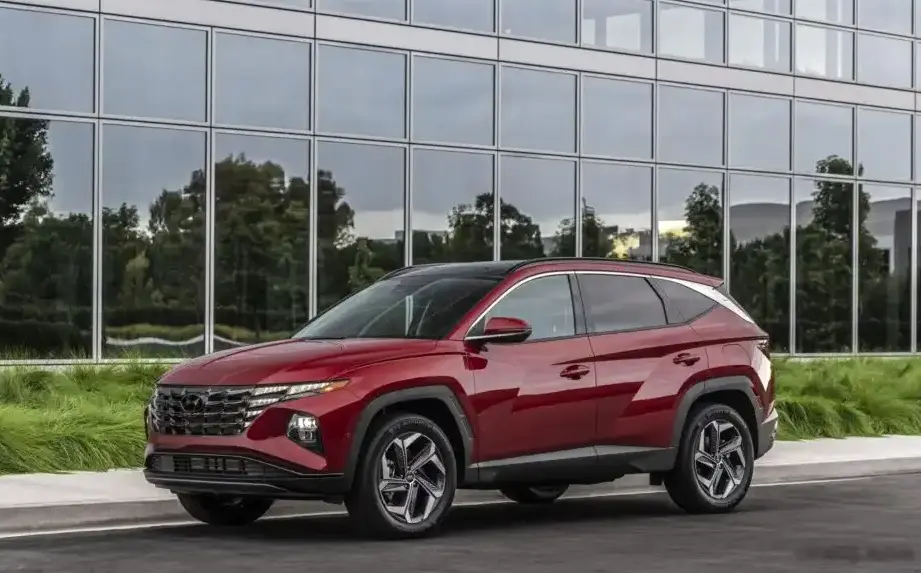
The Hyundai Tucson IV 1.6 CRDi (136 Hp) Mild Hybrid DCT represents a significant entry point into the fourth generation of Hyundai’s popular Tucson SUV, launched in December 2020 and continuing through October 2023. This variant was positioned as a fuel-efficient and technologically advanced option within the Tucson IV lineup, catering to buyers seeking a balance between practicality, economy, and modern features. It utilizes a mild hybrid powertrain to enhance fuel efficiency and reduce emissions, aligning with increasingly stringent European emission standards and growing consumer demand for greener vehicles. The Tucson IV itself marked a substantial design departure from previous generations, adopting a bolder, more angular aesthetic and a more spacious interior.
Technical Specifications
| Brand | Hyundai |
| Model | Tucson |
| Generation | Tucson IV |
| Type (Engine) | 1.6 CRDi (136 Hp) Mild Hybrid DCT |
| Start of production | December, 2020 |
| End of production | October, 2023 |
| Powertrain Architecture | MHEV (Mild Hybrid Electric Vehicle) |
| Body type | SUV |
| Seats | 5 |
| Doors | 5 |
| CO2 emissions (WLTP) | 146 g/km |
| Fuel consumption (urban) | 4.6 l/100 km (51.1 US mpg, 61.4 UK mpg, 21.7 km/l) |
| Fuel consumption (extra urban) | 4.4 l/100 km (53.5 US mpg, 64.2 UK mpg, 22.7 km/l) |
| Fuel consumption (combined) | 4.4 l/100 km (53.5 US mpg, 64.2 UK mpg, 22.7 km/l) |
| CO2 emissions (NEDC) | 117 g/km |
| Fuel Type | Diesel |
| Acceleration 0 – 100 km/h | 11.4 sec |
| Acceleration 0 – 62 mph | 11.4 sec |
| Acceleration 0 – 60 mph | 10.8 sec |
| Maximum speed | 180 km/h (111.85 mph) |
| Emission standard | Euro 6d |
| Weight-to-power ratio | 11.3 kg/Hp |
| Weight-to-torque ratio | 5.5 kg/Nm |
| Gross battery capacity | 0.44 kWh |
| Power | 136 Hp @ 4000 rpm |
| Torque | 280 Nm @ 1500-3000 rpm (206.52 lb.-ft.) |
| Engine layout | Front, Transverse |
| Engine Model/Code | D4FE |
| Engine displacement | 1598 cm3 (97.52 cu. in.) |
| Number of cylinders | 4 |
| Engine configuration | Inline |
| Cylinder Bore | 76.99 mm (3.03 in.) |
| Piston Stroke | 85.8 mm (3.38 in.) |
| Compression ratio | 15.9:1 |
| Number of valves per cylinder | 4 |
| Fuel injection system | Diesel Commonrail |
| Engine aspiration | Twin-Turbo, Intercooler |
| Engine oil capacity | 4.4 l (4.65 US qt, 3.87 UK qt) |
| Coolant capacity | 7.2 l (7.61 US qt, 6.34 UK qt) |
| Kerb Weight | 1531-1660 kg (3375.28 – 3659.67 lbs.) |
| Max. weight | 2140 kg (4717.89 lbs.) |
| Max load | 480-609 kg (1058.22 – 1342.62 lbs.) |
| Trunk (boot) space – minimum | 546 l (19.28 cu. ft.) |
| Trunk (boot) space – maximum | 1725 l (60.92 cu. ft.) |
| Fuel tank capacity | 54 l (14.27 US gal, 11.88 UK gal) |
| Max. roof load | 100 kg (220.46 lbs.) |
| Permitted trailer load (braked) | 1650 kg (3637.63 lbs.) |
| Permitted trailer load (unbraked) | 750 kg (1653.47 lbs.) |
| Permitted towbar download | 100 kg (220.46 lbs.) |
| Length | 4500 mm (177.17 in.) |
| Width | 1865 mm (73.43 in.) |
| Width (with mirrors) | 2130 mm (83.86 in.) |
| Height | 1651-1653 mm (65 – 65.08 in.) |
| Wheelbase | 2680 mm (105.51 in.) |
| Front track | 1615-1630 mm (63.58 – 64.17 in.) |
| Rear track | 1622-1637 mm (63.86 – 64.45 in.) |
| Front overhang | 895 mm (35.24 in.) |
| Rear overhang | 925 mm (36.42 in.) |
| Ride height | 170 mm (6.69 in.) |
| Drag coefficient (Cd) | 0.315 |
| Turning circle | 10.92 m (35.83 ft.) |
| Approach angle | 17.4° |
| Departure angle | 25.7° |
| Ramp-over angle | 16.7° |
| Drivetrain | Front wheel drive |
| Gearbox | 7-speed DCT (Dual Clutch Transmission) |
| Front suspension | Independent, McPherson with coil spring and anti-roll bar |
| Rear suspension | Independent multi-link with stabilizer |
| Front brakes | Ventilated discs, 291 mm |
| Rear brakes | Discs, 302 mm |
| Steering | Electric Power Steering, Rack and Pinion |
| Tire size | 215/65 R17; 235/55 R18; 235/50 R19 |
| Wheel rim size | 7.0J x 17; 7.5J x 18; 7.5J x 19 |
Powertrain & Engine Architecture
The heart of the Tucson IV 1.6 CRDi Mild Hybrid is the D4FE engine, a 1.6-liter inline-four cylinder diesel engine. This engine utilizes a twin-turbocharger setup with an intercooler, delivering 136 horsepower at 4000 rpm and 280 Nm (206.52 lb.-ft.) of torque between 1500 and 3000 rpm. The high compression ratio of 15.9:1 contributes to its efficiency. The “CRDi” designation signifies Common Rail Direct Injection, a fuel delivery system known for its precision and efficiency. The mild hybrid system incorporates a 48-volt starter generator (BSG) and a small battery (0.44 kWh) to provide assistance during acceleration and enable start-stop functionality, reducing fuel consumption and emissions. The engine is paired with a 7-speed Dual Clutch Transmission (DCT), offering quick and smooth gear changes.
Driving Characteristics
The 1.6 CRDi with the DCT delivers a comfortable and refined driving experience. While not a performance-oriented setup, the engine provides adequate power for everyday driving situations. The DCT transmission contributes to responsive acceleration, although some drivers may notice slight hesitation at lower speeds. Compared to higher-output Tucson variants, such as those with larger engines or more powerful diesel options, this version prioritizes fuel economy over outright speed. The mild hybrid system provides a subtle boost during acceleration, enhancing responsiveness. The gear ratios are tuned for efficiency, resulting in relaxed cruising at highway speeds.
Equipment & Trim Levels
The 1.6 CRDi Mild Hybrid DCT trim typically came well-equipped, often serving as a mid-range option. Standard features generally included air conditioning, a touchscreen infotainment system with Apple CarPlay and Android Auto compatibility, a rearview camera, and various safety systems like lane keeping assist and forward collision avoidance. Higher trim levels offered upgrades such as leather upholstery, a panoramic sunroof, heated seats, and a more advanced infotainment system with navigation. Optional extras could include adaptive cruise control, a premium sound system, and parking assist features.
Chassis & Braking
The Tucson IV utilizes an independent suspension setup, with McPherson struts at the front and a multi-link system at the rear. This configuration provides a comfortable ride and good handling characteristics. Stabilizer bars are included on both axles to reduce body roll during cornering. The braking system consists of ventilated discs at the front (291 mm) and solid discs at the rear (302 mm). ABS (Anti-lock Braking System) is standard, enhancing braking performance and stability. The steering is electric power-assisted, providing a light and responsive feel.
Market Reception & Comparison
The Hyundai Tucson IV 1.6 CRDi Mild Hybrid DCT was generally well-received by automotive critics for its fuel efficiency, comfortable ride, and modern features. It offered a compelling alternative to gasoline-powered SUVs, particularly for drivers who frequently cover long distances. Compared to other trims in the Tucson lineup, this variant provided a good balance between price, performance, and economy. The mild hybrid system was praised for its contribution to reducing emissions and improving fuel consumption. However, some reviewers noted that the engine could feel slightly underpowered when fully loaded or driving uphill.
Legacy
The D4FE engine, while not without its complexities due to the twin-turbo and common rail technology, has proven to be relatively reliable when properly maintained. The mild hybrid system has also demonstrated good durability. In the used car market, the Tucson IV 1.6 CRDi Mild Hybrid DCT remains a popular choice, offering a practical and efficient SUV option. Regular servicing, including oil changes and filter replacements, is crucial for maintaining the longevity of this powertrain. The combination of fuel efficiency, modern technology, and Hyundai’s reputation for value has ensured that this variant continues to hold its appeal for buyers seeking a well-rounded and economical SUV.