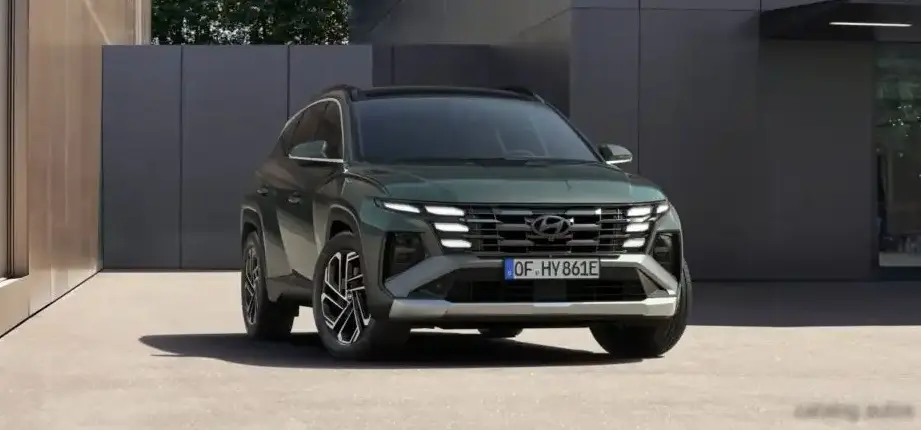
The Hyundai Tucson IV (facelift, introduced in late 2025) 1.6 T-GDI 288 hp Plug-in Hybrid Automatic represents a significant offering in Hyundai’s compact SUV lineup. Positioned as a premium variant within the fourth-generation Tucson range (codenamed NX4), this model combines a turbocharged gasoline engine with an electric motor and battery pack, offering both all-electric driving capability and extended range through its hybrid powertrain. This version builds upon the success of the Tucson IV, which aimed to provide a more sophisticated and technologically advanced package compared to its predecessors, appealing to buyers seeking fuel efficiency, practicality, and modern features.
Technical Specifications
| Brand | Hyundai |
| Model | Tucson |
| Generation | Tucson IV (facelift 2024) |
| Type (Engine) | 1.6 T-GDI (288 Hp) Plug-in Hybrid Automatic |
| Start of production | November, 2025 |
| Powertrain Architecture | PHEV (Plug-in Hybrid Electric Vehicle) |
| Body type | SUV |
| Seats | 5 |
| Doors | 5 |
| Combined fuel consumption (WLTP) | 2.7-2.9 l/100 km (87.1 – 81.1 US mpg, 104.6 – 97.4 UK mpg, 37 – 34.5 km/l) |
| CO2 emissions (WLTP) | 62-65 g/km |
| Fuel Type | Petrol / electricity |
| Acceleration 0 – 100 km/h | 7.5 sec |
| Acceleration 0 – 62 mph | 7.5 sec |
| Acceleration 0 – 60 mph | 7.1 sec |
| Maximum speed | 206 km/h (128 mph) |
| Emission standard | Euro 6e-bis |
| Weight-to-power ratio | 6.1 kg/Hp, 163.9 Hp/tonne |
| Weight-to-torque ratio | 4.6 kg/Nm, 215.7 Nm/tonne |
| Gross battery capacity | 13.8 kWh |
| Battery technology | Lithium-ion (Li-Ion) |
| Battery location | Below the floor, under the rear seats |
| All-electric range (WLTP) | 67-70 km (41.63 – 43.5 mi) |
| Average Energy consumption (WLTP) | 10.8-10.9 kWh/100 km (17.38 – 17.54 kWh/100 mi, 194 – 192 MPGe, 9.3 – 9.2 km/kWh, 5.8 – 5.7 mi/kWh) |
| Electric motor power | 107 Hp |
| Electric motor Torque | 334 Nm (246.35 lb.-ft.) |
| Electric motor location | Between the combustion engine and the transmission |
| Electric motor type | Synchronous |
| System power | 288 Hp |
| System torque | 379 Nm (279.54 lb.-ft.) |
| Power | 180 Hp @ 6000 rpm |
| Torque | 265 Nm @ 1500-4500 rpm (195.45 lb.-ft. @ 1500-4500 rpm) |
| Engine layout | Front, Transverse |
| Engine Model/Code | G4FP |
| Engine displacement | 1598 cm3 (97.52 cu. in.) |
| Number of cylinders | 4 |
| Engine configuration | Inline |
| Cylinder Bore | 75.6 mm (2.98 in.) |
| Piston Stroke | 89 mm (3.5 in.) |
| Number of valves per cylinder | 4 |
| Fuel injection system | Direct injection |
| Engine aspiration | Turbocharger, Intercooler |
| Valvetrain | DOHC |
| Engine oil capacity | 4.8 l (5.07 US qt | 4.22 UK qt) |
| Coolant | 6.8 l (7.19 US qt | 5.98 UK qt) |
| Kerb Weight | 1757-1883 kg (3873.52 – 4151.3 lbs.) |
| Max. weight | 2350 kg (5180.86 lbs.) |
| Max load | 467-593 kg (1029.56 – 1307.34 lbs.) |
| Trunk (boot) space – minimum | 558 l (19.71 cu. ft.) |
| Trunk (boot) space – maximum | 1721 l (60.78 cu. ft.) |
| Fuel tank capacity | 42 l (11.1 US gal | 9.24 UK gal) |
| Max. roof load | 100 kg (220.46 lbs.) |
| Permitted trailer load with brakes (12%) | 1210 kg (2667.59 lbs.) |
| Permitted trailer load without brakes | 750 kg (1653.47 lbs.) |
| Permitted towbar download | 103 kg (227.08 lbs.) |
| Length | 4525 mm (178.15 in.) |
| Width | 1865 mm (73.43 in.) |
| Height | 1650 mm (64.96 in.) |
| Wheelbase | 2680 mm (105.51 in.) |
| Front track | 1615-1630 mm (63.58 – 64.17 in.) |
| Rear (Back) track | 1622-1637 mm (63.86 – 64.45 in.) |
| Ride height (ground clearance) | 170 mm (6.69 in.) |
| Drivetrain Architecture | The Internal combustion engine (ICE) and electric motor drive the front wheels of the car with the ability to work in full electric or mixed mode. |
| Drive wheel | Front wheel drive |
| Number of gears and type of gearbox | 6 gears, automatic transmission |
| Front suspension | Independent type McPherson |
| Rear suspension | Independent multi-link suspension |
| Front brakes | Ventilated discs |
| Rear brakes | Disc |
| Assisting systems | ABS (Anti-lock braking system) |
| Steering type | Steering rack and pinion |
| Power steering | Electric Steering |
| Tires size | 215/65 R17; 235/55 R18; 235/50 R19 |
| Wheel rims size | 7.0J x 17; 7.5J x 18; 7.5J x 19 |
INTRODUCTION
The Hyundai Tucson IV 1.6 T-GDI 288 hp Plug-in Hybrid Automatic, launched in late 2025, is a key component of Hyundai’s strategy to expand its electrified vehicle offerings. Built on the NX4 platform, shared with the Kia Sportage, the Tucson IV represents a significant leap forward in design, technology, and driving experience compared to previous generations. This particular variant, combining a 1.6-liter turbocharged gasoline engine with a plug-in hybrid system, aims to deliver a balance of performance, fuel efficiency, and reduced emissions. It slots into the Tucson lineup as a premium option, positioned above the standard hybrid and gasoline-only models, and below any potential high-performance trims.
Powertrain & Engine Architecture
At the heart of this Tucson variant lies the Hyundai G4FP 1.6-liter turbocharged four-cylinder gasoline engine. This engine, part of Hyundai’s “Smartstream” engine family, utilizes direct injection and a twin-scroll turbocharger to produce 180 hp at 6000 rpm and 265 Nm of torque between 1500-4500 rpm. The engine’s design emphasizes efficiency and responsiveness. The electric motor, a synchronous unit, contributes an additional 107 hp and 334 Nm of torque. Combined, the system delivers a total output of 288 hp and 379 Nm of torque. The powertrain utilizes a 6-speed automatic transmission, specifically tuned to work seamlessly with both the gasoline engine and the electric motor. The 13.8 kWh lithium-ion battery pack is positioned under the rear seats, minimizing impact on passenger space. The plug-in hybrid system allows for electric-only driving for up to 67-70 km (41.63 – 43.5 mi) on the WLTP cycle.
Driving Characteristics
The 1.6 T-GDI Plug-in Hybrid Automatic Tucson offers a refined and comfortable driving experience. In electric mode, the vehicle provides near-silent acceleration and responsive performance for typical urban driving. When the gasoline engine engages, the transition is generally smooth and unobtrusive. The combined output of 288 hp provides brisk acceleration, with a 0-60 mph time of around 7.1 seconds. The 6-speed automatic transmission is well-programmed, offering smooth gear changes and efficient power delivery. Compared to lower-powered Tucson variants, this model offers significantly more performance, making it more suitable for highway driving and overtaking maneuvers. However, it doesn’t possess the sporty character of some competitors with more focused performance tuning. The added weight of the battery pack is noticeable, but the well-tuned suspension helps to maintain a composed ride.
Equipment & Trim Levels
The 1.6 T-GDI Plug-in Hybrid Automatic Tucson typically comes well-equipped, reflecting its position as a premium trim level. Standard features often include leather upholstery, heated and ventilated front seats, a large touchscreen infotainment system with navigation, a digital instrument cluster, a panoramic sunroof, and a suite of advanced driver-assistance systems (ADAS) such as adaptive cruise control, lane-keeping assist, and automatic emergency braking. Optional extras may include premium audio systems, upgraded interior trim materials, and a 360-degree camera system. The interior design emphasizes a modern and minimalist aesthetic, with high-quality materials and a user-friendly layout.
Chassis & Braking
The Tucson IV utilizes a front-wheel-drive layout as standard, with all-wheel drive available as an option. The suspension consists of an independent McPherson strut setup at the front and an independent multi-link setup at the rear, providing a comfortable and controlled ride. The braking system features ventilated discs at the front and solid discs at the rear, coupled with ABS and electronic stability control. The steering is electrically assisted, offering a light and precise feel. The chassis is designed to balance ride comfort with handling stability, making it well-suited for both city driving and longer journeys.
Market Reception & Comparison
The Hyundai Tucson IV Plug-in Hybrid has been generally well-received by automotive critics, praised for its fuel efficiency, spacious interior, and comprehensive feature set. The 1.6 T-GDI variant, in particular, has been noted for its strong performance and refined driving experience. Compared to other plug-in hybrid SUVs in its class, the Tucson offers a competitive combination of range, power, and value. Fuel economy is a key strength, with combined WLTP figures of 2.7-2.9 l/100 km. Reliability is expected to be good, based on Hyundai’s recent track record, although long-term data for this specific powertrain is still emerging.
Legacy
The Hyundai Tucson IV 1.6 T-GDI Plug-in Hybrid Automatic represents a significant step forward in Hyundai’s commitment to electrification. Its combination of performance, efficiency, and technology positions it as a compelling option in the increasingly competitive plug-in hybrid SUV segment. The long-term reliability of the powertrain remains to be seen, but Hyundai’s warranty and reputation for building durable vehicles suggest a positive outlook. As the automotive industry continues to shift towards electric mobility, this Tucson variant is likely to become a popular choice for buyers seeking a practical and environmentally friendly SUV.